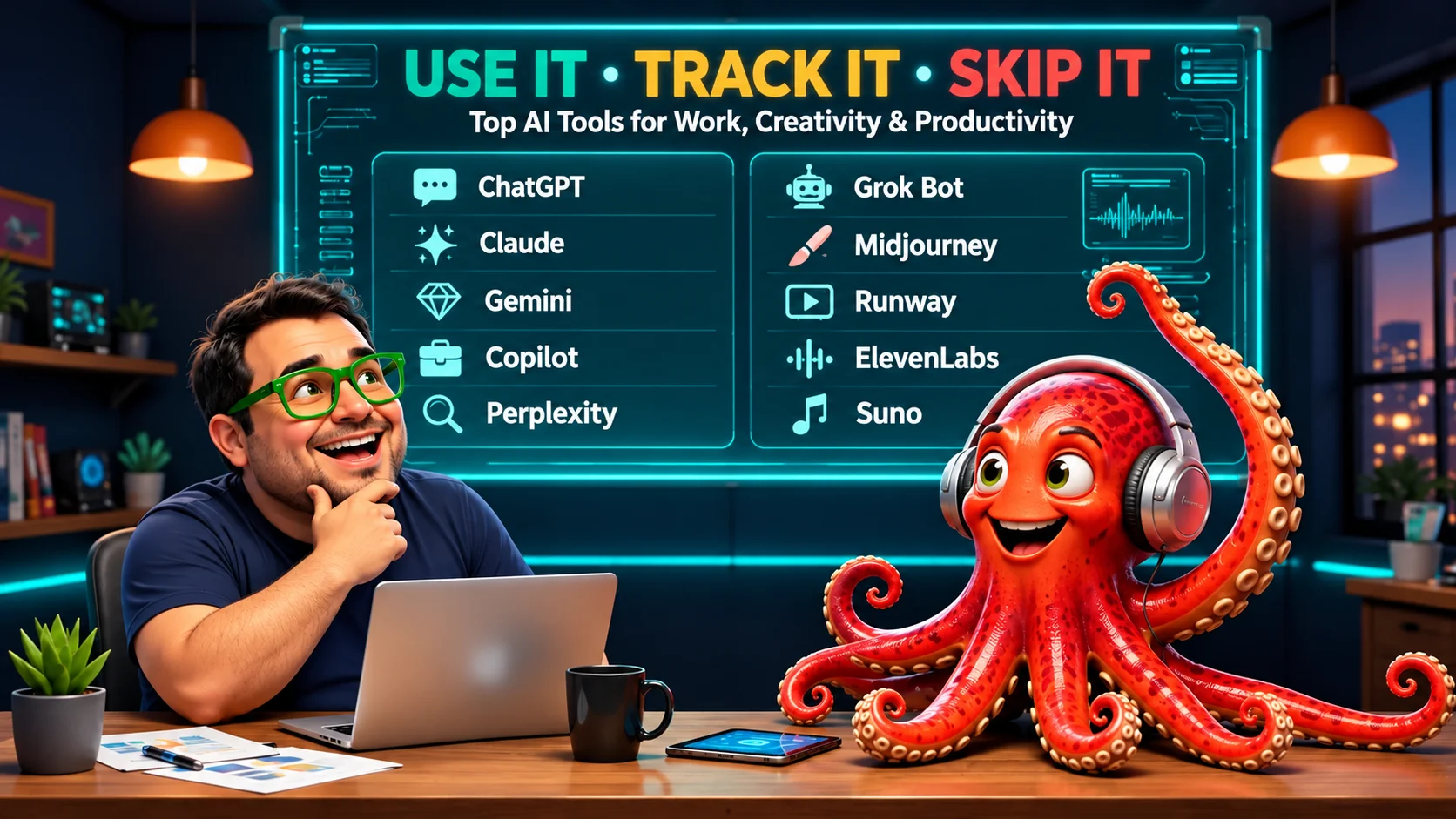
Every AI tool that crosses this desk gets the same six questions — and a straight verdict. No hype. No noise.
What it is. Who's behind it. What it does. What it costs. What the catch is. And whether it earns a place in a real working stack. Every price below was checked against a maker-controlled source where available. When no pricing page exists, the source is identified and launch-post pricing is labeled as a maker-stated claim. Every verdict is graded against the tools that actually run Honed Signal today: USE IT, TRACK IT, or SKIP IT.
99 tools briefed so far, newest first. The list grows as new briefs land — if a tool isn't here, it hasn't been checked yet.
An open-source multi-model deliberation CLI: one question goes to a panel of models in parallel, two judge models cross-validate the answers, and a synth model merges a verdict — with disagreement escalated to a human instead of averaged away.
Cost: $0 for the software; runs cost whatever the chosen OpenRouter models cost — free-tier models make a run $0, paid models draw on OpenRouter credit, always behind the --estimate preview and budget caps.
Read the full brief
What it is: An open-source multi-model deliberation CLI: one question goes to a panel of models in parallel, two judge models cross-validate the answers, and a synth model merges a verdict — with disagreement escalated to a human instead of averaged away.
Who's behind it: stoneskin on GitHub (github.com/stoneskin/muse-thinktank), Apache-2.0, v0.19.0, 2 stars / 0 forks — a small, young project developed in a private repo and synced publicly; cloned and audited by Muse on Nov 19, 2026 at commit be15448a — full audit: `~/workspace/github-audits/muse-thinktank-AUDIT-2026-11-19.md`. Despite the name, the panel models are not Meta Muse models — "built for Muse users" means the operator's assistant is Muse; the deliberation runs on OpenRouter models.
What it does: Verified in the audited code: pure Python standard library, genuinely zero dependencies, with a real test suite; one entry point (thinktank.py) runs panel → dual judges → synth over OpenRouter, with an --estimate mode that prints call count, token cap, cost cap and ETA before spending anything, budget caps, red-team mode (critic models attack a draft, an adjudicator grades findings by severity), LMArena benchmark priors fetched keylessly from HuggingFace, dynamic member selection by track record, live-data injection via --context-data, and stock-analysis / code-review skills; outbound traffic is only OpenRouter, HuggingFace (priors) and api.github.com (PR diffs), and the API key normally comes from the OPENROUTER_API_KEY environment variable.
What it costs: $0 for the software; runs cost whatever the chosen OpenRouter models cost — free-tier models make a run $0, paid models draw on OpenRouter credit, always behind the --estimate preview and budget caps.
The catch: Two audit findings. (1) An undisclosed Muse-credential hook sits in the public code (tt/transport.py, verified byte-identical upstream): before reading the env var, the key loader tries to import from a hard-coded Muse runtime path (/opt/hatch/…) and pull a "custom.openrouter" credential from the Muse connector vault — inert off-Muse and harmless on Freddie's setup (no such connector exists, so it falls through to the env var), but never mentioned in the "pure stdlib" framing. (2) The repo ships AI_SETUP.md, an instruction file addressed to AI assistants ("follow these steps exactly") that name-checks Muse's secure credential flow — the steps are benign and the key-handling advice is good, but it is the same agent-scripting pattern flagged with Glasser; Muse read it as data and did not follow it during the audit. Also: the "zero hallucinations" tagline oversells — dual judges catch divergence, not shared misconception — and the eval tooling contains a code-execution validator its own comments admit is "not a real sandbox," kept out of the main ask path.
Fit: TRACK IT — it automates the exact pattern Freddie already runs by hand for Honed Reports (multiple outside AIs pass over a draft, disagreements surface to him), at $0 on free OpenRouter models and with cost estimation up front. Limits: free-tier panel and judge models are materially weaker than the frontier models in his current manual passes, and it adds an OpenRouter account/key to the stack. Any future trial should run from the audited clone with the key supplied by env var, after a re-check of the transport code. No install, no key connected.
A curated, machine-readable directory — not software: a GitHub "awesome list" of free LLM API tiers with rate limits, context windows, credit-card/verification flags, base URLs, get-key links, and copy-paste config snippets for Claude Code, Cursor, Codex, Aider and others; companion site freellm.net. NOT the FreeLLMAPI router (tashfeenahmed, briefed separately Nov 19, TRACK IT) — this is a list, not an app.
Cost: $0 — the list is free to read and MIT; the listed tiers are the providers' own free tiers (most no card; NVIDIA NIM wants phone verification; OpenRouter's free tier improves to 1K requests/day only after a $10 top-up, and its Claude Code path needs that top-up).
Read the full brief
What it is: A curated, machine-readable directory — not software: a GitHub "awesome list" of free LLM API tiers with rate limits, context windows, credit-card/verification flags, base URLs, get-key links, and copy-paste config snippets for Claude Code, Cursor, Codex, Aider and others; companion site freellm.net. NOT the FreeLLMAPI router (tashfeenahmed, briefed separately Nov 19, TRACK IT) — this is a list, not an app.
Who's behind it: The open-free-llm-api GitHub org; MIT, repo created 2026-05-10, 5,811 stars, 913 forks, 249 commits at briefing; data is refreshed daily from freellm.net (their claim, last-updated stamp 2026-11-19 on the README).
What it does: Lists 22 providers in its directory table — permanent free tiers (NVIDIA NIM 82 free models, Cloudflare Workers AI 41, ModelScope 33, Google Gemini 12, Groq 9, Mistral 10, Cohere 10, and smaller/obscurer names like LLM7.io, Agnes AI, Gonka Broker) plus OpenRouter under "renewable credits" — each with free-model count, card/verification requirement, max context, and a direct key link; all expose OpenAI-compatible endpoints.
What it costs: $0 — the list is free to read and MIT; the listed tiers are the providers' own free tiers (most no card; NVIDIA NIM wants phone verification; OpenRouter's free tier improves to 1K requests/day only after a $10 top-up, and its Claude Code path needs that top-up).
The catch: Its own numbers don't agree: repo subtitle says "134+ free LLM APIs from 40+ providers," the README headline says "312+ from 22 providers" (312 is the sum of the table's free-model counts). Free tiers are perishable and provider-reported — the daily-refresh claim is the maintainer's, not verified per provider — and several listed providers are obscure brokers whose data terms for your prompts are unknown. Treat every entry as a lead to verify on the provider's own site, never as a fact.
Fit: TRACK IT — as a reference shelf only: a handy single place to check "who still has a free tier" when a disposable-experiment need arises (the same niche FreeLLMAPI was tracked for), at zero cost and zero install. It grants no tokens itself, holds no frontier access for Freddie's production work, and no provider signup follows from this brief.
GoDaddy's prompt-driven AI website builder — describe a business in plain language and it generates a multi-page site you refine through a sequence of chat prompts, all inside GoDaddy's platform. Surfaced via Mikey Website's "How to Build an AI Website That Actually Looks Good" video (Nov 9, 2026) Freddie shared and Muse assessed on Nov 19, 2026 (full transcript read).
Cost: Per GoDaddy's US pages as rechecked by multiple reviewers in November 2026: Free $0 with 50 AI credits/mo — preview only, publishing requires a paid plan; Starter $9.99/mo billed annually ($19.99 monthly), 150 credits, 1 published site; Professional $24.99/mo annual ($49.99 monthly), 300 credits, up to 10 sites; Ultimate $99.99/mo annual ($199.99 monthly), 750 credits, up to 50 sites. Credits expire each billing cycle and do not roll over; extra packs are $24.99 for 250 credits. The annual prices are first-term prices — GoDaddy's pages did not show the renewal amount when checked Nov 12, 2026.
Read the full brief
What it is: GoDaddy's prompt-driven AI website builder — describe a business in plain language and it generates a multi-page site you refine through a sequence of chat prompts, all inside GoDaddy's platform. Surfaced via Mikey Website's "How to Build an AI Website That Actually Looks Good" video (Nov 9, 2026) Freddie shared and Muse assessed on Nov 19, 2026 (full transcript read).
Who's behind it: GoDaddy, the registrar/hosting company; the builder is sold as its current website-builder product and is labeled Beta on GoDaddy's own pages (per Nov 12, 2026 rechecks of godaddy.com).
What it does: Generates a complete site from a detailed first prompt (the video's demo: a 5-page Sydney interior-design studio in under 30 seconds), then refines by prompt — visual polish, added content sections, an interactive quiz, per-page SEO metadata, a mobile pass — with hosting, analytics, SSL, automatic backups, email marketing and domain all in the same GoDaddy dashboard; paid plans can download the site as a ZIP of code, but live services (forms, booking, email) do not move with it.
What it costs: Per GoDaddy's US pages as rechecked by multiple reviewers in November 2026: Free $0 with 50 AI credits/mo — preview only, publishing requires a paid plan; Starter $9.99/mo billed annually ($19.99 monthly), 150 credits, 1 published site; Professional $24.99/mo annual ($49.99 monthly), 300 credits, up to 10 sites; Ultimate $99.99/mo annual ($199.99 monthly), 750 credits, up to 50 sites. Credits expire each billing cycle and do not roll over; extra packs are $24.99 for 250 credits. The annual prices are first-term prices — GoDaddy's pages did not show the renewal amount when checked Nov 12, 2026.
The catch: Single-vendor lock-in is the product: the site, its hosting, analytics and live services live inside GoDaddy, the builder is still Beta (the video itself warns about mid-build errors), and every AI refinement is metered in expiring credits — vague prompts literally cost the same as precise ones. There are no persistent guardrails: each fix is a one-off chat prompt, nothing carries to the next site, and there are no mechanical checks behind its "mobile pass."
Fit: SKIP IT — it is the beginner on-ramp version of a workflow Freddie already runs at a higher level on infrastructure he owns (his repos, Porkbun domains, Cloudflare Pages, the Anti-Slop Design skill as standing guardrails, the site monitor's mechanical checks, and QA-against-audit adopted Nov 19, 2026). Its demo use case — lead-gen sites that funnel to booked consultations for client businesses — is his cut lane (no sales calls / client outreach; product and inbound only), and his interactive tools (268 Money calculators, Debt/Leak Scans) already do the quiz's job while routing to products. Nothing signed up for or trialed.
A self-hosted, open-source router that stacks the free tiers of dozens of LLM providers behind one OpenAI-compatible endpoint on your own machine — Repo 1 of the BuildArc "~9 billion free AI tokens" Short Freddie shared on Nov 19, 2026.
Cost: $0 for the router itself (MIT); the live model catalog is freemium — free installs get a monthly snapshot delayed 30 days, premium is $19/yr for same-day updates. The tokens are not granted by the tool: the headline total (7.4B in the Short; the README now says 10.1B) is the sum of every provider's free-tier cap, reachable only by signing up for dozens of providers yourself; a realistic handful of providers yields a few hundred million.
Read the full brief
What it is: A self-hosted, open-source router that stacks the free tiers of dozens of LLM providers behind one OpenAI-compatible endpoint on your own machine — Repo 1 of the BuildArc "~9 billion free AI tokens" Short Freddie shared on Nov 19, 2026.
Who's behind it: tashfeenahmed on GitHub (github.com/tashfeenahmed/freellmapi), MIT, created April 2026, ~55,000 stars; targeted-audited by Muse on Nov 19, 2026 at commit dd0fb713 (app v0.16.36) — full audit: `~/workspace/github-audits/freellmapi-AUDIT-2026-11-19.md`.
What it does: Verified in the audited code and README: you add your own free provider keys (Google, Groq, Cerebras, Mistral, OpenRouter, Cloudflare, NVIDIA and dozens more — the README now claims 87 providers / 1,313 endpoints), and it routes requests across them with smart routing and automatic failover, exposes OpenAI, Anthropic Messages, Gemini and Ollama surfaces (so Claude Code and other coding agents can run on the pool), tracks per-key rate limits, and serves a login-gated dashboard; provider keys are AES-256-GCM encrypted in SQLite (verified: fresh IVs, auth tag pinned, production refuses to boot without the encryption key), the unified key is enforced on /v1 and /mcp, and the twice-daily model catalog sync from freellmapi.co is genuinely Ed25519 signature-verified against a pinned key, with no telemetry or usage reporting found anywhere in the code.
What it costs: $0 for the router itself (MIT); the live model catalog is freemium — free installs get a monthly snapshot delayed 30 days, premium is $19/yr for same-day updates. The tokens are not granted by the tool: the headline total (7.4B in the Short; the README now says 10.1B) is the sum of every provider's free-tier cap, reachable only by signing up for dozens of providers yourself; a realistic handful of providers yields a few hundred million.
The catch: The repo's install.sh is a 5-line shim that downloads and executes a script from freellmapi.co — outside the repo and changeable without a commit (the Docker path, loopback-bound by default, is the safer install); non-Docker runs bind all interfaces by default. Lose the encryption key and every stored provider key is permanently undecryptable, and in default installs the key file sits beside the database. The pool holds no frontier models, quality degrades as daily caps bite, providers retire free tiers without notice (GitHub Models retired Jul 30, 2026), and the README itself scopes it "personal experimentation only" — every prompt you route is also sent to whichever free provider serves it, under that provider's data terms.
Fit: TRACK IT — the strongest security engineering in the Nov 19 audit series and a legitimate $0 experimentation pool for throwaway coding-agent work, but it does not extend Freddie's Muse setup, holds none of the models his production work runs on, and fans prompts out to dozens of third-party free tiers. Not for production or private data; revisit only if a disposable-experiments need appears. No install.
A free, open-source AI gateway — one endpoint fronting 375 providers / 1,400+ models with quota-aware fallback and token compression — Repo 2 of the BuildArc "~9 billion free AI tokens" Short Freddie shared on Nov 19, 2026 (the old diegosouzapw/OmniRoute address now redirects to cheaper-inference/OmniRoute).
Cost: $0, MIT open source — no telemetry or analytics found among its 113 runtime dependencies, and update checks go only to npm.
Read the full brief
What it is: A free, open-source AI gateway — one endpoint fronting 375 providers / 1,400+ models with quota-aware fallback and token compression — Repo 2 of the BuildArc "~9 billion free AI tokens" Short Freddie shared on Nov 19, 2026 (the old diegosouzapw/OmniRoute address now redirects to cheaper-inference/OmniRoute).
Who's behind it: The cheaper-inference GitHub org; MIT, created Feb 2026, ~88,800 stars, "900+ contributors" claimed; targeted-audited by Muse on Nov 19, 2026 at v3.8.55, commit ac6c3822 (sparse clone; the repo is ~3.6 GB) — full audit: `~/workspace/github-audits/omniroute-AUDIT-2026-11-19.md`.
What it does: Verified in the audited code and docs: serves an OpenAI-compatible gateway on port 20128 for Claude Code, Codex, Cursor, OpenCode, Cline and Copilot, with auto-fallback across free and paid providers, an MCP/A2A surface, a dashboard, and RTK + Caveman compression — purely local string filtering (RTK's filters strip tool-output noise; Caveman deletes hedging/pleasantries from prose, rewriting the user's words), whose "15–95% savings" is stacked best-case math on terminal logs. The "+1.6B free tokens" is, like FreeLLMAPI's figure, a sum of third-party free-tier caps behind keys you supply yourself.
What it costs: $0, MIT open source — no telemetry or analytics found among its 113 runtime dependencies, and update checks go only to npm.
The catch: CVE-2026-88062 was real — a CVSS 9.5 unauthenticated remote-code-execution hole (GHSA-hf57-cqmx-p4gr), verified fixed in the audited v3.8.55 code — but the defaults remain unsafe: a bare npm/source install binds 0.0.0.0:20128 with REQUIRE_API_KEY=false, so any LAN device can spend your quota (the code prints its own warning citing another advisory), and .env.example ships an INITIAL_PASSWORD the file itself calls "publicly known," copied into place on install. All provider keys and imported subscription OAuth tokens concentrate in one SQLite database — AES-256-GCM encrypted, but the master key is auto-generated into a plaintext env file, and with no key set the code falls back to storing credentials in plaintext.
Fit: SKIP IT — serious engineering (real SECURITY.md, advisories cited in its own code comments, the CVE genuinely patched), but for Freddie it is exposure without benefit: a local coding-agent token pool with a large spawn/exec/tunnel surface, unsafe bare-install network defaults, and a design that concentrates every credential in one process — and it does not extend his Muse setup. His provider keys and subscription logins should not go near it. If it were ever trialed: Docker route only, ≥3.8.55, password replaced before boot, REQUIRE_API_KEY=true, throwaway keys only. No install.
pulsar
TRACK IT
yocontra / Eric Schoffstall · Briefed Nov 19, 2026
An open-source MCP server that puts every AI coding agent on one machine on a shared message bus, so agents in different harnesses can find and message each other.
Cost: $0 — MIT open source, installed with `npx pulsar setup` (setup shows every file it will change, asks once, backs up everything, and offers --dry-run and --uninstall); no telemetry, and the only network call in the code is `pulsar doctor` checking npm for a newer version.
Read the full brief
What it is: An open-source MCP server that puts every AI coding agent on one machine on a shared message bus, so agents in different harnesses can find and message each other.
Who's behind it: Eric Schoffstall (yocontra), per the repo's package.json; github.com/yocontra/pulsar, MIT, created Nov 17, 2026 — two days old at briefing — already at v1.4.0 with 50 stars, CI and a real test suite; cloned and audited in full by Muse on Nov 19, 2026 — full audit: `~/workspace/github-audits/pulsar-AUDIT-2026-11-19.md`.
What it does: Verified in the audited code and README: one small daemon per machine (user-only Unix socket in a 0700 folder, SQLite message log) keeps a live registry of agents across Claude Code, Codex, OpenCode, pi, omp, Cursor and Gemini CLI — including sessions that never installed pulsar — auto-tagged with harness, model, project, git branch, worktree and PR (found offline from local git refs and the agents' own session logs); agents can list, send, reply, ask (block for an answer), wait, and broadcast to a name, a selector (project=x, pr=1402, role=reviewer) or `*`, with push delivery that wakes idle agents and urgent messages that can land mid-turn.
What it costs: $0 — MIT open source, installed with `npx pulsar setup` (setup shows every file it will change, asks once, backs up everything, and offers --dry-run and --uninstall); no telemetry, and the only network call in the code is `pulsar doctor` checking npm for a newer version.
The catch: Setup widens other agents' trust settings as a side effect — it sets Claude Code's `crossSessionInbound: "accept"` so bus messages reach permission-skipping sessions without an approval dialog, and pre-approves pulsar's tools in Codex — and the bus is a cross-agent injection channel by design: any agent, or any process running as your user, can put text in front of every other agent and interrupt it; messages are stamped with their true sender by the daemon, marked as peer-origin and unable to grant permissions, with rate/size limits (64 KB, 60 sends/min, 6 broadcasts/min), but each harness's own guardrails are the only backstop. It also reads other harnesses' session transcripts to build its registry, and its announced next step is multi-machine messaging plus remote control of agents via Tailscale.
Fit: TRACK IT — the cleanest-designed agent-coordination tool in the Nov 19 audit series and directly adjacent to Freddie's multi-AI handoff patterns, but it solves a problem he does not currently have: his multi-AI work runs across services (Muse in its VM, Claude's scheduled tasks, ChatGPT), not across local coding harnesses on one Mac, and pulsar v1 is same-machine only, so it cannot bridge his actual agents. Two days old and iterating hourly is also the wrong moment to adopt infrastructure that edits other agents' security settings. Watch it — and re-audit before ever enabling the coming Tailscale remote-control release. No install.
A free, open-source local file bridge — a single-file Node HTTP service you run on your own computer and expose through your own Cloudflare Tunnel so a cloud Muse can read/write its files and run shell commands on it as a custom connector.
Cost: $0 — MIT open source, zero third-party dependencies, Node.js only; the real cost is your own domain and Cloudflare Tunnel to expose it, plus the machine it runs on staying on.
Read the full brief
What it is: A free, open-source local file bridge — a single-file Node HTTP service you run on your own computer and expose through your own Cloudflare Tunnel so a cloud Muse can read/write its files and run shell commands on it as a custom connector.
Who's behind it: star-power0, a single independent author on GitHub; repo created Sep 24, 2026, MIT, 1 star, 0 forks, 2 commits, no releases — cloned and code-audited in full by Muse on Nov 19, 2026 (server.mjs, 1,107 lines).
What it does: Verified in the audited code and its README: binds 127.0.0.1:8787, serves list/read/search plus write/edit/append/copy/move/delete over whitelisted directories only, and a /run endpoint executing arbitrary shell commands (pwsh/PowerShell/cmd — Windows-first, with .cmd/schtasks launchers and a PowerShell watchdog); write/edit/delete/run are two-phase (prepare a preview, then confirm within 600 seconds), with a backup before every overwrite, deletes moved to a trash folder, and every operation written to an audit log.
What it costs: $0 — MIT open source, zero third-party dependencies, Node.js only; the real cost is your own domain and Cloudflare Tunnel to expose it, plus the machine it runs on staying on.
The catch: The capability is the risk — whoever holds the 256-bit bearer token gets arbitrary shell execution on the host, and once the tunnel is up the service is publicly reachable with that token as the only lock (no IP allowlist, no rate limiting in the code; append/copy/move also bypass the two-phase confirm). The code itself is unusually careful — constant-time token comparison, symlink-resolved whitelist checks, a denylist for .env/keys/.ssh/.git even inside the whitelist, and refusal to serve its own token/config/audit files — but careful code does not shrink a full-machine blast radius.
Fit: SKIP IT — it solves a problem Freddie does not have: his Muse already runs in a persistent VM with direct filesystem, terminal, browser and connector access to his workspace under per-action approvals, which is exactly what this bridge gives a bare muse.ai chat, without punching a public tunnel into a personal machine. Windows-first design also misses his Mac/VM setup, and a 2-commit, single-author, unmaintained-since-September repo is the wrong thing to trust with shell access. No install; revisit only if a bare Muse chat ever needs one specific folder on one specific Windows PC. Full audit: `~/workspace/github-audits/muse-fileapi-AUDIT-2026-11-19.md`.
OpenAI's new model pair for ChatGPT Work and Codex — Astra, a frontier model for hard professional work, and Sol, a cheaper efficient model for everyday and agentic work; OpenAI released both on November 17, 2026, and they launched on Product Hunt on November 18, 2026.
Cost: Verified on developers.openai.com pricing (read November 18, 2026): Astra $8.00 per million input tokens / $40.00 output (cached input $0.40) — a 20% cut from GPT-6 Astra's $10 / $50; Sol $2.00 / $10.00 (cached $0.10). Per OpenAI's rate card, Ultrafast runs at promotional 3× Standard token rates through February 28, 2027, then 6× from March 1, 2027.
Read the full brief
What it is: OpenAI's new model pair for ChatGPT Work and Codex — Astra, a frontier model for hard professional work, and Sol, a cheaper efficient model for everyday and agentic work; OpenAI released both on November 17, 2026, and they launched on Product Hunt on November 18, 2026.
Who's behind it: OpenAI, in its own community announcement, "GPT-6.2 Astra and Sol are now available," on community.openai.com (November 17, 2026). All benchmark figures below are OpenAI's own.
What it does: Verified on community.openai.com and OpenAI's API pricing page: available in ChatGPT Work and Codex for Plus, Pro, Enterprise and Edu users (not regular Chat), and in the API as `gpt-6.2-astra` and `gpt-6.2-sol`, with an Ultrafast mode for Pro 500 (and now Pro 200 for Sol). OpenAI says Astra sets new highs on professional-work and science evals at less than a third of GPT-6 Astra's cost per task, and Sol nearly matches Astra on FrontierCode 2.0 merge-ready code at about one-fifth the cost — both are OpenAI's figures. The pair also ships with tighter safeguards for higher-risk cybersecurity work.
What it costs: Verified on developers.openai.com pricing (read November 18, 2026): Astra $8.00 per million input tokens / $40.00 output (cached input $0.40) — a 20% cut from GPT-6 Astra's $10 / $50; Sol $2.00 / $10.00 (cached $0.10). Per OpenAI's rate card, Ultrafast runs at promotional 3× Standard token rates through February 28, 2027, then 6× from March 1, 2027.
The catch: The headline price cut is real on Standard, but Ultrafast — the mode power users reach for — triples now and sextuples in March, which launch coverage notes early users already call "essentially unusable" pricing. The models are Work/Codex-only, not in regular Chat, and every capability figure is OpenAI's own evaluation.
Fit: TRACK IT — a 20% frontier price cut plus a $2/$10 workhorse resets the price anchor Freddie's stack is measured against, the same pattern as Gemini 4 Hydrogen and Muse Ember before it. But his agent work runs on Muse / Muse Wonder, he holds no OpenAI API spend for production, and there is nothing to buy. Signal only, no spend.
Google's agentic task mode inside the Gemini app — you hand over a multi-step job and Gemini works it in the background — which Google made free of charge on November 17, 2026 (it was previously a paid-tier feature; the prior $19.99/mo AI Pro figure is media reporting, not Google's post).
Cost: Verified on blog.google (read November 18, 2026): free of charge in the six launch countries — no subscription price is attached to Tasks itself in Google's post, and Google does not publish a per-day task, call or order limit in the post.
Read the full brief
What it is: Google's agentic task mode inside the Gemini app — you hand over a multi-step job and Gemini works it in the background — which Google made free of charge on November 17, 2026 (it was previously a paid-tier feature; the prior $19.99/mo AI Pro figure is media reporting, not Google's post).
Who's behind it: Google, in its own post, "Put Gemini to work for you," on blog.google (November 17, 2026), by the Gemini app team.
What it does: Verified on blog.google: rolling out free for hundreds of millions of users in the US, Japan, Korea, Canada, Australia and India, running on Gemini 4 Hydrogen (briefed November 13, 2026). In the US it can call local businesses in parallel via Google Maps/Duplex and book against your Calendar, shop and check out with Google Pay under a user-set hard spending cap using the Agent Payments Protocol (AP2, with tokenized cards), add to Instacart orders by text or photo, and take tasks by email forwarded to gemini@google.com; it connects to 60+ apps. It runs in a per-account isolated VM, and is designed to pause for confirmation before a Buy click — with an "Always allow" option for routine actions.
What it costs: Verified on blog.google (read November 18, 2026): free of charge in the six launch countries — no subscription price is attached to Tasks itself in Google's post, and Google does not publish a per-day task, call or order limit in the post.
The catch: The free agent wants the whole Google stack — email, calendar, passwords (via Password Manager integration), photos, files and payment cards — in one place, and the "Always allow" setting is exactly the standing-approval shape Freddie's rules reject. Google itself says mistakes are not eliminated and some sites hand the screen back for the final click; business calling is unavailable in Indiana, Louisiana, Minnesota, Montana and Nebraska.
Fit: TRACK IT — a free, frontier-backed personal agent that can call, book and pay is the strongest consumer-agent signal yet, and it costs nothing to watch. But Freddie's agent is Muse, with his memory, connectors and per-action approval; Gemini Tasks duplicates that inside Google's walls, and he holds no Google AI Pro plan (his full YouTube Premium is a hard keep and does not include it). No switch, no spend.
Microsoft MAI model family — MAI Code 2, MAI Image 2.7, MAI Realtime 1
A family of seven in-house Microsoft AI models released at Ignite on November 17, 2026 — coding (Code 2 / Code 2 Flash), image generation and editing (Image 2.7, plus its Flash variant), live voice (Realtime 1), cyber defense (Cyber 2 Flash), transcription (Transcribe 2, inside Dragon Copilot) and routing (Decision 1.1) — all pitched on price-performance; several launched on Product Hunt on November 18, 2026.
Cost: Verified on microsoft.ai: Image 2.7 Flash at about $10 per 1,000 images, with Image 2.7 at about $35 per 1,000 images per Microsoft's Foundry preview figures as reported in launch coverage; Realtime 1 starts at $0.01 per audio minute. In GitHub Copilot, MAI Code 2 is priced at $0.50 per million input tokens / $2.50 output and Code 2 Flash at $0.05 / $0.25 — per GitHub's pricing list as reported in launch coverage — and those are promotional rates that double on May 17, 2027 (to $1 / $5 and $0.10 / $0.50).
Read the full brief
What it is: A family of seven in-house Microsoft AI models released at Ignite on November 17, 2026 — coding (Code 2 / Code 2 Flash), image generation and editing (Image 2.7, plus its Flash variant), live voice (Realtime 1), cyber defense (Cyber 2 Flash), transcription (Transcribe 2, inside Dragon Copilot) and routing (Decision 1.1) — all pitched on price-performance; several launched on Product Hunt on November 18, 2026.
Who's behind it: Microsoft AI (MAI), in its own post, "Seven new world-class models at scalable price-performance," on microsoft.ai (November 17, 2026). All performance comparisons below are Microsoft's own except the Artificial Analysis image-editing ranking, which is independent.
What it does: Verified on microsoft.ai: MAI Code 2 is live in GitHub Copilot (Microsoft's figures: 98% of GPT-6.1 Sol's coding quality at about 40% of the price, 96% of Claude Opus 5.5 at 5%); Code 2 Flash is in Copilot and a limited Foundry preview. MAI Image 2.7 is #1 on the independent Artificial Analysis image-editing leaderboard (1,215 Elo vs GPT Image 2.6 Sunburst max's 1,211, per launch coverage) and #4 at text-to-image, in public preview on Foundry and via partners including fal and OpenRouter; Image 2.7 Flash is built for high-volume generation. MAI Realtime 1 is a speech-to-speech model tryable in MAI Labs. Microsoft also offers MAI Licensed Weights — frontier models customized and run in your own Azure environment.
What it costs: Verified on microsoft.ai: Image 2.7 Flash at about $10 per 1,000 images, with Image 2.7 at about $35 per 1,000 images per Microsoft's Foundry preview figures as reported in launch coverage; Realtime 1 starts at $0.01 per audio minute. In GitHub Copilot, MAI Code 2 is priced at $0.50 per million input tokens / $2.50 output and Code 2 Flash at $0.05 / $0.25 — per GitHub's pricing list as reported in launch coverage — and those are promotional rates that double on May 17, 2027 (to $1 / $5 and $0.10 / $0.50).
The catch: The headline coding comparisons are calculated at the 50% promotional price — the discount expiring May 17, 2027 is doing half the work in the "40% of the price" claim — and Microsoft itself says Code 2 is not yet tuned for fundamental science research or very long-horizon agentic work. Most of the family is preview-stage and Azure/Copilot-gated.
Fit: TRACK IT — two legs matter to Freddie: Image 2.7 topping independent image-editing rankings at one-fifth the rival's price is directly relevant to his artwork pipeline (at about 3.5 cents an image it sits between Muse Image's $0.01 and the incumbents), and Code 2 reprices everyday coding the way Muse Ember repriced small-model work. But his pipeline is locked (luminous storybook, deterministic compositing for counts — no generator guarantees exactly 8 arms), he holds no Copilot or Azure spend, and the promo-doubling is a flag, not a bargain. Watch Image 2.7's fal/OpenRouter availability; buy nothing.
AssemblyAI's new flagship speech-to-text family — STT-3.7 for recorded audio, STT-3.7-Realtime for live transcription, and STT-3.7-Realtime-Agent for voice agents; it launched on Product Hunt on November 18, 2026 (#1 in Product Hunt's own launch order that day).
Cost: Verified on assemblyai.com (read November 18, 2026): pay-as-you-go, pro-rated to the second, no minimums — STT-3.7 $0.21 per audio hour, Realtime $0.30/hr, Realtime-Agent $0.45/hr, with $50 in free credits and no card required per AssemblyAI's pricing guide. Add-ons are extra (keyterms and prompting $0.05/hr each, diarization $0.02/hr, Medical Mode $0.15/hr, per its pricing comparison).
Read the full brief
What it is: AssemblyAI's new flagship speech-to-text family — STT-3.7 for recorded audio, STT-3.7-Realtime for live transcription, and STT-3.7-Realtime-Agent for voice agents; it launched on Product Hunt on November 18, 2026 (#1 in Product Hunt's own launch order that day).
Who's behind it: AssemblyAI (assemblyai.com); verified below on AssemblyAI's own models and pricing pages (read November 18, 2026).
What it does: Verified on assemblyai.com: the flagship pre-recorded model targets entities, rare words and domain terminology, with native code-switching across 32 languages, automatic language detection and a new diarization model; the Realtime variants add built-in keyterm prompting, context carryover and realtime speaker labels, with Voice Focus on the Agent variant. STT-3.7 replaces Universal-3.5 Pro (deprecated November 17, 2026) as the default pre-recorded model, and existing accounts that don't set `speech_models` move to it automatically from December 8, 2026, per AssemblyAI's pricing guide.
What it costs: Verified on assemblyai.com (read November 18, 2026): pay-as-you-go, pro-rated to the second, no minimums — STT-3.7 $0.21 per audio hour, Realtime $0.30/hr, Realtime-Agent $0.45/hr, with $50 in free credits and no card required per AssemblyAI's pricing guide. Add-ons are extra (keyterms and prompting $0.05/hr each, diarization $0.02/hr, Medical Mode $0.15/hr, per its pricing comparison).
The catch: Streaming is billed on session duration — the whole time the connection stays open, not the audio sent — so idle connections burn money, and the accuracy figures are AssemblyAI's own November 2026 benchmarks. It is cloud-only transcription: your audio leaves your machine.
Fit: TRACK IT — at $0.21/hr it lands one cent above ElevenLabs Scribe v3's $0.20/hr (briefed November 11, 2026), which makes the pair the standing price-to-beat for transcription, and the $50 no-card credit is Freddie's cost shape. But he has no standing transcription bottleneck — his audio workflow generates speech rather than transcribing it — so there is nothing to change. Note the rate and the December 8 auto-migration if AssemblyAI is ever in the stack.
Alibaba's new flagship model — the first full Qwen4 release, a closed-weight multimodal model for coding, agentic work and visual reasoning; Alibaba released it on November 16, 2026 after a Token Plan-only preview from November 11, and it launched on Product Hunt on November 18, 2026.
Cost: Verified on Alibaba Cloud's own Model Studio pricing pages (read November 18, 2026): pay-as-you-go $1.50 per million input tokens / $4.50 output internationally (Singapore), $1.413 / $4.24 in the Global/Beijing scopes, cached input $0.075, with a 1 million-token free quota in Singapore valid 90 days. That is 25% below Qwen3.8-Max's $2 / $6. The Token Plan subscription alternative runs $6–$43/mo in opaque credits, with $3 / $5 new-user promo tiers through November 30, 2026.
Read the full brief
What it is: Alibaba's new flagship model — the first full Qwen4 release, a closed-weight multimodal model for coding, agentic work and visual reasoning; Alibaba released it on November 16, 2026 after a Token Plan-only preview from November 11, and it launched on Product Hunt on November 18, 2026.
Who's behind it: Alibaba Cloud / the Qwen team, in Alibaba's own release, "Alibaba Unveils Qwen4-Max," on alibabacloud.com (November 16, 2026). Benchmark figures below are Alibaba's own.
What it does: Verified on alibabacloud.com: a mixture-of-experts model with 2.4 trillion total parameters activating 71 billion per token (25% fewer than Qwen3.8-Max at the same scale, per Alibaba), native vision (text, image and video input), and a 1 million-token context window, served as `qwen4-max` on QwenCloud / Model Studio via the API or the Token Plan, and also listed on OpenRouter at the same list price per launch coverage.
What it costs: Verified on Alibaba Cloud's own Model Studio pricing pages (read November 18, 2026): pay-as-you-go $1.50 per million input tokens / $4.50 output internationally (Singapore), $1.413 / $4.24 in the Global/Beijing scopes, cached input $0.075, with a 1 million-token free quota in Singapore valid 90 days. That is 25% below Qwen3.8-Max's $2 / $6. The Token Plan subscription alternative runs $6–$43/mo in opaque credits, with $3 / $5 new-user promo tiers through November 30, 2026.
The catch: Max itself is closed — no weights; Alibaba says smaller Qwen4 models will be open-sourced later, which is a promise, not a release — and the Token Plan's credit burn per call is not published ("dynamically determined," per Alibaba), so the subscription route is a meter you cannot price in advance. All launch benchmarks are Alibaba's own, and independent early testing in launch coverage was mixed.
Fit: TRACK IT — $1.50 / $4.50 for a frontier-class 1M-context model is a real price anchor (Sol-tier work at a third of GPT-6.2 Sol's output price), and the 1M free tokens cost nothing to know about. But Freddie's agent work runs on Muse / Muse Wonder, he holds no Alibaba Cloud spend, and a closed Chinese-cloud flagship adds a data-terms question his current stack doesn't have. Signal only, no spend.
Meta's image generation and editing model — one model that generates from text, edits a supplied image, and refines across turns.
Cost: Verified on dev.meta.ai pricing (read Nov 18, 2026): flat $0.01 per successfully returned image, no minimums, same regardless of prompt length, reasoning strength or search use; failed/safety-filtered images not billed; 150 requests/min per team. Free for everyday use inside Meta AI / meta.ai, heavier consumer use behind Meta One.
Read the full brief
What it is: Meta's image generation and editing model — one model that generates from text, edits a supplied image, and refines across turns.
Who's behind it: Meta Superintelligence Labs (Meta); launched July 7, 2026 as its first in-house image model, opened to developers on the Meta Model API Aug 28, 2026.
What it does: Verified on dev.meta.ai: model `muse-image-1.0` at `https://api.meta.ai/v1` via the conversational Responses API or OpenAI-compatible `/v1/images/generations` and `/v1/images/edits`; agentic — built-in web/image search and code execution for layouts before rendering, included in the price; output base64 or signed URL, ~1600px / ~2.5MP cap per independent checks. Independent Artificial Analysis debut Sep 4, 2026: #5 Text-to-Image and #4 Image Editing.
What it costs: Verified on dev.meta.ai pricing (read Nov 18, 2026): flat $0.01 per successfully returned image, no minimums, same regardless of prompt length, reasoning strength or search use; failed/safety-filtered images not billed; 150 requests/min per team. Free for everyday use inside Meta AI / meta.ai, heavier consumer use behind Meta One.
The catch: Closed and hosted-only — no weights, no guarantee of exact counts; independent checks note non-deterministic output (same prompt, different image/text run to run) and the ~1600px cap is below Freddie's 2560×1440 banner and character-sheet needs. Whether API images carry the consumer app's Content Seal watermark is not stated on Meta's pages per independent review.
Fit: TRACK IT — the $0.01 flat rate makes a bounded arm-count test trivially cheap (the Nov 13 20-pose exercise would be $0.20; 100 tries = $1.00), and its planning/self-correction is exactly aimed at composition/count errors. But no generator has yet guaranteed exactly 8 arms (Freddie's Nov 13 research: no top model above 50% on requested object counts; his fal LoRA went 0/10 clean), so Muse Image does not replace the vector puppet / deterministic compositing for locked work, and the API needs a separate signup/key decision from Freddie. Worth a $1 test on his go; no adoption yet. **TEST RUN Nov 18, 2026 (Freddie's go, via fal at the same $0.01 — direct Meta route blocked, auth.meta.ai unreachable in Muse's browser + card required first): 20-pose Huxley rerun scored clean 2/20, count-correct 3/20 vs the Nov 13 baseline's 7/20 clean / 8/20 count-correct — Muse Image UNDERPERFORMS the incumbent generator on counting while beating it on identity/style consistency (20/20 recognizably Huxley, headphones on all). Verdict unchanged: TRACK IT, not adopted for locked character work. Full results: `~/workspace/muse-image-test-2026-11-18/RESULTS.md`.**
Zoom's AI presentation maker — it turns a Zoom meeting, documents or a prompt into a polished, editable slide deck; Zoom launched it on Product Hunt on November 16, 2026 (#1 Product of the Day).
Cost: Verified on zoom.com (read November 16, 2026): Zoom's own product data prices Zoom Slides at $8.33 to $10.00 USD per user per month, billed annually, as the AI Productivity Suite add-on to Workplace Basic — that tier includes 1,000 AI credits per user per month, recurring monthly. Limited Slides features ride Workplace Basic at no extra cost.
Read the full brief
What it is: Zoom's AI presentation maker — it turns a Zoom meeting, documents or a prompt into a polished, editable slide deck; Zoom launched it on Product Hunt on November 16, 2026 (#1 Product of the Day).
Who's behind it: Zoom Communications (zoom.com); verified on Zoom's own Zoom Slides product page (read November 16, 2026).
What it does: Verified on zoom.com: Slides integrates with Zoom Meetings so AI turns meeting transcripts and takeaways into decks, with built-in AI editing (rewrite, expand, condense, retone), branded templates, presenter tools, and .pptx import/export that preserves formatting for PowerPoint collaborators. The full AI generation features sit in the paid AI Productivity Suite tier (Slides, Sheets, Paper, Canvas); the Basic tier included with Workplace Basic gives unlimited manual creation and edits but only limited AI capabilities and no AI credits.
What it costs: Verified on zoom.com (read November 16, 2026): Zoom's own product data prices Zoom Slides at $8.33 to $10.00 USD per user per month, billed annually, as the AI Productivity Suite add-on to Workplace Basic — that tier includes 1,000 AI credits per user per month, recurring monthly. Limited Slides features ride Workplace Basic at no extra cost.
The catch: The AI work runs on a credit meter — 1,000 credits a month on the paid tier, none included on Basic — so the subscription price is not the usage price, and Zoom's own note says features are subject to usage limits, availability and credit balances. Decks you build live inside Zoom's suite.
Fit: TRACK IT — meeting-to-deck is directly adjacent to Freddie's Zoom meeting work, and the limited tier costs nothing to watch. But he holds no Zoom AI Productivity Suite subscription, his deck work already runs through Muse / Google Slides, and $8.33–$10/mo per user for a credit-metered deck maker fails the debt-first cost rule today. Signal only, no spend.
A payment wallet that lets OpenAI's always-on agents (dots) complete purchases for you without the agent or the merchant ever seeing your real card number; OpenAI launched it on November 13, 2026, and it launched on Product Hunt on November 16, 2026.
Cost: Verified on openai.com: no separate Wallet fee is listed — but access is gated to ChatGPT Pro subscribers aged 18+ in the US with eligible US-issued cards, and OpenAI's own pricing lists Pro in three tiers at $100, $200 and $500 per month (per OpenAI's pricing and Pro-tiers pages, as checked in November 2026 coverage of those pages). The wallet itself is the free rider; the Pro subscription is the price of entry.
Read the full brief
What it is: A payment wallet that lets OpenAI's always-on agents (dots) complete purchases for you without the agent or the merchant ever seeing your real card number; OpenAI launched it on November 13, 2026, and it launched on Product Hunt on November 16, 2026.
Who's behind it: OpenAI, in its own post, "Introducing ChatGPT Wallet," on openai.com (November 13, 2026), built in partnership with American Express, Chase, Mastercard and Visa.
What it does: Verified on openai.com: you add a card once, then before each purchase you review the items, total and selected card and approve with Face ID or a fingerprint scan; the payment network then issues a payment token — a substitute card number, security code and expiry — that is charged instead of your real details. Card rewards and dispute protections are preserved, and you transact directly with the merchant, which keeps pricing, fulfillment, returns and service. OpenAI says fully delegated buying under user-set spending limits, categories or time periods is expected over time — it is not the launch behavior. Alongside it, OpenAI published a Commerce Partner Playbook for businesses that want agent purchases to work on their sites.
What it costs: Verified on openai.com: no separate Wallet fee is listed — but access is gated to ChatGPT Pro subscribers aged 18+ in the US with eligible US-issued cards, and OpenAI's own pricing lists Pro in three tiers at $100, $200 and $500 per month (per OpenAI's pricing and Pro-tiers pages, as checked in November 2026 coverage of those pages). The wallet itself is the free rider; the Pro subscription is the price of entry.
The catch: The gate is the story — $100/mo minimum for a payment feature — and OpenAI itself warns some sites may unintentionally block Wallet purchases and risk systems may decline legitimate agent transactions. Delegated, no-approval buying is the stated direction of travel, which is exactly the always-allow shape Freddie's rules reject.
Fit: TRACK IT — as a buyer Freddie gains nothing today: he holds no ChatGPT Pro plan and Muse already shops for him with per-purchase approval. The real signal is on the seller side — agent-led checkout is now a live channel his Etsy / Gumroad / Shopify storefronts will meet, which pairs with AgentWatch below. Watch both sides; buy nothing.
A read-only Shopify app that shows how much revenue AI shopping agents bring your store and whether the surfaces those agents rely on are healthy; it launched on Product Hunt in the November 16, 2026 launches.
Cost: Per the maker's launch post: the Free plan is free forever, and paid plans start at $9/month with a 14-day trial. No fuller price list was published on a maker page located in this check, so treat the $9 figure as their claim until a pricing page confirms it.
Read the full brief
What it is: A read-only Shopify app that shows how much revenue AI shopping agents bring your store and whether the surfaces those agents rely on are healthy; it launched on Product Hunt in the November 16, 2026 launches.
Who's behind it: A small agency team led by Ha Anh, per the maker's own Product Hunt launch post (read November 16, 2026), which says the team has worked with more than 6,000 Shopify merchants over 9 years — that merchant figure is the maker's claim. No separate maker pricing page was located in this check; the pricing below is the maker's own launch-post statement.
What it does: Per the maker's launch post: it tracks AI-referred sessions, orders and sales by channel using Shopify's own AI-channel attribution (not referrer-string guesses), shows which products get the most search demand in Shopify's Global Catalog, and checks the analytics, catalog, cart and policy surfaces AI agents rely on — daily on the Free plan, hourly on paid plans. It opens an incident with evidence when AI traffic drops well below baseline (email alerts on paid plans) and sends a weekly digest. It never edits products or theme and never stores customer-level data, per the maker.
What it costs: Per the maker's launch post: the Free plan is free forever, and paid plans start at $9/month with a 14-day trial. No fuller price list was published on a maker page located in this check, so treat the $9 figure as their claim until a pricing page confirms it.
The catch: It only sees what Shopify attributes — AI-agent sales on Etsy, Gumroad or Amazon are invisible to it — and the incident detection, while rule-based rather than AI-guessed per the maker, still depends on Shopify's own channel attribution being right. A brand-new app from a small team, with pricing stated only in a launch post.
Fit: TRACK IT — the shape is exactly Freddie's: read-only, no customer-level data, free forever tier, alerts when a channel breaks — the same posture as his own site monitor, pointed at agentic commerce just as ChatGPT Wallet (above) makes that channel real. But his proven sales run through Etsy and Gumroad, not a Shopify storefront with AI-agent traffic to measure, so there is nothing to install today. Revisit if a Shopify storefront ever carries real volume.
A free desktop AI agent that turns one sentence into finished work — a website, deck, video, logo or research spreadsheet — on your own computer; it launched on Product Hunt on November 14, 2026.
Cost: Verified on tesseract.dev: there is no subscription. Bring your own AI (an existing Claude or ChatGPT plan) costs $0 on top and is never metered by Tesseract; with no plan, a free allowance refills on its own (larger when signed in), and prepaid top-ups for premium models start at $10, pay as you go.
Read the full brief
What it is: A free desktop AI agent that turns one sentence into finished work — a website, deck, video, logo or research spreadsheet — on your own computer; it launched on Product Hunt on November 14, 2026.
Who's behind it: Tesseract (tesseract.dev); the company is identified as Eightcell Labs, Inc. in pricing coverage of tesseract.dev. Verified below on Tesseract's own launch post and its own subscription explainer (read November 16, 2026).
What it does: Verified on tesseract.dev: 33 guided "makers" cover websites (220+ templates), presentations (exportable to editable PowerPoint and PDF), video with voice/music/captions, logos and brand kits, fonts, deep-research reports and more. Bigger jobs plan first — nothing runs until you approve the plan — then work through files, browser, screen and keyboard, with every touched file landing in a reviewable, undoable diff, and any step that could remove or send something waits for your yes. It runs the coding agent you already have — Claude Code, Codex, Gemini CLI, OpenCode, Cursor Agent and others — one per conversation, signed in with your own account, and includes remote desktop across your machines and a Chrome companion extension.
What it costs: Verified on tesseract.dev: there is no subscription. Bring your own AI (an existing Claude or ChatGPT plan) costs $0 on top and is never metered by Tesseract; with no plan, a free allowance refills on its own (larger when signed in), and prepaid top-ups for premium models start at $10, pay as you go.
The catch: Your underlying plan's own limits still apply — "free" means Tesseract adds no meter, not that the AI is free — and the free allowance's size is not published as a hard number. The Chrome companion works in the browser where you are already signed in and fills passwords from its vault, which is broad access to hand a new desktop app, and files stay local but conversations are processed in the cloud, per Tesseract's own materials as reported in pricing coverage.
Fit: TRACK IT — the cost shape is Freddie's rulebook verbatim: no subscription, bring-your-own plan, approval before anything runs, diffs you can undo. But Muse already is his agent across the same Claude Code / Codex seats, with his memory, schedules and connectors — Tesseract today is a second shell around the same engines, not a gap filled. Note it as the standing free fallback if a one-sentence finished-work app is ever wanted for a machine without Muse.
An identity layer for AI agents — each agent gets its own email address, calendar, and a seat in Slack, Discord and Telegram, so it can reach people directly instead of handing you drafts; it launched on Product Hunt on November 15, 2026.
Cost: Per the makers' launch post: plans start at $25 a month (their claim — no pricing page located to confirm tiers or what the entry plan includes). A launch offer of 25% off for the first 100 builders was posted with the launch.
Read the full brief
What it is: An identity layer for AI agents — each agent gets its own email address, calendar, and a seat in Slack, Discord and Telegram, so it can reach people directly instead of handing you drafts; it launched on Product Hunt on November 15, 2026.
Who's behind it: Puffin, built by Divyanshu and Akarsh Kushwaha, per the makers' own Product Hunt launch post (read November 16, 2026); the makers state they are part of NVIDIA Inception, AWS Activate and Claude for Startups. No separate maker pricing page was located in this check; pricing below is the makers' launch-post statement.
What it does: Per the makers' launch post: the agent gets a real email address and can work with Gmail and Google Calendar, sits in Slack, Discord or Telegram and answers people there using Puffin's built-in AI or your own agent, and — in its most-used flow — takes coding instructions from your phone in chat, running Claude Code or Codex on your own machine with an allow/reject prompt before every edit or command. Guardrails include approval before anything real goes out (dashboard or one click from email), a hold on messages that look like prompt injection, attachment virus scanning, sender rules and daily limits. Plugins for Claude Code, Codex, Hermes and OpenClaw are open source; there is also a hosted MCP server with 44 tools plus Python and JavaScript SDKs.
What it costs: Per the makers' launch post: plans start at $25 a month (their claim — no pricing page located to confirm tiers or what the entry plan includes). A launch offer of 25% off for the first 100 builders was posted with the launch.
The catch: The product is a broker for your agent's identity and inbox — one new company holding the address people will trust as your agent, with Gmail and Calendar access behind it — and the same launch post that promises approve-every-message also offers full autopilot as the alternative setting. That is the credential-and-identity concentration Freddie's least-privilege rule rejects, at $25/mo.
Fit: SKIP IT — Freddie's agent already has a dedicated mailbox (Muse Mail), messaging routes, and per-action approval inside Muse, so Puffin duplicates a working stack while adding a paid identity broker between him and his own agent's correspondents. $25/mo fails the debt-first cost rule and the least-privilege rule at once. Nothing to revisit unless the Muse Mail route itself ever breaks.
Google's fast Gemini 4 model for everyday coding and agentic work — the execution tier under the frontier Carbon and Argon models; Google introduced it on November 12, 2026, and it launched on Product Hunt on November 13, 2026.
Cost: Verified on blog.google (read November 13, 2026): priced flat across the entire 1 million-token context at $1.50 per million input tokens and $7.50 per million output tokens on the paid API. Consumer access rides the Gemini app, Search and AI Studio tiers you already have; Antigravity access requires a paid Google AI Pro or Ultra plan.
Read the full brief
What it is: Google's fast Gemini 4 model for everyday coding and agentic work — the execution tier under the frontier Carbon and Argon models; Google introduced it on November 12, 2026, and it launched on Product Hunt on November 13, 2026.
Who's behind it: Google DeepMind; announced in Google's own post, "Introducing Gemini 4 Hydrogen for Agentic Workflows," on blog.google (November 12, 2026, updated November 13), signed by Koray Kavukcuoglu, SVP, Google DeepMind. All benchmark figures below are Google's own.
What it does: Verified on blog.google: 1 million-token input with up to 1 million output tokens, four thinking levels (low, medium, high as default, and a new xhigh), and a claimed 2.5x speed gain over Gemini 3.8 Flash at the high setting with Terminal-Bench 4.1 scores of 57% vs 18.2% (Google's figures). It scores 51 on the Artificial Analysis Intelligence Index at high (54 at xhigh) vs Argon's 50, per Google. The new Orchestrator in Google Antigravity switches between Carbon and Hydrogen inside one session — near-Carbon success on Terminal-Bench 4.0 with 24% less quota and 19% faster completion, per Google. Rolling out globally in Google AI Studio (all tiers), the Gemini API, Gemini for business, the Gemini app, Google Search, and Antigravity for paid Google AI Pro and Ultra subscribers.
What it costs: Verified on blog.google (read November 13, 2026): priced flat across the entire 1 million-token context at $1.50 per million input tokens and $7.50 per million output tokens on the paid API. Consumer access rides the Gemini app, Search and AI Studio tiers you already have; Antigravity access requires a paid Google AI Pro or Ultra plan.
The catch: Every performance figure is Google's own, and the four thinking levels mean per-task cost scales with the reasoning depth you select — the flat token rate is not a flat job price. It is also a rented meter: closed weights, Google surfaces only.
Fit: TRACK IT — the pattern Freddie's stack already bets on (a fast execution model paired under a frontier coordinator, at a published flat rate) and a useful price anchor for agentic coding work. But his agent work runs on Muse / Muse Wonder, he holds no Gemini API spend and no Google AI Pro plan (his YouTube Premium is a hard keep and does not include it), so there is nothing to buy. Signal only, no spend.
A desktop AI creative teammate for video production — an agent that works with your local files and operates professional creative apps directly; YouArt launched it on Product Hunt on November 12, 2026 (#2 Product of the Day) with a company launch release on November 13, 2026.
Cost: Verified on youart.ai/pricing (read November 13, 2026): free to start with trial credits and a Free Mode on selected image models. Basic is $11/mo billed monthly or $7.99/mo billed annually, with 1,000 credits/mo (about 200 images or about 332 seconds of video), no watermark; Pro $36/mo or $23.99/mo annually with 3,300 credits; Max $198/mo or $119.99/mo annually with 18,000 credits; Team $435/mo or $263.99/mo annually with 36,300 credits. Extra credits are $5 for 500, for subscribers.
Read the full brief
What it is: A desktop AI creative teammate for video production — an agent that works with your local files and operates professional creative apps directly; YouArt launched it on Product Hunt on November 12, 2026 (#2 Product of the Day) with a company launch release on November 13, 2026.
Who's behind it: YouArt (youart.ai), backed by Y Combinator, per YouArt's own November 13, 2026 launch release.
What it does: Per YouArt's Product Hunt listing and launch release: the Mac and PC app pulls local files and context from Slack, Gmail and GitHub onto one canvas, and with computer use operates After Effects, CapCut and Blender directly, turning team feedback into edited video. You can bring your own API keys for third-party providers including Higgsfield, fal and BytePlus, and its smart routing compares provider prices and selects the lowest-priced option for the chosen model (YouArt's description). Its cited Seedance 2.5 rate — $0.208 per second at 720p pay-as-you-go — is YouArt's own pricing comparison, not independently verified.
What it costs: Verified on youart.ai/pricing (read November 13, 2026): free to start with trial credits and a Free Mode on selected image models. Basic is $11/mo billed monthly or $7.99/mo billed annually, with 1,000 credits/mo (about 200 images or about 332 seconds of video), no watermark; Pro $36/mo or $23.99/mo annually with 3,300 credits; Max $198/mo or $119.99/mo annually with 18,000 credits; Team $435/mo or $263.99/mo annually with 36,300 credits. Extra credits are $5 for 500, for subscribers.
The catch: Video work burns a credit meter whose per-model burn rate varies, so the subscription price is not the job price — and a desktop agent with local-file access plus Slack, Gmail and GitHub context is broad access to grant a brand-new app. The lowest-price routing claim is the maker's own.
Fit: TRACK IT — agent-first video editing is directly adjacent to Freddie's Honed video work, and bring-your-own-key plus price routing is the right cost shape. But all video series are held since November 2, 2026, his artwork/video pipeline is locked, and $11/mo and up fails the debt-first cost rule with no active series to serve. Revisit only if a series reopens.
A publishing host for things your AI builds — it is explicitly not an AI builder; your existing agent gets the infrastructure to put a site, app, deck or game live. Automattic launched it publicly on November 9, 2026, and it launched on Product Hunt on November 12, 2026 (#5 Product of the Day).
Cost: Verified on spacefast.com (read November 13, 2026): Personal $0, no card required — $1 of usage included monthly, 20 Spaces and 20 custom domains, commercial use allowed. Go $5/mo ($5 usage included, 100 Spaces/domains, hourly database backups); Pro $15/mo ($15 usage included, 500 Spaces/domains, free up to 5 members then $15/mo each); Enterprise custom. No overage rate beyond the included usage is stated in the pricing section.
Read the full brief
What it is: A publishing host for things your AI builds — it is explicitly not an AI builder; your existing agent gets the infrastructure to put a site, app, deck or game live. Automattic launched it publicly on November 9, 2026, and it launched on Product Hunt on November 12, 2026 (#5 Product of the Day).
Who's behind it: Automattic, the company behind WordPress.com, WooCommerce, Pocket Casts, Tumblr, Day One and Gravatar — verified on spacefast.com.
What it does: Verified on spacefast.com: tell Claude, ChatGPT, Codex, Cursor or another AI to publish via its MCP/API, or publish yourself by drag-and-drop, Git or CLI, and you get a live link in the chat. Each Space is private by default with share links and passwords, saves a version of every change with rollback, and comes with a built-in database, file uploads, stats and custom domains. Supported publishing includes static HTML and Next.js, Astro, TanStack Start and PHP projects, with runtime limits that depend on the path.
What it costs: Verified on spacefast.com (read November 13, 2026): Personal $0, no card required — $1 of usage included monthly, 20 Spaces and 20 custom domains, commercial use allowed. Go $5/mo ($5 usage included, 100 Spaces/domains, hourly database backups); Pro $15/mo ($15 usage included, 500 Spaces/domains, free up to 5 members then $15/mo each); Enterprise custom. No overage rate beyond the included usage is stated in the pricing section.
The catch: Unclaimed Spaces expire about 33 hours and 20 minutes after creation or the last file-changing publish, capped at 30 days — claim one or lose the link. Leaving is clean for static sites (download the files), but apps built on Spacefast runtimes need code changes to move, and app data exports separately, per its own FAQ.
Fit: TRACK IT — a genuinely Freddie-shaped free tier ($0, no card, private by default, commercial use, bring your own agent and pay only for hosting), and a plausible fallback host for one-off AI-built tools. But he already publishes at $0 through Muse artifacts and his own Cloudflare Pages / Workers Paid ($5/mo) stack, so Spacefast fills no gap today. Note it; no signup.
Claude joining a video call as a visible participant that takes notes and builds documents during the call; Anthropic moved it from announced to rolling out in beta on November 12, 2026, and it launched on Product Hunt on November 13, 2026 (#3 Product of the Day).
Cost: Verified on claude.com (article and pricing page, read November 13, 2026): Team and Enterprise plans only — Pro, Max and Free do not get it. During the beta, notes, transcripts and in-call answers are free on those plans (an answer using a connected tool counts toward plan usage), and docs, whiteboards and other artifacts made in a call are free through February 10, 2027; no post-beta or post-February price is published. Enterprise is $20 per seat per month plus usage billed at API rates, per Anthropic's pricing FAQ.
Read the full brief
What it is: Claude joining a video call as a visible participant that takes notes and builds documents during the call; Anthropic moved it from announced to rolling out in beta on November 12, 2026, and it launched on Product Hunt on November 13, 2026 (#3 Product of the Day).
Who's behind it: Anthropic, in its own post, "Introducing Claude Meetings, now in beta," on claude.com (November 12, 2026).
What it does: Verified on claude.com: Claude joins Google Meet (other platforms coming soon), answers questions out loud or in chat (written by default), uses a person's connected tools only with that person's permission, and builds docs and whiteboards live with the team while they talk. It writes the notes and action items, and after the call everything sits on that meeting's page in claude.ai. It saves a transcript, summary and screen descriptions — not audio — and by default stays out of calls with outside guests and leaves if one joins. Transcript export to tools such as Gong, Granola, Fireflies.ai, Otter and Plaud is described as coming soon through partners.
What it costs: Verified on claude.com (article and pricing page, read November 13, 2026): Team and Enterprise plans only — Pro, Max and Free do not get it. During the beta, notes, transcripts and in-call answers are free on those plans (an answer using a connected tool counts toward plan usage), and docs, whiteboards and other artifacts made in a call are free through February 10, 2027; no post-beta or post-February price is published. Enterprise is $20 per seat per month plus usage billed at API rates, per Anthropic's pricing FAQ.
The catch: The gate is the story: a solo operator on no Claude consumer plan cannot use it at any price short of a Team plan, and the artifact pricing cliff on February 10, 2027 is unpriced. A first permission for a connected tool applies going forward, per Anthropic, and the beta excludes organizations on zero data retention, HIPAA-ready configuration or customer-managed encryption keys.
Fit: TRACK IT — this closes the loop on the November 11 brief (announced → beta), and live note-taking plus in-call document building is a real capability. But Freddie is a solo operator, holds no Claude Team plan, and his meetings run through Zoom, not Google Meet — a team seat bought for this fails the cost rule. Signal only, no spend.
Adobe AI Assistant / Adobe Creative Agent expansion
Conversational AI assistants inside Creative Cloud apps, powered by Adobe's Creative Agent, that carry out multi-step creative tasks in your own words; Adobe announced the expansion at Adobe MAX on November 10, 2026, and Adobe AI Assistant launched on Product Hunt on November 12, 2026.
Cost: No separate AI Assistant price is listed in Adobe's release — it rides a Creative Cloud subscription. Adobe's commerce page lists Creative Cloud Pro starting at US$69.99/mo (20+ apps, 100 GB storage, 4,000 monthly generative credits for premium AI video and audio features), checked November 13, 2026.
Read the full brief
What it is: Conversational AI assistants inside Creative Cloud apps, powered by Adobe's Creative Agent, that carry out multi-step creative tasks in your own words; Adobe announced the expansion at Adobe MAX on November 10, 2026, and Adobe AI Assistant launched on Product Hunt on November 12, 2026.
Who's behind it: Adobe (Nasdaq: ADBE); announced in Adobe's own release, "Adobe Powers a New Era of Creativity," on news.adobe.com (November 10, 2026).
What it does: Verified on news.adobe.com: Creative Agent powers expanded AI Assistants (beta) in Illustrator, Premiere, InDesign, After Effects and Frame.io, and the Firefly AI Assistant (beta) gains customization, Plan Mode and Model Selector. Adobe is also previewing local MCP integrations that would let a creative professional direct a third-party agent they already use to edit native project files in Photoshop, Illustrator, Premiere and After Effects with layers, sequences and compositions staying editable — that MCP route is a preview, not a shipped feature (launch coverage puts its private beta in early 2027).
What it costs: No separate AI Assistant price is listed in Adobe's release — it rides a Creative Cloud subscription. Adobe's commerce page lists Creative Cloud Pro starting at US$69.99/mo (20+ apps, 100 GB storage, 4,000 monthly generative credits for premium AI video and audio features), checked November 13, 2026.
The catch: The headline assistants are beta, and the part most relevant to Freddie's agent workflow — outside agents editing native Adobe files over MCP — does not exist yet beyond a preview. The entry price is a full Creative Cloud subscription, not an assistant add-on.
Fit: TRACK IT — the MCP preview matters as a signal: the major creative suite is opening native files to third-party agents, which is the direction Freddie's whole stack runs. But he holds no Creative Cloud subscription, his artwork pipeline is the locked luminous storybook route through Muse / Meta AI and Canva, and $69.99/mo fails the debt-first cost rule outright. Watch the MCP beta; buy nothing.
An open-source, LLM-powered daily stock analysis system that produces a buy/watch/sell "decision dashboard" per watchlist stock and pushes it on a schedule.
Cost: Code is free (MIT). Running it is not quite $0: it needs at least one LLM API key (Gemini/Claude/OpenAI-compatible/DeepSeek/Ollama, etc.), and the README's recommended path pushes sponsored aggregators Modelflare and AIHubMix, plus paid-leaning SerpApi news and TickPlus/Tushare/Longbridge data. Free defaults (AkShare, Baostock, YFinance) are stated in the README to be rate-limited/unstable.
Read the full brief
What it is: An open-source, LLM-powered daily stock analysis system that produces a buy/watch/sell "decision dashboard" per watchlist stock and pushes it on a schedule.
Who's behind it: ZhuLinsen on GitHub (514 of 1,087 commits; MIT, created 2026-01-10, v3.34.0 on 2026-11-09); 72,283 stars / 57,490 forks — the fork count is inflated by design, since forking is the recommended install route.
What it does: Aggregates multi-market data (A/HK/US/JP/KR/TW + ETF), news search, technicals and fundamentals, then an LLM writes score, trend, entry/exit points, risk alerts, catalysts and a checklist; runs free via GitHub Actions (weekdays 18:00 Beijing), or locally/Docker, with a Web/desktop workbench, backtesting, holdings, and a 15-strategy agent Q&A; pushes to email/Telegram/Discord/Slack/WeChat/Feishu.
What it costs: Code is free (MIT). Running it is not quite $0: it needs at least one LLM API key (Gemini/Claude/OpenAI-compatible/DeepSeek/Ollama, etc.), and the README's recommended path pushes sponsored aggregators Modelflare and AIHubMix, plus paid-leaning SerpApi news and TickPlus/Tushare/Longbridge data. Free defaults (AkShare, Baostock, YFinance) are stated in the README to be rate-limited/unstable.
The catch: Credential concentration in a fork — LLM, news, data and email/webhook secrets all sit as GitHub Secrets in a fast-moving, A-share-first project (Chinese docs/data sources first; US sentiment is an optional add-on, and YFinance is one of its US fallbacks). Its scored buy/sell calls are unproven and conflict with Freddie's graded-sourcing rule.
Fit: TRACK IT — zero-cost scheduling and MIT code pass the cost rule, and it even supports Finnhub as an optional US source, but it recreates the weekday watchlist-close report Freddie cancelled on 2026-10-05 to tailor later, US markets are not its home turf, and no adoption without a bounded side-by-side test on TSM/NVDA/AVGO against his StockAnalysis + Finnhub stack, using his own Gemini/Claude key only — never the sponsored aggregators.
An open-source, self-hostable alternative to Semrush/Ahrefs for keyword research, rank tracking, backlinks, competitor insights, site audits and AI-visibility tracking.
Cost: Software is free (MIT) when self-hosted, but a DataForSEO API key is mandatory for SEO data — DataForSEO is pay-as-you-go with a $50 minimum top-up (balance never expires; $1 trial credit for new accounts). Hosted OpenSEO is $10/mo Base including $10 of usage (Pro $30, Agency $100), and the hosted service marks DataForSEO requests up 28% — per-action costs are small (~$0.05 per keyword search, up to $0.015 per rank check, ~$0.08 per domain backlink overview on the hosted estimator).
Read the full brief
What it is: An open-source, self-hostable alternative to Semrush/Ahrefs for keyword research, rank tracking, backlinks, competitor insights, site audits and AI-visibility tracking.
Who's behind it: EveryApp (GitHub org created Oct 2025; "the open source personal software platform"); repo created 2026-02-27, MIT, 27,735 stars / 3,884 forks, 1,102 commits but heavily two-person (bensenescu 778, carterwsmith 271 contributions) and still pre-1.0 at v0.1.27 (2026-11-11).
What it does: A web app plus an MCP server and pre-built agent skills so Claude/ChatGPT/Codex/Cursor can query SEO data directly; Google Search Console data is free/included. Self-hosts via Docker or a one-command Cloudflare deploy (works on the free plan); hosted version at openseo.so.
What it costs: Software is free (MIT) when self-hosted, but a DataForSEO API key is mandatory for SEO data — DataForSEO is pay-as-you-go with a $50 minimum top-up (balance never expires; $1 trial credit for new accounts). Hosted OpenSEO is $10/mo Base including $10 of usage (Pro $30, Agency $100), and the hosted service marks DataForSEO requests up 28% — per-action costs are small (~$0.05 per keyword search, up to $0.015 per rank check, ~$0.08 per domain backlink overview on the hosted estimator).
The catch: The $50 DataForSEO top-up is new paid SEO spend, which sits against Freddie's Ahrefs HOLD / $0-baseline rule (Keyword Planner + Search Console + Trends). Project is <9 months old, v0.1.x, two-maintainer bus factor, 123 open issues. Site-audit features overlap his own Creator Site Scan / site-monitor; the genuinely new pieces are keyword, backlink and rank data.
Fit: TRACK IT — unusually good structural fit (MIT, self-host on his own Cloudflare, BYO revocable DataForSEO key instead of a credential broker, MCP/agent-native, no subscription when self-hosted), but adoption means a $50 top-up he has not approved, on a pre-1.0 project, while his current SEO volume is covered by the $0 baseline. Revisit if keyword/backlink work outgrows the free tools or for a bounded trial-credit test on honedsignal.com.
An open-source social media scheduling platform — schedule, cross-post and analyze across X, Bluesky, Instagram, Threads, Facebook, TikTok, YouTube, LinkedIn, Reddit, Pinterest, Mastodon and more, with a public API, MCP server and CLI built for AI agents.
Cost: Cloud: Standard $29/mo (5 channels, unlimited posts; $23/mo annual), Team $39, Pro $49, Ultimate $99, 7-day free trial. Self-hosted software is free forever under AGPL, but you pay for a VPS (typically ~$6/mo class) and your own maintenance.
Read the full brief
What it is: An open-source social media scheduling platform — schedule, cross-post and analyze across X, Bluesky, Instagram, Threads, Facebook, TikTok, YouTube, LinkedIn, Reddit, Pinterest, Mastodon and more, with a public API, MCP server and CLI built for AI agents.
Who's behind it: Gitroom / Postiz (postiz.com); repo created 2023-07-08, AGPL-3.0, 41,621 stars / 7,947 forks, 3,640 commits, v2.26.0 on 2026-11-13; lead maintainer nevo-david (1,775 contributions). Previously assessed by Muse on 2026-10-12 in the Buffer-alternatives scan as the "DIY mirage" — this brief updates that assessment, it does not reverse it.
What it does: Calendar scheduling, cross-posting, analytics, RSS auto-post, repeated posts and AI features; automation via Make.com integration, n8n node, public API/webhooks, and MCP/CLI agent surfaces (MCP included on every cloud plan). Two routes: Postiz Cloud (their pre-approved platform apps, connect in minutes) or self-hosted open-source (Docker; Postgres + Redis + Temporal stack).
What it costs: Cloud: Standard $29/mo (5 channels, unlimited posts; $23/mo annual), Team $39, Pro $49, Ultimate $99, 7-day free trial. Self-hosted software is free forever under AGPL, but you pay for a VPS (typically ~$6/mo class) and your own maintenance.
The catch: Self-hosting is not a free Buffer: the README's own comparison table says you must create your own developer app on each platform and pass their approvals (Meta/YouTube/TikTok can take weeks), and X posting then runs on your own X API access — the per-post meter Freddie's Oct 2026 audit already rejected. Cloud avoids that by holding OAuth for all your channels in one service, at $29/mo for what Buffer's free tier already covers (3 channels, 10 queued posts/channel).
Fit: SKIP IT — it duplicates routes Freddie already has: direct Muse connectors for Facebook/Instagram/Threads, the free Fedica manual dashboard for X/Bluesky, and the Make→Buffer chain (stopped since 2026-10-31, awaiting Freddie's own fix — a repair, not a $348/yr replacement). Fails the cost rule on cloud and the least-of-Freddie's-time rule self-hosted. Revisit only if Buffer's free tier dies or the announcement chain needs a full agent-native rebuild, where its MCP/API would make it the strongest fallback.
An open-source publishing platform that combines a website/CMS, email newsletters, and free + paid memberships/subscriptions in one system — the independent alternative to Substack/WordPress.
Cost: Ghost(Pro): Starter $18/mo billed yearly (1,000 members, 1 newsletter, no paid subscriptions), Publisher $29/mo (custom themes, paid subscriptions, 3 newsletters), Business $199/mo (10,000 members) — unlimited email sends included, prices from ghost.org/pricing checked 2026-11-14. Self-hosted software is free, but needs a persistent Ubuntu server (Node + MySQL 8; ~$6–12/mo VPS class) and, for newsletter sending, a Mailgun account — Mailgun is Ghost's only supported bulk-email provider (free tier ~100 emails/day; paid from ~$15/mo, per secondary hosting guides).
Read the full brief
What it is: An open-source publishing platform that combines a website/CMS, email newsletters, and free + paid memberships/subscriptions in one system — the independent alternative to Substack/WordPress.
Who's behind it: The Ghost Foundation, a non-profit; Ghost(Pro) revenue funds the project itself (per its README). The most mature repo in the Nov 14 batch by far: created 2013-05-04, MIT, 55,823 stars / 12,136 forks, 56,182 commits, 1,018 releases, at v6.77.0 on 2026-11-11.
What it does: Headless Node.js CMS with editor, themes and APIs; built-in member signup/tagging, paid tiers via Stripe with 0% Ghost transaction fees, built-in email newsletters, native analytics, SEO/RSS and social-web distribution. Two routes: Ghost(Pro) managed hosting, or self-host via Ghost-CLI/Docker on your own server.
What it costs: Ghost(Pro): Starter $18/mo billed yearly (1,000 members, 1 newsletter, no paid subscriptions), Publisher $29/mo (custom themes, paid subscriptions, 3 newsletters), Business $199/mo (10,000 members) — unlimited email sends included, prices from ghost.org/pricing checked 2026-11-14. Self-hosted software is free, but needs a persistent Ubuntu server (Node + MySQL 8; ~$6–12/mo VPS class) and, for newsletter sending, a Mailgun account — Mailgun is Ghost's only supported bulk-email provider (free tier ~100 emails/day; paid from ~$15/mo, per secondary hosting guides).
The catch: It cannot run on Freddie's current stack — Cloudflare Pages/Workers host static sites, Ghost needs a stateful server he would have to rent and maintain. Adopting it means migrating a hand-built static site into a CMS and replacing/duplicating MailerLite, to serve a general newsletter Freddie explicitly deferred on 2026-11-08 ("not producing enough content regularly") and parked with a do-not-nudge note.
Fit: TRACK IT — exemplary on the standing rules (MIT, non-profit, own your audience and data, no platform cut, no credential broker), but there is no job for it today: the newsletter is deferred, MailerLite free already covers the one live funnel, and his sites are static by design. Natural revisit trigger: if the general newsletter un-parks or a paid Honed Reports publication is seriously considered, Ghost is the first candidate to evaluate against MailerLite/Sender.
REA ("Reverse Engineer Anything") — an MCP server + CLI that lets an AI agent reverse-engineer software it doesn't have source for: native binaries, Electron/JavaScript apps, .NET assemblies, Android APKs, websites, network captures, firmware and more, returning findings with evidence.
Cost: The software is free (MIT, npm). Real costs sit around it: your agent's model usage, and commercial analysis engines are NOT included — IDA Pro/Hopper/JEB must be legally licensed by you (Ghidra is the free engine option).
Read the full brief
What it is: REA ("Reverse Engineer Anything") — an MCP server + CLI that lets an AI agent reverse-engineer software it doesn't have source for: native binaries, Electron/JavaScript apps, .NET assemblies, Android APKs, websites, network captures, firmware and more, returning findings with evidence.
Who's behind it: morluto, a solo maintainer (4,389 of 7,589 commits; bio only "member of technically staff"), repo created 2026-04-14, MIT, rea-agents 6.9.0 on npm (package created 2026-07-12, 35 versions). Displayed adoption is extraordinary for a 7-month-old project — 460,198 stars and 112,776 forks on GitHub, ~1.94M npm downloads in the last month — a pace with no real precedent; treat the popularity as displayed-but-unverified, not as proof of quality or safety.
What it does: `npx rea-agents setup` registers REA's MCP server and installs matching workflow instructions into your agent (Claude Code, Codex, Cursor, Gemini CLI, others), with config backups. Static JS/.NET inspection needs no extra engine; deep native analysis drives your existing Hopper, Ghidra, IDA or Kuna install (setup can install Hopper with approval). Analysis runs locally; runtime capture runs/interacts with the target using your user permissions. It can also record a web app session and export it as an RL/eval environment.
What it costs: The software is free (MIT, npm). Real costs sit around it: your agent's model usage, and commercial analysis engines are NOT included — IDA Pro/Hopper/JEB must be legally licensed by you (Ghidra is the free engine option).
The catch: Least-privilege problem in both directions: it writes an MCP server + instructions into your agent's configuration and executes target code under your permissions, installed via the `npx @latest` pattern from a 7-month-old, one-maintainer project whose headline metrics are implausible on their face. It is also explicitly dual-use — the project's own disclaimer limits it to software you own or are authorized to examine.
Fit: TRACK IT (revised) — the first brief said SKIP IT on "no reverse-engineering workload"; Freddie corrected that the same night: he IS building his own image renderer (the Rio Puppet Library v1, built Nov 14, 2026 — deterministic SVG-first renderer, Rio as data with exactly 8 arm objects, count asserted in code). REA's headline use case is exactly a builder's one — inspect how an existing app implements a feature, with evidence, then build your own version — so a plausible bounded job exists: studying a closed app's rendering/export/rig behavior when the renderer build hits a feature question. Limits stay on record: the renderer core is original code (nothing to reverse-engineer), the reference renderers worth studying (Rive, Blender, Inkscape, Cairo) are open source where reading source beats RE pseudocode, and cloud image generators can't be inspected locally. Still no install now: high permission surface and unverified hype metrics mean any future use is an isolated install for a specific question, never a standing `npx @latest` addition to the main agent setup.
Meta's personal AI agent — not just a chatbot. Each user gets a personal agent with a dedicated computer, browser, files, and memory that persist between conversations, so it can do multi-step work, not just answer questions.
Cost: Verified on Meta's own subscription help page (read November 20, 2026): Free with a usage limit that refreshes; Power $20/mo for 500M Muse tokens per week and 10 phone calls per day; Maximum $100/mo for 3B tokens per week and 20 phone calls per day. Subscriptions renew monthly unless canceled.
Read the full brief
What it is: Meta's personal AI agent — not just a chatbot. Each user gets a personal agent with a dedicated computer, browser, files, and memory that persist between conversations, so it can do multi-step work, not just answer questions.
Who's behind it: Meta. Launched September 8, 2026, at muse.ai, with iOS, Android, and Mac apps; available in the US, Canada, Japan, and Singapore. Free accounts run on Muse Spark; paid plans run on Muse Wonder, Meta's most capable model.
What it does: Researches, drafts, builds documents, pages and apps, generates media, works in apps and services the user chooses to connect, uses the browser to complete tasks on websites, and runs scheduled and background jobs — confirming before consequential or irreversible actions. At Honed Signal it is the day-to-day working agent: research, drafts, site building and checks, and file work.
What it costs: Verified on Meta's own subscription help page (read November 20, 2026): Free with a usage limit that refreshes; Power $20/mo for 500M Muse tokens per week and 10 phone calls per day; Maximum $100/mo for 3B tokens per week and 20 phone calls per day. Subscriptions renew monthly unless canceled.
The catch: Still in limited testing and not available in all locations. The weekly allowance is a real cap — long background jobs burn it. Like any model, it can be wrong, so output needs review, and connecting a service means granting access — per-service, per-action approvals are the control that makes that workable.
Fit: USE IT — this is the core of the stack the other 70 briefs were graded against. It doesn't win a demo, it's already doing the work those tools were measured against.
Disclosure: This entry was drafted by Muse itself and edited by Freddie Avalos.
An open-source personal agent with its own computer — a local sandbox and browser that finishes jobs in your apps and on websites instead of handing you a to-do list; n8n Labs released it as a research preview on November 10, 2026, and it took #1 Product of the Day on Product Hunt on November 11, 2026.
Cost: Verified on blog.n8n.io (read November 11, 2026): Nod is open source under Apache 2.0 and free. You pay your model provider for the AI you use (API key or your ChatGPT plan), or connect an open-source model running on your own computer at no model cost. Cost guardrails are built in: a receipt per finished task, a settable monthly spending limit, a check-in once a task passes $5 (adjustable), and an estimated monthly cost per schedule.
Read the full brief
What it is: An open-source personal agent with its own computer — a local sandbox and browser that finishes jobs in your apps and on websites instead of handing you a to-do list; n8n Labs released it as a research preview on November 10, 2026, and it took #1 Product of the Day on Product Hunt on November 11, 2026.
Who's behind it: n8n Labs, a new team within n8n experimenting outside the core product; announced in n8n's own post, "Meet Nod: a standalone personal agent from n8n Labs that runs on your computer," on blog.n8n.io (November 10, 2026). Nod is standalone — separate from n8n, and no n8n account is needed.
What it does: Verified on blog.n8n.io: it works in connected apps (Gmail, Calendar, Drive and Slack) and on websites with no integration, runs several jobs in parallel and on schedules, and is reachable in the app or over Telegram or WhatsApp. It remembers months of conversation (93.2% on LongMemEval is n8n's figure), writes down how it did a task and reuses those notes, and logs every sign-in, card use and action with what each task cost. Before it sends, pays, posts or deletes anything you didn't ask for, a separate check confirms you asked for it, and a web page or email cannot give it orders; saved logins and cards are encrypted on your machine and entered through forms the model can't read.
What it costs: Verified on blog.n8n.io (read November 11, 2026): Nod is open source under Apache 2.0 and free. You pay your model provider for the AI you use (API key or your ChatGPT plan), or connect an open-source model running on your own computer at no model cost. Cost guardrails are built in: a receipt per finished task, a settable monthly spending limit, a check-in once a task passes $5 (adjustable), and an estimated monthly cost per schedule.
The catch: It is a research preview, and n8n says so plainly: the permission check is itself a model and can make mistakes, and some early testers found tasks cost more than they expected. It stops when the laptop it runs on sleeps (a hosted version is roadmap, not shipped), each installation has one owner, and it cannot make phone calls.
Fit: TRACK IT — the shape matches Freddie's rules unusually well (open source, bring-your-own model, approval before anything irreversible, cost receipts and caps), but Muse already is his personal agent with his accounts, memory and schedules, so Nod today is a duplicate stack, not a gap filled. Worth knowing exists if a local, self-hosted agent is ever wanted; no install, no switch.
ElevenLabs' new speech-to-text models — Scribe v3 for recorded audio and Scribe v3 Live for realtime streams; ElevenLabs launched both on November 10, 2026, and Scribe v3 was in Product Hunt's November 11, 2026 launches.
Cost: Verified on elevenlabs.io/pricing/api (read November 11, 2026): Scribe v3 is $0.20 per audio hour and Scribe v3 Live is $0.22 per audio hour, the same rate on every plan; keyterm prompting adds $0.05 per hour (batch) or $0.08 (realtime), the v3 Live keyterm library adds $0.08 per hour, and transcript editing adds $0.07 / $0.12. Included hours run from 4.5 batch / 2.5 realtime hours on Free / Pay as you go up through the paid plans (Starter $6/mo, Creator $22/mo, Pro $99/mo, Scale $299/mo, Business $990/mo). Prices exclude taxes.
Read the full brief
What it is: ElevenLabs' new speech-to-text models — Scribe v3 for recorded audio and Scribe v3 Live for realtime streams; ElevenLabs launched both on November 10, 2026, and Scribe v3 was in Product Hunt's November 11, 2026 launches.
Who's behind it: ElevenLabs; the model figures below are ElevenLabs' own, from its API pricing page (read November 11, 2026) and its launch documentation as reported in launch coverage.
What it does: Verified on elevenlabs.io/pricing/api: Scribe v3 is billed as its most accurate speech recognition model, with 27% fewer errors than Scribe v2 (ElevenLabs' figure), its lowest tested diarization error, and number formatting and language hints; Scribe v3 Live is its most accurate realtime model, with 43% fewer errors than v2 Realtime (ElevenLabs' figure), improved turn detection, a keyterm library and multilingual mode, and availability in ElevenAgents. Per launch coverage of ElevenLabs' documentation, v3 is the default transcriber in the ElevenLabs app, both models are in ElevenAPI (switch by model ID, `scribe_v3` / `scribe_v3_live`), with a 5 GB file cap, a 15-hour duration limit and diarization for up to 32 speakers, running in the US by default with isolated EU, India and Singapore environments.
What it costs: Verified on elevenlabs.io/pricing/api (read November 11, 2026): Scribe v3 is $0.20 per audio hour and Scribe v3 Live is $0.22 per audio hour, the same rate on every plan; keyterm prompting adds $0.05 per hour (batch) or $0.08 (realtime), the v3 Live keyterm library adds $0.08 per hour, and transcript editing adds $0.07 / $0.12. Included hours run from 4.5 batch / 2.5 realtime hours on Free / Pay as you go up through the paid plans (Starter $6/mo, Creator $22/mo, Pro $99/mo, Scale $299/mo, Business $990/mo). Prices exclude taxes.
The catch: The accuracy figures are ElevenLabs' own internal evaluations (its FLEURS run), not independent tests, and it is cloud-only transcription — your audio leaves your machine, with region and retention terms to check per use. Launch-week teething is already visible: incident trackers recorded a Scribe v3 Live outage of about two hours on November 11, 2026.
Fit: TRACK IT — twenty cents an hour, pay-as-you-go with no subscription required, from a provider Freddie already has connected for voice work, is exactly his cost shape, and realtime speaker labels are a real step for call and meeting audio. But he has no standing transcription bottleneck today — his audio workflow generates speech rather than transcribing it — so there is nothing to change. Note the rate; it is the new price to beat for transcription.
MiniMax's image generation and editing model built on its H3 video model — its headline is a 16-megapixel (4K) image in a claimed 10 to 20 seconds, with open weights; MiniMax announced it on November 10, 2026.
Cost: Per MiniMax's own price list as reported in that coverage (read November 10, 2026): token billing — standard model $2.30 per million input text tokens, $1.50 per million input image tokens and $3.80 per million output image tokens (Highspeed doubles the image rates); MiniMax's example costs are $0.02179 for a 1K image and $0.06879 for a 4K image, with 4K at half price under a launch discount that ended November 17, 2026 (the November 10 price check is historical). The examples are expressly not fixed per-image prices, and a request that times out is still charged, per the guide.
Read the full brief
What it is: MiniMax's image generation and editing model built on its H3 video model — its headline is a 16-megapixel (4K) image in a claimed 10 to 20 seconds, with open weights; MiniMax announced it on November 10, 2026.
Who's behind it: MiniMax; announced in its own post on X (November 10, 2026), with its API guide and price list on platform.minimax.io — the details below are from launch coverage that read those MiniMax pages and the Hugging Face model card on November 10, 2026.
What it does: Per MiniMax's API guide as reported in that coverage: text-to-image and image editing from 1 to 16 reference images, output at any size up to 20 million pixels (1K, 2K and 4K presets, 4K the default), in JPEG, PNG or WebP, through MiniMax's API, MiniMax Code and Hailuo AI. The guide lists three things as not supported: preview images, masked edits and transparent backgrounds — and image edits always go through prompt rewriting, which cannot be turned off.
What it costs: Per MiniMax's own price list as reported in that coverage (read November 10, 2026): token billing — standard model $2.30 per million input text tokens, $1.50 per million input image tokens and $3.80 per million output image tokens (Highspeed doubles the image rates); MiniMax's example costs are $0.02179 for a 1K image and $0.06879 for a 4K image, with 4K at half price under a launch discount that ended November 17, 2026 (the November 10 price check is historical). The examples are expressly not fixed per-image prices, and a request that times out is still charged, per the guide.
The catch: The weights are public (33.1 billion parameters, about 68.65 GB on Hugging Face) but under MiniMax's own community license, which excludes the United States, the European Union, the United Kingdom and South Korea outright — people there are told to seek a separate license — and requires written authorization above $1 million in annual revenue or for any hosted service. There is also no benchmark and no hardware named behind the 10-to-20-second claim; every performance figure is MiniMax's own.
Fit: SKIP IT — the license excludes the country Freddie works in, and the two capabilities his artwork pipeline depends on most are the two it does not have: no transparent backgrounds (his badge standard is a transparent cutout) and no masked edits (his fixes are deterministic masked composites, not whole-frame re-rolls, and edits here force prompt rewriting). A two-cent 1K image does not cure either. Nothing to revisit unless the US license and the transparency/masking gaps both change.
Three new workspaces inside Claude — a spreadsheet and a shared whiteboard Claude builds with you, plus dashboards renamed Claude Data; Anthropic introduced them on November 10, 2026, with Sheets and Whiteboards in beta and Claude Data generally available.
Cost: Verified on claude.com/pricing (read November 11, 2026): no separate price — the Pro card lists "Claude Data, plus Sheets and Whiteboards (beta)" as included. Pro is $20/mo billed monthly or $17/mo with the annual discount ($200 billed up front); Max $100/mo and Ultra $200/mo sit above it. The Free plan does not include them.
Read the full brief
What it is: Three new workspaces inside Claude — a spreadsheet and a shared whiteboard Claude builds with you, plus dashboards renamed Claude Data; Anthropic introduced them on November 10, 2026, with Sheets and Whiteboards in beta and Claude Data generally available.
Who's behind it: Anthropic, in its own post, "More ways to work with Claude: Sheets, Whiteboards, and Interactive Connectors," on claude.com (November 10, 2026).
What it does: Verified on claude.com: in Claude Sheets, you and Claude build spreadsheets together across multiple tabs, organizing data and creating and editing formulas; Claude Whiteboards is a shared board for laying out ideas in a meeting, which Claude can then summarize; Claude Data (formerly Dashboards) connects to tools such as Snowflake and Salesforce and uses definitions your data team certifies (that part still beta) to create dashboards, visual data stories or narrated short videos. The same context carries from a whiteboard to a spreadsheet to a dashboard without re-explaining, and the same launch upgrades interactive connectors so partner apps such as Adobe and Atlassian open inside Claude. Claude Meetings — Claude joining a call to take notes — was announced the same day as coming soon; it has not launched.
What it costs: Verified on claude.com/pricing (read November 11, 2026): no separate price — the Pro card lists "Claude Data, plus Sheets and Whiteboards (beta)" as included. Pro is $20/mo billed monthly or $17/mo with the annual discount ($200 billed up front); Max $100/mo and Ultra $200/mo sit above it. The Free plan does not include them.
The catch: Both headline tools are beta and rolling out gradually — independent launch-day checks found paid accounts where Sheets had not arrived yet — and Sheets is deliberately simple for now (Anthropic's documentation, as reported in launch coverage, caps a sheet at 100,000 cells with 144 functions; no macros or Power Query class features). Anything built in them lives inside Claude's app and plans.
Fit: TRACK IT — a spreadsheet Claude builds from a prompt is adjacent to Freddie's money work, and if he ever holds a Claude plan for another reason these ride along at no extra cost — the same logic as Personal Finance in Claude (briefed November 6, 2026). Today he holds no Claude consumer plan, his agent work runs through Muse, and $20/mo for a beta spreadsheet fails the debt-first cost rule. Signal only, no spend.
A free app that solves the first problem of local AI — it reads your memory, graphics card and disk, tells you which open models will actually run on your machine, and then runs them for you, offline; it launched on Product Hunt on November 10, 2026.
Cost: Verified on docs.rs and its Product Hunt listing: free — "RigSpark Community is free, MIT-licensed and built in the open" — with no account, no cloud and nothing metered. The real costs are the hardware you already own and the model downloads themselves.
Read the full brief
What it is: A free app that solves the first problem of local AI — it reads your memory, graphics card and disk, tells you which open models will actually run on your machine, and then runs them for you, offline; it launched on Product Hunt on November 10, 2026.
Who's behind it: The RigSpark community project (github.com/rigspark/rigspark); its Product Hunt launch post and its documentation page on docs.rs are the sources below. Its "38 releases since August 2026" figure is the maker's own, from the launch post.
What it does: Verified on docs.rs (the rigspark-cli documentation, read November 11, 2026): every model gets a yes / slow / no verdict for your RAM and GPU with the reason, plus its download size and memory need before you download; you can paste any Hugging Face repository and it sizes each version and picks the largest that fits. It then runs chat with open models such as Llama, Qwen, Gemma and DeepSeek fully offline, plus images, short video and voice in the same window, through Ollama, llama.cpp, MLX, LM Studio or BitNet, and can point Claude Code, Codex or OpenCode at your local model. Its own trust notes: its servers listen only on 127.0.0.1, it sends no usage data, model files must match a pinned SHA-256 digest before they run, and the signed model catalog changes only when you choose to update it.
What it costs: Verified on docs.rs and its Product Hunt listing: free — "RigSpark Community is free, MIT-licensed and built in the open" — with no account, no cloud and nothing metered. The real costs are the hardware you already own and the model downloads themselves.
The catch: There is no Linux desktop app yet (Linux uses the command line and a browser window), the Windows installer is not code-signed yet so SmartScreen warns (the Mac app is signed and notarized), image and video setup on Windows needs your own ComfyUI, and its speed figures are estimates, not benchmarks — a limit RigSpark itself states.
Fit: TRACK IT — the least-privilege shape done completely: local-only, no account, no telemetry, verified downloads, and a $0 price that passes the cost rule outright; the fit-check alone would save the classic wasted 30 GB download. But Freddie's production work runs on Muse as his agent, no local-model workload is proven in his stack today, and briefs install nothing. Note it as the standing answer if a local or offline model need ever becomes real.
Anthropic's most capable model pair for ambitious technical work — one underlying model sold two ways: Fable 5.2, generally available with cybersecurity and biology safeguards on, and Mythos 5.2, the same model with those safeguards adjusted, limited to vetted organizations; Anthropic introduced both on November 9, 2026.
Cost: Verified on anthropic.com/claude/fable (read November 9, 2026): $8.00 per million input tokens and $40.00 per million output tokens, down from $10 / $50 for Fable 5.1; cache reads $0.20 per million; optional fast mode (up to 2.5× faster generation, Anthropic's figure) is $16 / $80. Mythos 5.2 is priced the same, per Anthropic's Mythos page.
Read the full brief
What it is: Anthropic's most capable model pair for ambitious technical work — one underlying model sold two ways: Fable 5.2, generally available with cybersecurity and biology safeguards on, and Mythos 5.2, the same model with those safeguards adjusted, limited to vetted organizations; Anthropic introduced both on November 9, 2026.
Who's behind it: Anthropic, in its own announcement, "Introducing Claude Fable 5.2 and Claude Mythos 5.2," on anthropic.com (November 9, 2026). All benchmark figures below are Anthropic's own.
What it does: Verified on anthropic.com: improvements in coding, reasoning and vision over 5.1, output up to 30% faster than Fable 5.1 / Mythos 5.1 (Anthropic's figure), and it can act as Advisor (smaller models consult it) or Orchestrator (it delegates to smaller models). Anthropic's own table puts Fable 5.2 ahead of Opus 5.5 on almost every capability it evaluated — FrontierCode 2.0 49.1% vs 45.5%, FrontierSWE v2 69.9% vs 62.3% — and its launch stories (a Python-to-Rust production migration, three working electronic devices designed from scratch, a 1,000-agent formalization of Fermat's Last Theorem in 30 hours) are Anthropic's prerelease-testing accounts. Fable 5.2 is available to Pro, Max, Ultra, Team and Enterprise users and on the Claude Platform, AWS, Google Cloud and Microsoft Foundry as `claude-fable-5-2`; using Fable models requires 30-day data retention for safety monitoring by default, per Anthropic's own Fable page. Mythos 5.2 is not in the consumer plans: access is through the Cyber Verification Program or the Life Sciences Verification Program, or to Enterprise customers through Claude Security.
What it costs: Verified on anthropic.com/claude/fable (read November 9, 2026): $8.00 per million input tokens and $40.00 per million output tokens, down from $10 / $50 for Fable 5.1; cache reads $0.20 per million; optional fast mode (up to 2.5× faster generation, Anthropic's figure) is $16 / $80. Mythos 5.2 is priced the same, per Anthropic's Mythos page.
The catch: Anthropic itself tells most users not to start here: for most coding and knowledge work it recommends Opus 5.5, its daily driver, at half this price ($4 / $20 in its own comparison material) — Fable is the step up for the hardest, most open-ended work only. In the consumer route, flagged cybersecurity and biology queries are automatically routed away to less capable Opus models, and the 30-day retention default is a real data-terms change from ordinary use.
Fit: TRACK IT — a genuine frontier step and a 20% price cut at the top tier, and the Advisor/Orchestrator pattern (a big model consulted or delegating, rather than doing every token itself) is the cost shape Freddie's stack already runs. But Freddie's agent work runs on Muse / Muse Wonder, he holds no Claude API spend for production work, and $8/$40 token pricing fails the debt-first cost rule for anything routine. Signal only, no spend.
Meta's smallest and most efficient Muse model, built for the repetitive work agents do all day — tool calls, coding subtasks, routing, extraction and long-document parsing; Meta released it on November 9, 2026.
Cost: Verified on research.meta.ai (read November 9, 2026): $0.10 per million input tokens, $0.004 per million cached input tokens and $0.50 per million output tokens. Note the headline token rates are not a price cut — they match Haiku 5.5's and GPT-6 Luna's standard short-context rates; Meta's claim is lower cost per finished task, not per token.
Read the full brief
What it is: Meta's smallest and most efficient Muse model, built for the repetitive work agents do all day — tool calls, coding subtasks, routing, extraction and long-document parsing; Meta released it on November 9, 2026.
Who's behind it: Meta (Meta Superintelligence Labs), in its own post, "Introducing Our Smallest, Most Efficient Model: Muse Ember," on research.meta.ai (November 9, 2026). Meta says Ember is the first model trained using Muse Wonder Full.
What it does: Verified on research.meta.ai: natively multimodal (text, images, audio and video in), a 1M-token context window and up to 512K output tokens, available on the Meta Model API and in Muse Code as `muse-ember-1.0`, with Responses API support. On the Artificial Analysis Intelligence Index (November 9, 2026, cited by Meta) Ember scores 36 at max reasoning — the same as Claude Haiku 5.5's best — at about $0.14 per task against Haiku's $0.41, because it uses roughly a third as many tokens per job; the per-task figures are Meta's, computed at list pricing.
What it costs: Verified on research.meta.ai (read November 9, 2026): $0.10 per million input tokens, $0.004 per million cached input tokens and $0.50 per million output tokens. Note the headline token rates are not a price cut — they match Haiku 5.5's and GPT-6 Luna's standard short-context rates; Meta's claim is lower cost per finished task, not per token.
The catch: The weights are closed — unlike Muse Glimmer, Ember cannot be downloaded or self-hosted; it runs only through Meta's API and resellers, so the cheap rate is a meter you rent, not an asset you own. The efficiency claim also rests on token frugality measured on one benchmark suite; a workload where Ember burns as many tokens as its rivals costs the same as its rivals.
Fit: TRACK IT — this is the cost curve Freddie's whole stack bets on: Haiku-class intelligence at about a third of the per-task cost is exactly the tier that runs high-volume agent grunt work, and it lands inside his own Muse family. But he does not buy Meta Model API capacity separately today — Muse is his agent — so there is nothing to purchase. Note the price point; it is the new floor for small-model agent work.
ByteDance's next-generation image generation and editing model — its headline claims are edits that do not wear the picture down and images that come out with transparent backgrounds built in; ByteDance Seed released it on November 9, 2026.
Cost: No public USD pricing page on ByteDance's own sites was located in this check, so there is no verified price. Chinese launch coverage puts a 2K edit at about 0.28 RMB (below some Seedream 5.0 Pro tiers) — that figure is reported coverage of ByteDance's pricing, labeled their claim, not a maker-published rate Freddie can be billed at today.
Read the full brief
What it is: ByteDance's next-generation image generation and editing model — its headline claims are edits that do not wear the picture down and images that come out with transparent backgrounds built in; ByteDance Seed released it on November 9, 2026.
Who's behind it: ByteDance, through its Seed research team (seed.bytedance.com lists Seedream 5.5 as its current image model). Every performance figure below is ByteDance's own, from its launch material as reported in launch coverage — none is independently verified.
What it does: Per ByteDance's own launch material: pixel-level preservation of unedited regions across multi-turn editing — demonstrated with 100 consecutive edits to one portrait, changing clothing, glasses, rings and tabletop items, with no color shift or detail loss in the untouched areas (a single vendor demo, not a test set); native RGBA output, so generated assets carry a real alpha channel (full or partial transparency) with no separate background-removal step; and sharper text, with a severe text-corruption rate of 0.4% and a minor rate of 1.7% in ByteDance's own MagicArena evaluation, where it also reports a +55.62% preference score for image-to-image realism over Seedream 5.0 Pro. Rollout is staged inside ByteDance's own properties — Jimeng, Doubao, Doubao Work and Volcengine Ark, with Dreamina, CapCut and BytePlus named in launch coverage — and a Pro version is promised, not out.
What it costs: No public USD pricing page on ByteDance's own sites was located in this check, so there is no verified price. Chinese launch coverage puts a 2K edit at about 0.28 RMB (below some Seedream 5.0 Pro tiers) — that figure is reported coverage of ByteDance's pricing, labeled their claim, not a maker-published rate Freddie can be billed at today.
The catch: The two headline capabilities rest on vendor evidence only: the 100-round claim is one demo portrait, and the comparison set ByteDance chose predates the newest rival image models (its named text-structure rival is GPT Image 2.5 Sunburst, superseded by 2.6 on November 4). Access today is through ByteDance's own apps and cloud, largely China-facing at launch, so a US creator cannot simply slot it into an existing pipeline yet.
Fit: TRACK IT — no launch this run speaks more directly to Freddie's daily artwork pain: pixel-level preservation of unedited regions is the exact failure his Rio workflow works around with deterministic compositing, and native transparent output is his badge standard (transparent cutout, ruled November 9, 2026) generated instead of cut out by hand. But his house pipeline is locked (luminous storybook, Muse / Meta AI), the model is not reachable through a verified US price or his existing tools, and vendor demos are not a reason to move production. Watch for a Dreamina / CapCut or API arrival with published pricing.
An AI biographer that turns spoken life stories into a finished memoir book — you talk, it asks follow-ups, transcribes and assembles chapters in your own words; it launched on Product Hunt on November 9, 2026.
Cost: Verified on memorias.io's pricing section (read November 9, 2026): no subscription — pay-per-use credits, 1 credit = $0.10, sold in packs of 100 ($10) with a minimum top-up of 200 ($20), taxes excluded. Standard: an hour of storytelling runs about 70–96 credits and assembly of a 150–200-page book from 204 credits, so a whole ~7-hour book starts at about 694 credits (~$69) — using the stated 70–96 credits per hour, the range runs roughly 694–876 credits (~$69–$88), before any additional usage. Premium (deeper editing, same recordings): about 195–255 credits per hour and 410–590 for assembly, putting a whole ~7-hour book at about 1,700–2,500 credits (~$170–$250). Exact totals are estimated and confirmed before assembly, which never starts without your consent, per the site.
Read the full brief
What it is: An AI biographer that turns spoken life stories into a finished memoir book — you talk, it asks follow-ups, transcribes and assembles chapters in your own words; it launched on Product Hunt on November 9, 2026.
Who's behind it: Memorias (memorias.io); no company, funding or team facts were verified beyond its own site. Its Product Hunt listing states the book is built only from what you said — "nothing invented: every chapter is checked against what you actually said" — that no-invention check is the maker's claim.
What it does: Verified on memorias.io: you record memories in any order, session by session; Memorias transcribes everything, maps the people, places and years into a life timeline, and assembles a structured, edited book of typically 50–100 pages (about 25,000–50,000 words), in the language you speak (interface in nine languages, books in 50+). Photos can be added, text input is supported on every paid plan, and you export to EPUB, PDF or DOCX and keep the book for good. Per its own FAQ, recordings and the book are private and ad-free and your words are never used to train AI models. A first story can be recorded free for a sample chapter, no card required.
What it costs: Verified on memorias.io's pricing section (read November 9, 2026): no subscription — pay-per-use credits, 1 credit = $0.10, sold in packs of 100 ($10) with a minimum top-up of 200 ($20), taxes excluded. Standard: an hour of storytelling runs about 70–96 credits and assembly of a 150–200-page book from 204 credits, so a whole ~7-hour book starts at about 694 credits (~$69) — using the stated 70–96 credits per hour, the range runs roughly 694–876 credits (~$69–$88), before any additional usage. Premium (deeper editing, same recordings): about 195–255 credits per hour and 410–590 for assembly, putting a whole ~7-hour book at about 1,700–2,500 credits (~$170–$250). Exact totals are estimated and confirmed before assembly, which never starts without your consent, per the site.
The catch: The honest-billing shape hides a wide range: the same 7 hours costs ~$60 on Standard or up to ~$250 on Premium, and the final number depends on how talkative the narrator is and how much fact-checking the material triggers — you commit to a meter, not a price, even though the estimate is confirmed before assembly. And a life story is among the most personal data there is to hand a brand-new service; its no-training and privacy promises are its own statements.
Fit: TRACK IT — the model is right (no subscription, pay only for work actually done, a free no-card sample, export-and-keep in open formats) and it sits adjacent to Freddie's own book work at Honed Flint, where turning spoken material into a finished book is a real production shape. But he has no memoir project in the line today, his books are children's titles built in-house at $0 tooling cost, and a ~$60–$250 metered book fails the cost rule without a named project or gift behind it. Note it; revisit if a family memoir ever becomes a real project.
Product Hunt's official MCP server — it plugs Product Hunt into the AI assistants you already use, so launches can be researched and your own launch drafted from inside the chat; it launched on Product Hunt on November 9, 2026.
Cost: No separate charge for the MCP server is listed on Product Hunt's own install page, and independent launch guides describe the official server as free to connect and use with a free Product Hunt account (guide claim, not a Product Hunt price list). The AI client you connect it from may itself be a paid plan — that cost is the client's, not the server's.
Read the full brief
What it is: Product Hunt's official MCP server — it plugs Product Hunt into the AI assistants you already use, so launches can be researched and your own launch drafted from inside the chat; it launched on Product Hunt on November 9, 2026.
Who's behind it: Product Hunt itself; the server and its install guide are on producthunt.com (producthunt.com/mcp/install), running remotely at mcp.producthunt.com.
What it does: Verified on producthunt.com/mcp/install (read November 9, 2026): connect Claude, ChatGPT, Codex, Cursor, VS Code, Gemini CLI and other MCP clients over Streamable HTTP — sign in with Product Hunt, no API key or token to copy, nothing to install locally. In chat you can search launches, browse categories, pull leaderboards for any day, week, month or year, and read product profiles with makers, pricing type, ratings and review highlights, plus alternatives. Signed in, it also surfaces investable startups ranked by Product Hunt's Series A forecast (their ranking). On the maker side it can start a launch draft, add images, check for missing details, preview, and — only after you confirm the preview — submit, edit or reschedule; per Product Hunt's own FAQ, submitting, editing and rescheduling each start with a preview of the exact change and the server instructs the assistant to wait for your confirmation. Account access is scoped to your profile and the drafts and launches you can manage; disconnecting is removing the server from your AI tool's settings.
What it costs: No separate charge for the MCP server is listed on Product Hunt's own install page, and independent launch guides describe the official server as free to connect and use with a free Product Hunt account (guide claim, not a Product Hunt price list). The AI client you connect it from may itself be a paid plan — that cost is the client's, not the server's.
The catch: It is a broker connection by design: one sign-in lets an assistant read your Product Hunt profile and act on your drafts and launches. The preview-and-confirm gate is the safeguard and it is a server instruction to the assistant, not a hard technical block — the same always-allow caution Freddie applies to any connected tool applies here. It also only works in clients that support remote MCP with OAuth sign-in, so whether it fits a given assistant has to be checked client by client.
Fit: TRACK IT — this is the discovery source behind this very scan, productized: live Product Hunt research inside the assistant, at no listed cost, with an approval-preview shape that matches Freddie's rules and a revocable OAuth sign-in instead of a copied token. It changes nothing today — this scan already reads Product Hunt directly, Freddie has no launch in flight, and briefs adopt nothing — but the next time he launches a product (a pack, a book, a scan tool), drafting and checking that launch from inside the chat is a real time save. Revisit at the next launch.
A Personal Finance hub inside Claude that links your bank and card accounts and answers money questions from your real balances and transactions; Anthropic announced it on November 5, 2026, rolling out in beta in the US that week (the week of November 6, 2026).
Cost: No separate Personal Finance price — it rides the existing paid Claude plans, and only those: Pro, Max and Ultra in the US (Free, Team and Enterprise are excluded, per reports citing Anthropic's Help Center). The plan prices, as listed on claude.com/pricing and checked in early-November 2026 summaries of that page, are Pro $20/mo ($17/mo billed annually), Max $100/mo and Ultra $200/mo.
Read the full brief
What it is: A Personal Finance hub inside Claude that links your bank and card accounts and answers money questions from your real balances and transactions; Anthropic announced it on November 5, 2026, rolling out in beta in the US that week (the week of November 6, 2026).
Who's behind it: Anthropic, in its own announcement, "Introducing Personal Finance in Claude," on claude.com (November 5, 2026).
What it does: Verified on claude.com: you sign in to your bank yourself through Plaid and approve read-only access — Claude never asks for or sees your bank password, and it can't move, manage, or invest your money. For only the accounts you choose, Claude sees the bank name, account name, type and last four digits, balances and credit limits, and up to two years of transactions; it totals spending by category, flags duplicate charges, unexpected fees and bills that have crept up, shows payments due before payday, and builds charts and dashboards you can keep adjusting. Chats inside the Personal Finance hub are not used to train models, and the feature carries no ads or sponsored recommendations and offers no cards, loans or savings accounts of its own.
What it costs: No separate Personal Finance price — it rides the existing paid Claude plans, and only those: Pro, Max and Ultra in the US (Free, Team and Enterprise are excluded, per reports citing Anthropic's Help Center). The plan prices, as listed on claude.com/pricing and checked in early-November 2026 summaries of that page, are Pro $20/mo ($17/mo billed annually), Max $100/mo and Ultra $200/mo.
The catch: Read-only is not no-risk: it hands a second AI a two-year transaction history across your linked banks, on top of the Plaid access Freddie already grants Muse. Anthropic itself warns Claude can make mistakes — ask which transactions sit behind a number and check important figures with your bank — and the no-training promise covers the Personal Finance hub; anything shared outside the hub falls under your normal privacy settings. The rollout is gradual, so an eligible account may not see it yet.
Fit: TRACK IT — the read-only, no-ads shape is exactly Freddie's standing finance posture, and the launch validates the Plaid read-only pattern his whole debt-first workflow already runs on through Muse. But that is the point: Muse already reads the same accounts read-only, so a $20/mo Claude plan bought for this alone would duplicate a working stack and fail the cost rule. If a Claude plan is ever bought for another reason, this feature rides along free.
A layer that turns your website into an agent that answers and sells to visitors and to the AI agents they send — it launched on Product Hunt on November 6, 2026 and took #1 Product of the Day.
Cost: Verified on tobira.ai/agentic-site (read November 6, 2026): a free plan that runs on your own AI key; Lite $49/mo (about 300 conversations/mo with Tobira's model included, up to 5,000 replies on your own AI), Start $169/mo, Business $399/mo (payments for consultations and services arrive at this tier), Premium $799/mo — USD, excluding taxes, conversation counts stated as approximate. Assisted setup is extra on the paid tiers ($899 / $1,799 / $2,499), and the launch-week offers in the Product Hunt post (first days free, first month free with a card) are promos.
Read the full brief
What it is: A layer that turns your website into an agent that answers and sells to visitors and to the AI agents they send — it launched on Product Hunt on November 6, 2026 and took #1 Product of the Day.
Who's behind it: Tobira (tobira.ai); its founder Vlad wrote the Product Hunt launch post. The "800+ agents" network figure in that post is the founder's claim.
What it does: Verified on tobira.ai/agentic-site: you paste your URL and Tobira scans your site, services, prices and blog, publishes the machine-readable files agents look for (llms.txt, agent.json and AGENTS.md, per its own FAQ) and adds a badge/widget. The agent answers people and their ChatGPT, Claude or Gemini agents from your site, PDFs and FAQ only — if the answer is not in your materials it offers a call instead of guessing — then qualifies the visitor, books a calendar slot, sends a trial link or takes a payment/order inside the chat, and sends leads to Telegram, email, WhatsApp or your CRM. It can run on your own OpenAI or OpenRouter key, and an optional extra lets visitors subscribe to an AI under your brand, of which Tobira keeps 15% of subscription revenue.
What it costs: Verified on tobira.ai/agentic-site (read November 6, 2026): a free plan that runs on your own AI key; Lite $49/mo (about 300 conversations/mo with Tobira's model included, up to 5,000 replies on your own AI), Start $169/mo, Business $399/mo (payments for consultations and services arrive at this tier), Premium $799/mo — USD, excluding taxes, conversation counts stated as approximate. Assisted setup is extra on the paid tiers ($899 / $1,799 / $2,499), and the launch-week offers in the Product Hunt post (first days free, first month free with a card) are promos.
The catch: The product's center of gravity is booking sales calls and, through the Tobira network, having your agent look for partners and clients through other people's agents — outbound selling by design. The meter is approximate conversations, not a hard unit, and the features Freddie's shop would actually use (taking payments) sit at $399/mo.
Fit: SKIP IT — run through the D.E.A.L. gate: Demand is unproven (visitors' AI agents are not a demonstrated buying channel for him, and his actual sales happen off-site on Etsy and Amazon, where a site agent cannot take the order), Edge is none, and $49–$799/mo fails the debt-first cost rule outright; the call-booking and client-hunting shape also sits outside his no-sales-calls, product/inbound-only rule. The one takeaway is free: the agent-readable site pattern (llms.txt / agent.json) is the same side of the street his own Creator Site Scan and site monitor already work, at $0.
OpenAI's image update for ChatGPT, Codex and the API — it adds animated GIFs and saved reference images; OpenAI introduced it on November 4, 2026.
Cost: Verified on openai.com: Images 2.6 is available globally in ChatGPT and Codex across all subscription tiers on desktop, mobile and web, so in ChatGPT it rides whatever plan you already have. API pricing, verified on OpenAI's own API pricing page (developers.openai.com, read November 6, 2026), is token-metered and identical for Flare and Sunburst: image input $8.00 and text input $5.00 per million tokens, cached input $2.00 (image) / $1.25 (text), image output $30.00 per million tokens.
Read the full brief
What it is: OpenAI's image update for ChatGPT, Codex and the API — it adds animated GIFs and saved reference images; OpenAI introduced it on November 4, 2026.
Who's behind it: OpenAI, in its own post, "Introducing Images 2.6," on openai.com (November 4, 2026). Its "4 billion images per week" figure is OpenAI's own.
What it does: Verified on openai.com: Images 2.6 generates 50% faster than before (OpenAI's figure); in the API, GPT-Image-2.6 Flare is the speed variant (an image in as little as six seconds at low quality) and GPT-Image-2.6 Sunburst is the detail variant, with greater consistency across edits at medium or high quality. You can turn a prompt or an image into an animated GIF — OpenAI's own examples animate a brand mascot and turn a simple sketch into an animated character — and edits keep characters, products and brand details consistent. The API adds image markup (pinpoint where a change goes), SVG exports for websites, apps and print, and a new complexity parameter, separate from image quality, that controls how much planning the model does.
What it costs: Verified on openai.com: Images 2.6 is available globally in ChatGPT and Codex across all subscription tiers on desktop, mobile and web, so in ChatGPT it rides whatever plan you already have. API pricing, verified on OpenAI's own API pricing page (developers.openai.com, read November 6, 2026), is token-metered and identical for Flare and Sunburst: image input $8.00 and text input $5.00 per million tokens, cached input $2.00 (image) / $1.25 (text), image output $30.00 per million tokens.
The catch: The API meter is tokens, not pictures, so a per-image cost cannot be read off the price list — and OpenAI's own developer community thread on the launch carries reports that low and medium quality on 2.6 bill significantly more output tokens than 2.5 did (developer-reported, not OpenAI-stated). GIF output in the API works through frame parameters whose documented limits disagree between OpenAI's guide and its API reference, per launch-week testing reports.
Fit: TRACK IT — animating a mascot and holding a character consistent across edits is directly on Freddie's Rio work, and the feature costs him nothing to watch because it rides existing tiers. But his house artwork runs on the locked luminous storybook pipeline through Muse and Meta AI, all video series are held since November 2, 2026, and no ChatGPT plan purchase is justified by an image update alone. Signal only, no spend.
Google's video generation and editing model, now generally available — clips get longer (15 seconds, up from 10) and the price drops 30%; Google rolled it out on November 5, 2026.
Cost: Verified on blog.google: $0.07 per second for 720p video, a 30% drop from Omni 1.1 — about $1.05 for a full 15-second clip at that rate. Google's API pricing page, as summarised in launch-week checks, bills it by token (video output $12.00 per million tokens, input $1.50 per million) and lists no free tier for this model on the API.
Read the full brief
What it is: Google's video generation and editing model, now generally available — clips get longer (15 seconds, up from 10) and the price drops 30%; Google rolled it out on November 5, 2026.
Who's behind it: Google DeepMind; announced in Google's own post, "Gemini Omni 1.2 Flash: 15-second video and lower pricing," on blog.google (November 5, 2026), signed by Anish Nangia, Product Manager, Google DeepMind.
What it does: Verified on blog.google: native video generation and editing from 3 to 15 seconds in one-second increments, multi-turn conversational editing (fix one detail in the same clip instead of re-generating), enhanced reference following across character, product and style images, short motion clips and audio cues, more natural speech with clearer lip-sync and distinct multi-speaker voices, and a draft-low-then-upscale workflow (draft at 360p or 720p, upscale the keeper to 1080p or 4K). It is generally available across the Gemini API and Gemini for business, rolls into Flow, Google Vids (15-second clips at no additional cost with a Google account or Workspace subscription) and the Gemini app (rolling out to Google AI Ultra subscribers). Outputs carry an imperceptible SynthID watermark.
What it costs: Verified on blog.google: $0.07 per second for 720p video, a 30% drop from Omni 1.1 — about $1.05 for a full 15-second clip at that rate. Google's API pricing page, as summarised in launch-week checks, bills it by token (video output $12.00 per million tokens, input $1.50 per million) and lists no free tier for this model on the API.
The catch: Per-second pricing bills every attempt, not just keepers, so the real cost of a finished clip is the rate times your number of generations — and 1080p and 4K are upscales of the generated clip, not native renders. The Gemini app route is an Ultra-tier rollout, and every output is SynthID-watermarked whether you want the mark or not.
Fit: TRACK IT — 15-second clips at about a dollar a pass is the cheapest credible per-clip math in this batch and the multi-turn edit-don't-regenerate shape matches how Freddie already fixes Rio scenes. But his video route runs through Meta AI by his settled judgment, all video series are held since November 2, 2026, and there is no proven bottleneck a second paid video model solves today. Revisit only if a series reopens.
OpenAI's cybersecurity-specialised frontier model — built to find and validate exploitable vulnerabilities and help patch them, while staying inside the scope researchers set; OpenAI introduced it on November 5, 2026.
Cost: Verified on OpenAI's own API pricing page (developers.openai.com, read November 6, 2026): gpt-6-cyber is listed at $20.00 per million input tokens, $100.00 per million output tokens and $2.00 per million cached input tokens — but the price is academic without access (see the catch).
Read the full brief
What it is: OpenAI's cybersecurity-specialised frontier model — built to find and validate exploitable vulnerabilities and help patch them, while staying inside the scope researchers set; OpenAI introduced it on November 5, 2026.
Who's behind it: OpenAI, in its own announcement, "GPT-6 Cyber: Advancing the frontier of aligned cybersecurity agents," on openai.com (November 5, 2026).
What it does: Verified on openai.com: GPT-6 Cyber scores 48.5% on ExploitGym (exploiting a specified vulnerability in a remote target), up from 32.1% for GPT-5.6 Cyber, and 40.3% recall on OpenAI's new web penetration-testing evaluation against 32.0% for GPT-6 Astra. OpenAI says its researchers used it to identify 81 previously unknown high-severity vulnerabilities in Firefox (Mozilla has released fixes for many of them) and to develop working exploits for 948 Linux kernel vulnerabilities, and that security teams at Cisco, Calif and CodeRabbit are using it. On staying in bounds — the launch's headline alignment claim — it avoided exploiting out-of-scope services in 99.93% of honeypot tests without its deployment prompt and 100% with it, up from 94.49% for GPT-5.6 Cyber. All benchmark and impact figures are OpenAI's own.
What it costs: Verified on OpenAI's own API pricing page (developers.openai.com, read November 6, 2026): gpt-6-cyber is listed at $20.00 per million input tokens, $100.00 per million output tokens and $2.00 per million cached input tokens — but the price is academic without access (see the catch).
The catch: Almost nobody can buy it: GPT-6 Cyber is initially available through the API and Codex only to a select group of approved Daybreak Red customers, with a separate approval for this model, IP allowlisting required by default for Daybreak Red API access, and only a promise to expand to all Daybreak Red customers "soon," with no date. OpenAI classifies it Critical in cybersecurity under its own Preparedness Framework — the first Cyber model so rated, up from High — which is OpenAI's own signal for why the gate is tight.
Fit: TRACK IT — a frontier capability signal in the same family as Gemini 4 Carbon (briefed October 30, 2026), and the scope-discipline result (99.93% / 100% in-bounds) is the part that matters for anyone running agents with real access. But there is no access for Freddie to buy, no security-research workload in his stack that needs an exploit model, and $20/$100 token pricing fails the cost rule on its face. Note it, no action.
The full release of Tencent's flagship Hunyuan model — the first in the line with vision and computer use — released November 4, 2026; its weights are promised, not yet out.
Cost: Verified on Tencent's own announcement: approximately $0.90 per million input tokens, $2.70 per million output tokens and $0.045 per million cached input tokens — the same pricing as the preview (OpenRouter's listing shows $0.834 / $2.501). Two launch promos: the WorkBuddy and CodeBuddy free offer ran November 4–15, 2026, and has ended, and Hy4 is 50% off on TokenHub through December 31, 2026.
Read the full brief
What it is: The full release of Tencent's flagship Hunyuan model — the first in the line with vision and computer use — released November 4, 2026; its weights are promised, not yet out.
Who's behind it: Tencent, through its Hy team; announced in Tencent's own release, "Tencent Launches Hy4, Joining the Ranks of the World's Leading Open-Source AI Models," on tencent.com (November 4, 2026). The 770-billion-parameter figure is TechNode's reporting of the announcement, not a number in Tencent's English release.
What it does: Verified on tencent.com: visual understanding (fine-grained image processing, complex chart analysis, mathematical visual reasoning), computer use across command-line and graphical interfaces with specialised training on professional software such as Blender and CAD, long-context and long-horizon agentic work, integrated into WorkBuddy, CodeBuddy, Yuanbao, WeCom's Dayuan assistant and ima, with the API also on Tencent Cloud TokenHub, OpenRouter, Hermes and OpenCode.
What it costs: Verified on Tencent's own announcement: approximately $0.90 per million input tokens, $2.70 per million output tokens and $0.045 per million cached input tokens — the same pricing as the preview (OpenRouter's listing shows $0.834 / $2.501). Two launch promos: the WorkBuddy and CodeBuddy free offer ran November 4–15, 2026, and has ended, and Hy4 is 50% off on TokenHub through December 31, 2026.
The catch: Despite the open-source framing, the model weights and system card are only planned "in the coming days" — today Hy4 is API-only through Tencent and its partners, so nothing can be self-hosted yet. Every benchmark in the announcement is Tencent's own, and the headline access offers are expiring promos.
Fit: TRACK IT — another verified step in the frontier-price / open-weight direction Freddie tracks (Mistral Large 4 was the last one), but his work runs on Muse / Muse Wonder, there is no downloadable model to evaluate yet, and no workload needs a second model API today. Signal only, no spend.
An AI vision assistant app for blind and low-vision people — point your phone and hear what is in front of you, in 74 languages; it launched on Product Hunt on November 3, 2026 and was still surfacing in the November 4 launches.
Cost: Verified on beamfy.ai's pricing section: Free $0 to download — 7 days of full access after sign-up (60 descriptions/day fair-use), then 5 descriptions or readings every day free, SOS always free. Premium is $4.99/mo or $39.99/yr for unlimited use subject to a 300/day fair-use limit.
Read the full brief
What it is: An AI vision assistant app for blind and low-vision people — point your phone and hear what is in front of you, in 74 languages; it launched on Product Hunt on November 3, 2026 and was still surfacing in the November 4 launches.
Who's behind it: Beamfy (beamfy.ai); no company, funding or team facts were verified beyond its own site. Its privacy page states the photo analysis runs on OpenAI, with Anthropic as a backup.
What it does: Verified on beamfy.ai: it photographs what is in front of you and speaks a description with hazards first (saying plainly when it is unsure), reads printed text aloud, reads a walking route step by step before you set off (a preview, not live guidance), and an SOS button counts down 10 seconds, then texts your chosen emergency contact with your location. Built for VoiceOver and TalkBack on iPhone and Android; photos are not stored, and descriptions, recognised text and approximate location are deleted within 30 days.
What it costs: Verified on beamfy.ai's pricing section: Free $0 to download — 7 days of full access after sign-up (60 descriptions/day fair-use), then 5 descriptions or readings every day free, SOS always free. Premium is $4.99/mo or $39.99/yr for unlimited use subject to a 300/day fair-use limit.
The catch: It is cloud-only — no internet, no descriptions — and your photos travel to Beamfy's servers and then to its AI provider. The maker itself states the limits plainly: AI can make mistakes; it does not replace a cane, guide dog, or your own judgment, and it is not a medical device.
Fit: TRACK IT — not a tool for Freddie's own workflow, but a genuinely notable accessibility product with honest pricing and honest limits, squarely in the useful-AI territory his Honed reporting covers. The free tier is real and permanent (5/day plus SOS). Nothing to buy; note it as a reference point.
A ChatGPT plugin and MCP launch for LiveReacting, the pre-recorded and 24/7 live-streaming platform — "Run 24/7 and pre-recorded live streams from ChatGPT" launched on Product Hunt on November 4, 2026.
Cost: Verified on livereacting.com/pricing (read November 4, 2026): Free $0 — 3 streams/mo, 30 minutes each, 720p, watermarked; Small $16/mo billed yearly ($19.99/mo monthly), streams up to 1 hour; Medium $33/mo billed yearly ($39.99/mo monthly), up to 3 hours at 1080p; the dedicated 24/7 plan is $39.99/mo or $33/mo billed yearly, with a new-customer promo of $23.99/mo for the first year running until November 30, 2026.
Read the full brief
What it is: A ChatGPT plugin and MCP launch for LiveReacting, the pre-recorded and 24/7 live-streaming platform — "Run 24/7 and pre-recorded live streams from ChatGPT" launched on Product Hunt on November 4, 2026.
Who's behind it: LiveReacting (livereacting.com), the established streaming platform; the new piece is the assistant control layer, not the streaming service itself.
What it does: Verified on livereacting.com's pricing and help pages: the ChatGPT plugin, an AI agent (Claude Code, Codex or Cursor) over MCP, or the API can create, schedule and control streams from a conversation; the platform loops playlists of pre-recorded videos as a 24/7 stream, multistreams to YouTube, Facebook, Twitch, Instagram or any RTMP destination, and adds polls, trivia and giveaways drawn from live chat.
What it costs: Verified on livereacting.com/pricing (read November 4, 2026): Free $0 — 3 streams/mo, 30 minutes each, 720p, watermarked; Small $16/mo billed yearly ($19.99/mo monthly), streams up to 1 hour; Medium $33/mo billed yearly ($39.99/mo monthly), up to 3 hours at 1080p; the dedicated 24/7 plan is $39.99/mo or $33/mo billed yearly, with a new-customer promo of $23.99/mo for the first year running until November 30, 2026.
The catch: The headline 24/7 capability is a paid plan, the cheapest entry to it is promo pricing that expires November 30, and quality upgrades multiply the bill — 60 fps costs 1.5× the price, 4K 2×, 4K at 60 fps 3×, set up manually through support chat.
Fit: TRACK IT — an always-on channel of finished Honed videos is a plausible inbound use and the agent-control shape is notable, but all video series are held since November 2, 2026, no 24/7 channel need is proven, and $33/mo fails the debt-first cost rule today. Revisit only if a channel idea is reopened.
An iPhone AI chat app with a real browser inside the chat — the AI opens live web pages in your own session and does the clicking, instead of answering from memory; it launched on Product Hunt on November 1, 2026 and resurfaced in the November 4 launches.
Cost: Free on the App Store, per the Product Hunt listing ($0). Pro "adds usage," but no Pro price is published on the Product Hunt page or any maker page found in this check — the Pro price is unverified, visible only in-app.
Read the full brief
What it is: An iPhone AI chat app with a real browser inside the chat — the AI opens live web pages in your own session and does the clicking, instead of answering from memory; it launched on Product Hunt on November 1, 2026 and resurfaced in the November 4 launches.
Who's behind it: Peji, a solo maker per his own Product Hunt launch post ("I built Peji because the big AI chats stop short on the tasks that matter"); no company, funding or team facts were verified beyond that post.
What it does: Per the maker's own Product Hunt post: Peji drives WebKit tabs on your iPhone in the session you already use, so signed-in sites work; it reads, clicks and types through tasks such as a price comparison across three shops, a filled-in form or a PDF summary, shows every step in the chat, lets you open any tab and continue by hand, and waits for your tap before it sends, buys, pays, books, deletes or publishes. Answers such as price lists return as tables with source links, and chats, files and dictation stay on the phone — the maker's statements.
What it costs: Free on the App Store, per the Product Hunt listing ($0). Pro "adds usage," but no Pro price is published on the Product Hunt page or any maker page found in this check — the Pro price is unverified, visible only in-app.
The catch: iPhone only — no Android or desktop version announced at launch. An agent browsing inside your signed-in session is powerful access, so its tap-before-anything-irreversible gate is the whole safeguard, and the opaque Pro pricing cannot be judged until it is published.
Fit: TRACK IT — the approval-gate shape matches Freddie's own rules exactly and live price comparison is a real use, but his browser-agent job is already done by Muse on desktop, and an unpublished Pro price cannot pass the cost rule. Pattern noted; no install.
An AI-native game engine: describe a game, an AI agent builds a playable 3D game, you edit it in a visual editor and publish it; it launched on Product Hunt on November 4, 2026.
Cost: The Product Hunt listing starts at $0. No public pricing page on the maker's own site was located in this check, so paid-tier prices are unverified, not free beyond the start.
Read the full brief
What it is: An AI-native game engine: describe a game, an AI agent builds a playable 3D game, you edit it in a visual editor and publish it; it launched on Product Hunt on November 4, 2026.
Who's behind it: Wanaka Studio; no company, funding or team facts were verified beyond its Product Hunt listing.
What it does: Per the maker's Product Hunt listing: you write a prompt and the agent builds the world, characters and gameplay loop; a visual editor synced with everything the AI made lets you change things by clicking and dragging, with no code; auto-rigging, multiplayer and one-click publish are built in. Its claim of using about 80% fewer tokens than pairing a frontier model with a traditional engine is the maker's claim, not independently tested.
What it costs: The Product Hunt listing starts at $0. No public pricing page on the maker's own site was located in this check, so paid-tier prices are unverified, not free beyond the start.
The catch: Brand new and unproven: every capability above is a launch claim, pricing is not published where it can be checked, and "AAA-style" output from a prompt is marketing language until a shipped game demonstrates it.
Fit: TRACK IT — building a game to sell is product/inbound monetisation in shape, so it passes that rule in principle, but Freddie has no games line, the D.E.A.L. gate has not been run on one, and unverified pricing fails the cost rule today. Signal only; revisit if a game idea ever gets gated in.
A payments layer for Floot, the connector that builds and hosts full-stack apps from inside ChatGPT or Claude — Floot Payments lets those apps take real money; it launched on Product Hunt on November 4, 2026 ("Take payments in apps you build in ChatGPT and Claude").
Cost: Verified on floot.com/pricing (read November 4, 2026): Free $0 with 100 building actions/day and a one-time $3 hosting allowance — and per Floot's own pricing FAQ, the Free plan requires an upgrade to publish an app; Pro $25/mo with 1,000 actions/day, $10/mo hosting included and 5,000 AI credits/mo; Power $100/mo with 5,000 actions/day, $25/mo hosting and 15,000 credits/mo. No separate Floot Payments price appears on the pricing page (Stripe's own transaction fees are not stated there).
Read the full brief
What it is: A payments layer for Floot, the connector that builds and hosts full-stack apps from inside ChatGPT or Claude — Floot Payments lets those apps take real money; it launched on Product Hunt on November 4, 2026 ("Take payments in apps you build in ChatGPT and Claude").
Who's behind it: Floot (floot.com); launch coverage of Floot's own pages reports it as Y Combinator-backed — treat the backing as reported, not maker-stated in the pages read for this brief.
What it does: Verified across Floot's own launch post and pricing/docs pages: you ask your assistant in ChatGPT, Claude or Cursor for a plan or a checkout and Floot sets it up — subscriptions with a billing page, one-time payments, tickets and deposits, coupons and refunds, plus shipping with live rates, labels and tracking — running on Stripe with no API keys or webhooks to wire, testable free in preview and live when you publish. The building itself runs on your existing Claude/ChatGPT subscription (your assistant does the thinking); Floot meters platform work in daily building actions plus hosting and AI credits.
What it costs: Verified on floot.com/pricing (read November 4, 2026): Free $0 with 100 building actions/day and a one-time $3 hosting allowance — and per Floot's own pricing FAQ, the Free plan requires an upgrade to publish an app; Pro $25/mo with 1,000 actions/day, $10/mo hosting included and 5,000 AI credits/mo; Power $100/mo with 5,000 actions/day, $25/mo hosting and 15,000 credits/mo. No separate Floot Payments price appears on the pricing page (Stripe's own transaction fees are not stated there).
The catch: Platform lock-in is written into Floot's own FAQ: cancel and your projects stop working until you re-subscribe or export the code and self-host elsewhere. Plan credits do not roll over, and the real stack of costs is Floot's plan plus your AI subscription plus Stripe fees.
Fit: TRACK IT — this is the one launch in the batch shaped for Freddie's product/inbound-only rule (an app that can charge, with no second AI bill for the building), but he sells through Etsy, KDP and Shopify today and has no app product that needs a checkout; $25/mo just to publish fails the cost rule until one exists. Note it; no sign-up.
A Mac menu-bar app that masks secrets and personal data on your clipboard the moment you copy, so what you paste into an AI chat is tokens, not real values; it launched on Product Hunt on November 4, 2026.
Cost: Verified on pasteguard.byquan.app (read November 4, 2026): the core app is Free $0 — "no trial, no time limit," covering auto-mask on every paste, all 26 types, and restore. Pro, which adds only custom rules and CSV import, is listed at $1.99/mo or $12.99/yr, or $19.99 lifetime — but is marked "coming soon" and is not on sale yet.
Read the full brief
What it is: A Mac menu-bar app that masks secrets and personal data on your clipboard the moment you copy, so what you paste into an AI chat is tokens, not real values; it launched on Product Hunt on November 4, 2026.
Who's behind it: PasteGuard (pasteguard.byquan.app, the site linked from its Product Hunt page); no company, funding or team facts were verified beyond the maker's own site. Several unrelated products share the PasteGuard name — this brief is only about the Mac clipboard app.
What it does: Verified on pasteguard.byquan.app: it checks what you copy on your Mac against 26 types in 6 groups (API keys and tokens, passwords, private keys, emails, phone numbers, card numbers, bank accounts, ID/passport numbers, database URLs and more, plus your own rules), replaces each value on the clipboard with a token such as [EMAIL_1], keeps the originals in an encrypted vault on that Mac, and restores the real values into the AI's answer with a keyboard shortcut. Per its own privacy page: no account needed, no network access of its own, no analytics, and no clipboard history saved (the last three copies live in memory only).
What it costs: Verified on pasteguard.byquan.app (read November 4, 2026): the core app is Free $0 — "no trial, no time limit," covering auto-mask on every paste, all 26 types, and restore. Pro, which adds only custom rules and CSV import, is listed at $1.99/mo or $12.99/yr, or $19.99 lifetime — but is marked "coming soon" and is not on sale yet.
The catch: Mac only: it runs on macOS 14 or later, and its optional on-device Apple Intelligence check needs macOS 27 with Apple Intelligence. Detection is pattern-based, so a secret in an unusual shape can still slip through, and the encrypted vault of your real values sits on the Mac under a solo maker's app — the design is right, the trust is still a judgement call.
Fit: TRACK IT — the least-privilege pattern done right (on-device, no account, nothing leaves the Mac) and a free core that passes the cost rule outright; it speaks directly to Freddie's daily habit of pasting sensitive material into AI chats. It only pays if that pasting happens on a Mac, and briefs install nothing — worth adopting the pattern either way.
A Mac app that listens to your calls from your own computer (no bot joins), transcribes on-device, remembers what you promised each client, and whispers answers from your own documents while you are still on the call; it launched on Product Hunt on November 4, 2026.
Cost: Verified on tellpip.eu pricing (read November 4, 2026): free trial of 5 sessions of up to 10 minutes, no card. Solo $25/month + tax — with Invisibility and Real-time answers as separate add-ons at +$19/month each. Everything was a launch price of $39/month + tax for subscribers who joined during the November 4, 2026 launch, rising to $59/month after the promo; that launch offer period has passed. A no-subscription 5-hour pack is $39 one-off at launch ($49 after), valid 90 days.
Read the full brief
What it is: A Mac app that listens to your calls from your own computer (no bot joins), transcribes on-device, remembers what you promised each client, and whispers answers from your own documents while you are still on the call; it launched on Product Hunt on November 4, 2026.
Who's behind it: TellPip (tellpip.eu); its own launch post says it is built in Europe with GDPR in mind — their framing.
What it does: Verified on tellpip.eu and its official download page: local transcription in 25 European languages, working offline; before a call it reviews what it remembers about the client, during the call one key press gets you a whispered answer drawn from your documents, price list and past calls (or it answers on its own), and after the call it produces decisions, commitments and a follow-up email; past calls stay searchable on the Mac. The Everything tier adds Invisibility — its window does not appear in screen shares or recordings.
What it costs: Verified on tellpip.eu pricing (read November 4, 2026): free trial of 5 sessions of up to 10 minutes, no card. Solo $25/month + tax — with Invisibility and Real-time answers as separate add-ons at +$19/month each. Everything was a launch price of $39/month + tax for subscribers who joined during the November 4, 2026 launch, rising to $59/month after the promo; that launch offer period has passed. A no-subscription 5-hour pack is $39 one-off at launch ($49 after), valid 90 days.
The catch: The headline price is expiring promo pricing — Everything jumps from $39 to $59 — and on Solo the two features that make TellPip distinctive are $19/month add-ons each. It is Mac-only (Apple Silicon, macOS 14.2 or later), and a tool designed to be invisible to the other side of a call, recordings included, carries an obvious consent and disclosure risk.
Fit: SKIP IT — Freddie has no client-call load to be whispered through, his follow-up work already runs through Muse, the ready-made modes lean toward sales calls (outreach-adjacent), and $25–$59/month fails the debt-first cost rule. NoteOwl, briefed November 4, already covers the honest half of this job (private on-device notes) at a one-time $79 with no whisper layer.
A team of named AI "employees" that runs an ecommerce brand end to end — research, creative, ads, social, store edits and email; "KREV AI: An AI team that runs your ecommerce brand" (KREV 2.0) launched on Product Hunt on November 4, 2026.
Cost: Verified on krev.ai/pricing (read November 4, 2026): Starter $49/mo with only Scout + Luna, 100 credits/mo and 25 products; Team $198/mo with all AI employees and 250 credits/mo; Grow $398/mo with 500 credits/mo; Enterprise custom. Credits are spent only on image/video generation and reset every billing cycle; full commercial rights are included on paid plans.
Read the full brief
What it is: A team of named AI "employees" that runs an ecommerce brand end to end — research, creative, ads, social, store edits and email; "KREV AI: An AI team that runs your ecommerce brand" (KREV 2.0) launched on Product Hunt on November 4, 2026.
Who's behind it: Krev (krev.ai); no company, funding or team facts were verified beyond its own site.
What it does: Verified on krev.ai and its pricing page: Scout tracks competitor ads (Krev's Ad Library is its claim of over 1 million analysed ads), Luna makes product photos and videos, Kai plans and buys Meta/TikTok media, Chloe posts social content, Toshi edits your Shopify store (drafts shown for your approval before anything goes live, per its own page), Max works on search and AI answers, and Rue sends customer email (5,000 emails/mo on Team, 25,000 on Grow). MCP access for Claude/Codex arrives only on Team and above.
What it costs: Verified on krev.ai/pricing (read November 4, 2026): Starter $49/mo with only Scout + Luna, 100 credits/mo and 25 products; Team $198/mo with all AI employees and 250 credits/mo; Grow $398/mo with 500 credits/mo; Enterprise custom. Credits are spent only on image/video generation and reset every billing cycle; full commercial rights are included on paid plans.
The catch: The full "team" is $198/month — Starter at $49 is a funnel holding two of the seven agents — and the operating model hands an agent your ad accounts and your customer email list, which is outbound marketing at scale run by a broker, not per-service least-privilege access.
Fit: SKIP IT — run through the D.E.A.L. gate, it fails: Demand exists only at Freddie's current scale of five Etsy packs with no Shopify brand operation for a seven-agent team to run; Edge is none over his existing pipeline; and $49–$398/month against the debt-first cost rule is disqualifying on its own. An agent that sends customer email and buys ads also sits outside his product/inbound-only posture. Nothing to revisit unless a real store operation appears.
The fourth generation of Kling's text- and image-to-video model — longer, more controllable AI video in one pass; it became available to everyone on October 15, 2026 and was launching on Product Hunt on November 4, 2026.
Cost: Kling's own membership page did not render its prices in this check, so treat these as secondary summaries of that official page, consistently reported in October 2026 checks: Basic $0 with no monthly credits and no commercial use; Standard $8.80/mo ($6.99 first month) with 660 credits/mo; Pro $32.56/mo ($25.99 first month) with 3,000 credits/mo; higher Premier/Ultra tiers above that. Subscription credits expire after 31 days, per those summaries.
Read the full brief
What it is: The fourth generation of Kling's text- and image-to-video model — longer, more controllable AI video in one pass; it became available to everyone on October 15, 2026 and was launching on Product Hunt on November 4, 2026.
Who's behind it: Kuaishou, the Chinese short-video company behind Kwai, through its Kling AI platform (kling.ai).
What it does: Verified on kling.ai's own release notes and Kling 4.0 user guide: native 3–30-second generation (up from 15 seconds in 3.0), 720p / 1080p / 4K, Omni Reference combining up to 15 reference assets (images, videos, elements, including a specified voice), up to 10 keyframe inputs, stereo audio, more stable complex motion and targeted edits to existing footage, inside the Canvas workspace alongside Image 3.0.
What it costs: Kling's own membership page did not render its prices in this check, so treat these as secondary summaries of that official page, consistently reported in October 2026 checks: Basic $0 with no monthly credits and no commercial use; Standard $8.80/mo ($6.99 first month) with 660 credits/mo; Pro $32.56/mo ($25.99 first month) with 3,000 credits/mo; higher Premier/Ultra tiers above that. Subscription credits expire after 31 days, per those summaries.
The catch: Credits are the real meter and Kling does not publish a Kling 4.0 per-second credit rate on its public pricing pages (third-party checks of the generator report 10 credits/sec at 720p and 15/sec at 1080p — their claim); the free tier carries no commercial rights, 4K / 10-bit HDR items are marked "coming soon" in Kling's own guide, and its API still lists 4.0 as coming soon.
Fit: TRACK IT — 30-second controllable clips with reference pinning is directly relevant to Freddie's video work, and the Standard entry is cheap, but his video route runs through Meta AI by his settled judgment, all video series are held since November 2, 2026, and there is no proven bottleneck a second paid video model solves today. Signal only, no spend.
An AI content studio plus video hosting workspace that turns one long recording into branded short-form clips and a campaign; it launched on Product Hunt on November 3, 2026 (#5 Product of the Day).
Cost: Verified on videco.io/pricing (read November 4, 2026 — this supersedes older third-party listings quoting €19/€79 plans): 7-day free trial, no card required, 500 MB storage / 10-min duration; Pro $9.99/mo (2 TB storage, 5-hr duration, API access, captions and AI transcription); Business $49/mo (4 TB, custom domain, 100 AI credits/mo included).
Read the full brief
What it is: An AI content studio plus video hosting workspace that turns one long recording into branded short-form clips and a campaign; it launched on Product Hunt on November 3, 2026 (#5 Product of the Day).
Who's behind it: Videco (videco.io), founded 2023 in the Netherlands per directory listings of the company.
What it does: Verified on videco.io: AI finds standout moments in demos, webinars and recordings, turns them into captioned, branded short-form clips, and you host, embed and measure everything in the same workspace, with personalised landing pages and lead capture, client review links on a magic link, and copy repurposing alongside the clips.
What it costs: Verified on videco.io/pricing (read November 4, 2026 — this supersedes older third-party listings quoting €19/€79 plans): 7-day free trial, no card required, 500 MB storage / 10-min duration; Pro $9.99/mo (2 TB storage, 5-hr duration, API access, captions and AI transcription); Business $49/mo (4 TB, custom domain, 100 AI credits/mo included).
The catch: AI credits are split from hosting: Pro includes no AI credits at all — Content Studio actions (generating a project, preparing a short, rewriting copy) need packs at 100 credits for $9 bought in-app — and only Business includes credits (100/mo, resetting each period). Hitting the monthly bandwidth cap puts a playback wall up until the next month or an upgrade.
Fit: TRACK IT — the repurpose-one-recording shape matches Freddie's clip workflow and Pro at $9.99/mo is a low entry, but his clips already run through his existing pipeline, all video series are held, and the AI work he would actually use sits behind credit packs on top of the subscription. Note it; no purchase.
A private AI meeting note-taker and dictation app for Mac that runs entirely on your own computer — no bot joins the call and nothing is uploaded; it launched on Product Hunt on November 3, 2026.
Cost: Verified on noteowl.ai: dictation is free, unlimited, forever, with no account. NoteOwl Pro — meeting notes, transcription imports, chat and memory, action items, voice rewriting and custom vocabulary — is $79 lifetime for one Mac, no subscription, with a 7-day free trial in the app and no card.
Read the full brief
What it is: A private AI meeting note-taker and dictation app for Mac that runs entirely on your own computer — no bot joins the call and nothing is uploaded; it launched on Product Hunt on November 3, 2026.
Who's behind it: NoteOwl (noteowl.ai); no company, funding or team facts were verified beyond the maker's own site.
What it does: Verified on noteowl.ai: it records your microphone and your Mac's audio from Zoom, Google Meet, Teams and other apps, then writes a speaker-labelled transcript, summary, decisions and action items on-device, builds a searchable memory of every meeting you can chat with, and tracks commitments with owners and due dates. Dictation is separate and free: tap fn and your words type live at the cursor in any app, with a per-app tone, Polish / Shorten / Clarify, and your raw words kept beside the polished version.
What it costs: Verified on noteowl.ai: dictation is free, unlimited, forever, with no account. NoteOwl Pro — meeting notes, transcription imports, chat and memory, action items, voice rewriting and custom vocabulary — is $79 lifetime for one Mac, no subscription, with a 7-day free trial in the app and no card.
The catch: Mac only, and a demanding one: macOS 26 or later, Apple Silicon (M1 or newer), 16 GB memory minimum (24 GB recommended), and about an 8 GB one-time model download. There is no Windows, iPhone or iPad version at launch.
Fit: TRACK IT — the on-device, no-bot, no-upload design is the least-privilege pattern in its purest form and a one-time $79 licence beats a subscription under the cost rule, but it only pays on a Mac meeting workflow and Freddie has no proven meeting-notes bottleneck today — his follow-up work already runs through Muse. Note the pattern; no purchase.
An AI teammate that lives in Slack, Telegram or Discord, joins Zoom / Meet / Teams calls, presents your slides for you, and does follow-up work across connected tools; "Cedric AI for Meetings" launched on Product Hunt on November 2, 2026.
Cost: Verified on meet-cedric.com: sign-up is free with 100,000 credits ($50 of work), no card needed, with a launch offer of an extra $50 using code PRODUCTHUNT2026. No paid plan prices are published on Cedric's own site as of this check, so what sustained use costs is unverified, not free.
Read the full brief
What it is: An AI teammate that lives in Slack, Telegram or Discord, joins Zoom / Meet / Teams calls, presents your slides for you, and does follow-up work across connected tools; "Cedric AI for Meetings" launched on Product Hunt on November 2, 2026.
Who's behind it: Cedric (meet-cedric.com), built in Zurich, Switzerland, per its own site, which also states GDPR compliance and that data is never sold or used to train models — their claim.
What it does: Verified on meet-cedric.com: brief him beforehand and he joins the call, shares and presents the deck, answers questions from your connected context and a Company Brain you teach him, then posts notes, decisions and proposed follow-ups for your review; beyond meetings he runs automations, scheduling, reports and deliverables across Gmail, Calendar, Stripe, GitHub, Notion, Drive and "3,000 more" tools, asks before anything risky or outward, and logs every action.
What it costs: Verified on meet-cedric.com: sign-up is free with 100,000 credits ($50 of work), no card needed, with a launch offer of an extra $50 using code PRODUCTHUNT2026. No paid plan prices are published on Cedric's own site as of this check, so what sustained use costs is unverified, not free.
The catch: No published paid pricing means it cannot pass the cost rule today; every action burns credits, so the free $50 is a funnel, not a price; and the shape is one broker agent holding connections to thousands of tools — the opposite of per-service, revocable, least-privilege access — with its own homepage example built around booking calls with new leads, which is outreach.
Fit: SKIP IT — Freddie is a solo operator with no deck-presenting meeting load, his agent-teammate job is already done by Muse/Huxley with approval gates, and a credit-metered agent pitching lead booking fails both the no-outreach rule and the cost rule. Nothing to revisit unless paid pricing is published and a real meeting bottleneck appears.
A free, open-source memory layer for AI coding agents — it captures session history across coding tools and turns corrections and debugging patterns into reusable knowledge; it hit #1 on Product Hunt (launch post November 3, 2026, for the previous day's launch).
Cost: $0 — Beacon itself is free and open source under MIT. Asymptote's revenue is a separate enterprise platform built on top of it (hosted visibility, policy controls and investigations, offered on request, no public price), per its launch coverage.
Read the full brief
What it is: A free, open-source memory layer for AI coding agents — it captures session history across coding tools and turns corrections and debugging patterns into reusable knowledge; it hit #1 on Product Hunt (launch post November 3, 2026, for the previous day's launch).
Who's behind it: Asymptote Labs, a New York startup co-founded by former Doppel engineers Justin D'Souza and Shukan Shah, per its own announcement of a $5.5 million seed round (October 20, 2026) led by Tower Research Ventures, with Lytical Ventures, 1984 Ventures and South Park Commons participating.
What it does: Verified on Asymptote's own GitHub repo (github.com/Asymptote-Labs/agent-beacon, MIT licence): it captures prompts, responses, tool calls, commands, file activity, approvals, MCP interactions and token usage from Claude Code, Cursor, Codex, OpenCode, Cline and 20+ other harnesses, normalises them into one OpenTelemetry-based trace in local JSONL, reviews and extracts useful patterns, and makes approved knowledge retrievable by future agents through MCP or Agent Skills, with a local read-only dashboard.
What it costs: $0 — Beacon itself is free and open source under MIT. Asymptote's revenue is a separate enterprise platform built on top of it (hosted visibility, policy controls and investigations, offered on request, no public price), per its launch coverage.
The catch: The interactive installer is the trap to read carefully: setup signs you in through beacon.sh and preselects Beacon Cloud — signing in forwards nothing, but confirming that preselected option starts forwarding your session history to Asymptote Labs; Local is the explicit opt-out (all stated plainly in its own README). Coverage also varies by harness, with gaps in its own support table.
Fit: SKIP IT — do not install. The local-first, reviewed-memory pattern is sound and mirrors Freddie's own memory system, but it serves coding harnesses he does not run (settled October 21, 2026: Muse is his coding layer, no Claude Code / Cursor / Codex stack to remember across), so there is nothing for it to capture today. Pattern noted; no install.
Four AI agents inside Riverside, the remote recording and editing platform — a production team for video and podcasts that launched October 26, 2026 and was listed on Product Hunt on November 1, 2026 (#3 Product of the Day).
Cost: No separate Agents price — but there is no free plan anymore. Verified on Riverside's own pricing explainer (riverside.com, updated September 10, 2026): Pro $35/mo billed monthly or $29/mo billed annually, Grow $45/mo or $39/mo annually, Webinar $99/mo or $79/mo annually, Business custom. A 14-day free trial of Pro/Grow/Webinar requires a credit card and converts to a paid subscription on day 15 unless cancelled.
Read the full brief
What it is: Four AI agents inside Riverside, the remote recording and editing platform — a production team for video and podcasts that launched October 26, 2026 and was listed on Product Hunt on November 1, 2026 (#3 Product of the Day).
Who's behind it: Riverside (riverside.com), the established recording platform; its launch release (via Podnews, October 27, 2026) says Spotify, NBC and the New York Times use Riverside — their claim for the platform, not the agents.
What it does: Verified across Riverside's release and its own site: Producer preps the session (questions, talking points, layouts, branding), Editor builds an editing plan and turns the raw recording into a finished episode with layouts, B-roll, captions and audio polish, Clipper finds the moments worth sharing and cuts them for social, and Marketer writes captions and show notes, then posts or schedules once you approve — nothing is published without approval. Agents run on web and iOS, are included on every plan (some capabilities follow plan tier), and per Riverside's agent overview, chatting is free while a task that costs AI credits shows its price and asks before spending.
What it costs: No separate Agents price — but there is no free plan anymore. Verified on Riverside's own pricing explainer (riverside.com, updated September 10, 2026): Pro $35/mo billed monthly or $29/mo billed annually, Grow $45/mo or $39/mo annually, Webinar $99/mo or $79/mo annually, Business custom. A 14-day free trial of Pro/Grow/Webinar requires a credit card and converts to a paid subscription on day 15 unless cancelled.
The catch: The trial is the auto-converting kind Freddie is wary of (card up front, charged on day 15). Multi-track export is capped (15 hours/mo on Pro), agent tasks burn AI credits on top of the subscription, and the whole workflow lives inside Riverside's platform — recordings, edits and hosting move there.
Fit: TRACK IT — the approval-before-posting shape is right and it maps onto Freddie's podcast/video work, but he has no remote-guest recording bottleneck today, his current pipeline works, and a $29–$35/mo minimum spend fails the debt-first cost rule without a proven need. Revisit if a guest-based show starts.
A canvas where you generate images, design, and animate in one place, directing several AI agents at once and keeping every result as editable layers; the Creative Canvas topped Product Hunt on November 2, 2026.
Cost: "Get started for free" on hera.video, and the official pages list the product at $0 to start — but Hera publishes no public pricing page on its own site as of this check, so paid-tier prices are unverified, not free. Secondary review sites consistently report Standard $20/mo monthly or $12/mo billed annually, Pro $40/$24, Mega $100/$60 — treat those as their claim until Hera publishes them.
Read the full brief
What it is: A canvas where you generate images, design, and animate in one place, directing several AI agents at once and keeping every result as editable layers; the Creative Canvas topped Product Hunt on November 2, 2026.
Who's behind it: Hera (hera.video), a Y Combinator S25 company; founders Peter Tribelhorn (CEO, built YouTube channels) and Chia-Lun Wu (CTO, an early Vyond developer), per Y Combinator's own Hera listing. Its "over 1.2 million sign-ups" figure is Hera's claim on that listing.
What it does: Verified on hera.video: paste your website and it builds a brand kit (logo, colours, fonts, product photos); one prompt returns six drafts and you can run multiple agents on the same brief and compare side by side; any result can be split into editable layers, restyled in your brand formats (1:1, 4:5, 9:16), and animated on the same canvas; exports include MP4, GIF and transparent MOV, and Hera's own FAQ says exported animations carry full commercial rights.
What it costs: "Get started for free" on hera.video, and the official pages list the product at $0 to start — but Hera publishes no public pricing page on its own site as of this check, so paid-tier prices are unverified, not free. Secondary review sites consistently report Standard $20/mo monthly or $12/mo billed annually, Pro $40/$24, Mega $100/$60 — treat those as their claim until Hera publishes them.
The catch: No maker-published pricing means it cannot pass the cost rule today — the same position as SurgePix on October 26. Co-founder Peter's own Product Hunt post also says plainly this first canvas version is "still rough" in parts.
Fit: TRACK IT — the multi-agent, editable-layer canvas is the exact edit-don't-regenerate shape that fits Honed Signal social and ad graphics, and starting is free, but Freddie's house artwork runs on his locked luminous storybook pipeline (navy/orange/teal), and there is no price list to approve. Revisit when Hera publishes pricing.
The 4.0 update of the Mac screen recorder that turns raw screen recordings into polished demos and tutorials automatically; it was Product Hunt's top product on November 1, 2026, headlined by Glass Loupe, Camera Cutout, and Edit by Transcript.
Cost: Verified on screen.studio's own pricing section: $29/mo billed monthly, or $9/mo billed annually ($108/yr), every feature included on both; free to download and use, but exporting video files requires a paid plan.
Read the full brief
What it is: The 4.0 update of the Mac screen recorder that turns raw screen recordings into polished demos and tutorials automatically; it was Product Hunt's top product on November 1, 2026, headlined by Glass Loupe, Camera Cutout, and Edit by Transcript.
Who's behind it: Screen Studio (screen.studio), the established macOS recorder used for product demos at companies it names on its own homepage (Stripe, Notion, GitHub and others — its testimonial wall, their claim).
What it does: Verified on screen.studio: automatic and manual zooms that follow your clicks, smoothed cursor motion with optics-style motion blur, camera layouts including a background-removed Camera Cutout (processed on your Mac), one recording reframed for wide/square/vertical with zooms, layouts and captions adjusting automatically, edit-by-transcript (delete a sentence to cut it, filler words and pauses cleared in one pass), local Whisper captions, on-device noise reduction, and MP4 export up to 4K at 60 fps or shareable links. Recordings, transcripts and voice cleanup run locally; cloud features are optional and flagged before anything leaves the Mac.
What it costs: Verified on screen.studio's own pricing section: $29/mo billed monthly, or $9/mo billed annually ($108/yr), every feature included on both; free to download and use, but exporting video files requires a paid plan.
The catch: Mac only — its own FAQ says there are no near-future plans for Windows. It is also subscription-only now: one-time licences are no longer sold to new buyers (existing ones stay valid), so the cheap yearly rate is a recurring cost, not an owned tool.
Fit: TRACK IT — genuinely strong for polished walkthroughs of Honed tools and calculators, local-first processing fits the least-privilege rule, and $9/mo on annual billing is the cheapest paid entry in this batch. But it only pays on a Mac-based recording workflow, Freddie's video route currently runs through his existing pipeline, and no screen-demo bottleneck is proven. Note it; no purchase.
An AI agent that lives inside Xmind mind maps and builds and develops them with you through conversation; Xmind Agent launched October 28, 2026, and "Xmind 2027 — your mind map is now an AI thinking partner" was a top Product Hunt launch on November 2, 2026.
Cost: Verified on Xmind's own site pages: Free $0; Pro $4.92/mo billed annually ($10/mo monthly); Premium $8.25/mo billed annually ($15/mo monthly) with 500 AI credits/mo. The Agent runs on credits on every plan — per Xmind's launch coverage, Free and Pro users get a one-time grant of 50 Agent credits, and only Premium subscribers get a recurring 500/mo.
Read the full brief
What it is: An AI agent that lives inside Xmind mind maps and builds and develops them with you through conversation; Xmind Agent launched October 28, 2026, and "Xmind 2027 — your mind map is now an AI thinking partner" was a top Product Hunt launch on November 2, 2026.
Who's behind it: Xmind Ltd., the mind-mapping company founded in 2006; launch coverage of Xmind's own release says the app is used by more than 100 million people in over 190 countries — Xmind's figure.
What it does: Verified on xmind.com/ai: start from an idea, file, image or link and the Agent organises it into a map, grows or reshapes branches through chat, turns a map into next steps with order and due dates, and presents straight from the map. Xmind also shipped a ChatGPT plugin and an MCP server, so Claude and other compatible assistants can create, find and update maps in your Xmind workspace. Available on web, desktop and Android, with iOS coming soon per the launch coverage.
What it costs: Verified on Xmind's own site pages: Free $0; Pro $4.92/mo billed annually ($10/mo monthly); Premium $8.25/mo billed annually ($15/mo monthly) with 500 AI credits/mo. The Agent runs on credits on every plan — per Xmind's launch coverage, Free and Pro users get a one-time grant of 50 Agent credits, and only Premium subscribers get a recurring 500/mo.
The catch: Credits are the real meter: the free and Pro tiers' Agent allowance is a one-time 50 credits, and a single task can use anywhere from a few to several dozen credits, so sustained agent use effectively requires Premium. The Agent is also not on iOS yet.
Fit: TRACK IT — the cheapest credible entry in this batch, and the MCP opening (outside agents editing maps) is the interesting pattern for Freddie's report and project planning. But his planning lives in Muse and Google Docs today, mind-mapping is not a proven bottleneck, and even $8.25/mo needs a job to do under the cost rule. Signal only, no spend.
A private AI chat app that runs its language model entirely on your own phone or laptop — no account, no chat server; it launched on Product Hunt on November 2, 2026 ("Private AI that runs on your device. No account.").
Cost: Listed at $0 on Product Hunt, and the launch guide describes it as a free app with no account and no subscription step. CuriousLM publishes no pricing page on its own site as of this check, so "free" is the listing's claim, not a maker-published price list.
Read the full brief
What it is: A private AI chat app that runs its language model entirely on your own phone or laptop — no account, no chat server; it launched on Product Hunt on November 2, 2026 ("Private AI that runs on your device. No account.").
Who's behind it: CuriousLM (curiouslm.com); its builder's own write-up on building CuriousLM documents the architecture decisions below. No company, funding or team facts were verified beyond that first-party account.
What it does: Verified on the builder's own CuriousLM write-up: for normal chat the model runs on the device and prompts and responses never go to a CuriousLM inference server; chats, projects, memories, imported files and retrieval indexes are stored on the device (encrypted on Android via Android Keystore, per that write-up). The network is used only for initial delivery, model/runtime downloads and updates; optional web search and response reports use the network only after showing the content and asking for confirmation, and disclosed cookieless aggregate analytics can be disabled in settings. A beginner guide to the launch adds voice, an offline Pocket Wikipedia and a journal, plus optional Android notification/calendar reads that stay on-device — guide-reported, not maker-stated.
What it costs: Listed at $0 on Product Hunt, and the launch guide describes it as a free app with no account and no subscription step. CuriousLM publishes no pricing page on its own site as of this check, so "free" is the listing's claim, not a maker-published price list.
The catch: A small on-device model is the trade: the launch guide itself concedes local models are slower, know less, and are more likely to make factual mistakes than frontier cloud models. Model files run from hundreds of megabytes to several gigabytes, there is no account — so no cloud sync — and "works offline" applies after the one-time setup downloads.
Fit: TRACK IT — this is the least-privilege pattern in its purest form (no account, no server, per-action network consent) and it costs nothing to know about, but Freddie's agent work needs frontier capability, web research and cross-device context that a small local model cannot carry. Useful as an offline/private scratchpad concept, not a replacement for Muse. No action.
A free, open-source plugin of skills for AI coding agents: a deep-context "elephant" agent drafts a spec, then zero-context "goldfish" reviewer subagents attack the draft before any code is written. Surfaced via Julian Goldie's Nov 1, 2026 video (436K subs), assessed in the video thread.
Cost: $0 — Apache-2.0; the underlying coding-agent subscription is on you.
Read the full brief
What it is: A free, open-source plugin of skills for AI coding agents: a deep-context "elephant" agent drafts a spec, then zero-context "goldfish" reviewer subagents attack the draft before any code is written. Surfaced via Julian Goldie's Nov 1, 2026 video (436K subs), assessed in the video thread.
Who's behind it: A small team at Google; repo google/elephant-goldfish-model (created Sep 13, 2026; first tag v0.1.0 on Oct 27, 2026; ~4,900 stars by Oct 29). README states it is built at Google but NOT an officially supported Google product.
What it does: Seven skills in a chain — brainstorm, draft, review, review loop, resolve findings, document a codebase, compare documents against source. Installs into Claude Code (2.1.271+ needed for verified reviewer isolation), Codex, and Antigravity; setup notes exist for Claude Cowork / ChatGPT Work, where isolation is not fully verified.
What it costs: $0 — Apache-2.0; the underlying coding-agent subscription is on you.
The catch: It is a software-spec workflow at v0.1.0, not a general content tool. Goldie's marketing adaptations (audience-check / storyboard skills) are his own and sit inside his paid Skool community (price not stated in the video); his five demo builds were judged subjectively, with the only score coming from an AI persona grading ads (2.0 → 5.7 of 10).
Fit: SKIP IT — do not install. Freddie does not run Claude Code (settled Oct 21, 2026: Muse is his coding layer, and a second at-the-keyboard tool adds a bill for no new capability). The underlying move — fresh-context adversarial review before building — is already his adopted plan-review system (Standard/Deep tiers, Oct 18, 2026), and Huxley's subagents provide the isolation natively. The one borrowable twist is persona-based fresh-eyes review for public-facing pages/listings; available on request, no purchase needed.
An "AI employee" that lives in Slack and Microsoft Teams (also web app/Discord) — not a chatbot, a packaged hire with its own cloud computer.
Cost: Free start with up to $100 in credits, no credit card; Team $100/month per workspace (no per-seat fee) for 40,000 shared credits/month (quick tasks ~100–300 credits, full projects 2,000–5,000; unused credits roll over one month); Enterprise custom. (Verified on viktor.com/pricing 2026-11-02; older Viktor blog posts and reviews still quote a superseded $50/20,000-credit tier.)
Read the full brief
What it is: An "AI employee" that lives in Slack and Microsoft Teams (also web app/Discord) — not a chatbot, a packaged hire with its own cloud computer.
Who's behind it: Viktor (getviktor.com), launched publicly in early 2026; SOC 2 Type 1, 4.9 on G2, claims 77,000+ teams.
What it does: Executes end-to-end across 9,800+ connected tools — writes and runs code, builds/deploys apps, runs scheduled tasks, keeps persistent memory and self-written "skills"; proposes next steps and asks for approval before anything irreversible.
What it costs: Free start with up to $100 in credits, no credit card; Team $100/month per workspace (no per-seat fee) for 40,000 shared credits/month (quick tasks ~100–300 credits, full projects 2,000–5,000; unused credits roll over one month); Enterprise custom. (Verified on viktor.com/pricing 2026-11-02; older Viktor blog posts and reviews still quote a superseded $50/20,000-credit tier.)
The catch: Credit-metered and built for teams whose work lives in Slack/Teams; scheduled tasks burn credits every run. Same structural problem as Grokbot: a less controllable, less customizable version of the agent architecture Freddie already runs.
Fit: SKIP IT — duplicates Muse/Huxley, $100/month fails the cost rule, and Freddie's one-man operation doesn't run on Slack/Teams. Surfaced via Stacy La's sponsored video "I asked an AI employee to make me as much money as possible" (2026-11-02); the three money routes Viktor picked for her — vibe-code an app, create a digital product, grow YouTube views — are already Freddie's Fits #6, #3, and #1.
An AI book-generation platform for KDP: generate, illustrate, and edit coloring books, children's stories, non-fiction, word search/word fit/Sudoku books, and covers in one workspace, with PDF exports and a niche-research tool.
Cost: Credit-based subscriptions, priced as annual billing: Basic $20/mo ($239.99/yr, 720 credits/yr), Standard $33.33/mo ($399.99/yr, 1,800 credits), Premium $66.67/mo ($799.99/yr, 4,800 credits), Unlimited $133.33/mo ($1,599.99/yr, fair-use). Generation is cheap in credits (30 coloring pages = 10 credits; AI cover +5; 30-page word search = 5), but edits/regenerations cost extra. (Verified on litpal.ai 2026-11-02.)
Read the full brief
What it is: An AI book-generation platform for KDP: generate, illustrate, and edit coloring books, children's stories, non-fiction, word search/word fit/Sudoku books, and covers in one workspace, with PDF exports and a niche-research tool.
Who's behind it: LitPal (litpal.ai); founder Zachary Donovan, who disclosed in his own demo video that he is the founder and that the video itself was produced with his AI voice and AI avatar.
What it does: One Create page generates whole book interiors per type — the video demo made five books (mandala coloring, large-print sudoku, seniors' trivia, 2nd-grade math workbook, gratitude journal); includes an editor for text/art regeneration and layout, plus cover tools.
What it costs: Credit-based subscriptions, priced as annual billing: Basic $20/mo ($239.99/yr, 720 credits/yr), Standard $33.33/mo ($399.99/yr, 1,800 credits), Premium $66.67/mo ($799.99/yr, 4,800 credits), Unlimited $133.33/mo ($1,599.99/yr, fair-use). Generation is cheap in credits (30 coloring pages = 10 credits; AI cover +5; 30-page word search = 5), but edits/regenerations cost extra. (Verified on litpal.ai 2026-11-02.)
The catch: It is the volume-generation model Freddie's Flint line is positioned against: his demand check found buyers literally searching "puzzle book for adults no ai," his puzzle line's stated edge is programmatically generated puzzles with every solution verified before the Claude proofing loop, and the 50-state series rule is "genuinely researched, not a template swap." LitPal's own FAQ concedes AI output can contain errors and marketplace acceptance is not guaranteed — the QC burden stays on the publisher. Also the Book Bolt precedent (assessed 2026-10-19, PARK/CUT): a paid generator duplicating his $0 KDP pipeline, with even one month exceeding the KDP test budget; LitPal's cheapest plan is $20/mo billed annually against $11.08 left in the cap.
Fit: SKIP IT — duplicates the $0 in-house pipeline (Muse generation + Claude proof loop + in-house KDP research tool), fails the cost rule, and its output profile is the one his buyers are searching to avoid.
Desktop software for Amazon KDP keyword and category research — the tool Caroline's Self Publishing Central video links as an affiliate. Not an AI tool; briefed on Freddie's "what is Publisher Rocket?" ask, restating his existing panel verdict (assessed 2026-10-19 in the Book Bolt alternatives panel; price re-verified 2026-11-01).
Cost: $199 one-time, lifetime access, free updates, 30-day money-back guarantee; NO free trial (price re-verified Nov 1, 2026 across Kindlepreneur and current reviews; raised from $97 in 2024; only regular discount is Black Friday, ~$30 off in 2025).
Read the full brief
What it is: Desktop software for Amazon KDP keyword and category research — the tool Caroline's Self Publishing Central video links as an affiliate. Not an AI tool; briefed on Freddie's "what is Publisher Rocket?" ask, restating his existing panel verdict (assessed 2026-10-19 in the Book Bolt alternatives panel; price re-verified 2026-11-01).
Who's behind it: Dave Chesson of Kindlepreneur; launched 2016 as KDP Rocket, renamed Publisher Rocket in 2019; the standard keyword tool in indie-author communities (vendor claims 102,000+ authors — their claim).
What it does: Keyword Search (estimated Amazon search volumes/competition), Competition Analyzer, Category Search (surfaces winnable categories and sales needed to hit #1/top 10), Reverse ASIN (pull a competitor book's keywords; capped, ~50 lookups/mo per the Oct 2026 audit), and Amazon Ads keyword lists.
What it costs: $199 one-time, lifetime access, free updates, 30-day money-back guarantee; NO free trial (price re-verified Nov 1, 2026 across Kindlepreneur and current reviews; raised from $97 in 2024; only regular discount is Black Friday, ~$30 off in 2025).
The catch: Every number is an estimate — Amazon publishes no search volumes, so volumes and sales-needed figures are modeled, not measured. The vendor's own sales page warns the one-time model may become an annual subscription (urgency framing, not a reason to rush). At Freddie's $4.95 Texas Wildlife royalty, $199 ≈ 41 copies — more than his whole 60-day pass gate (30 copies = $148.50) and ~8× the remaining $25 KDP test cap.
Fit: SKIP IT — and closed out. Parked by Freddie's Oct 19, 2026 ruling with a royalties-based reopen trigger; on Nov 1, 2026, after the in-house KDP research tool was built and verified (`~/workspace/kdp-research-tool/`), Freddie retired it outright ("Might as well dump Publisher Rocket now"). The trigger is deleted, not met: the function is covered at $0 in-house, so there is nothing left for a purchase to reopen.
The open-weights release of Mistral's 1-trillion-parameter multimodal model "Le Chonk" — the weights dropped on October 29, 2026, three weeks after its October 6 public preview; surfaced via ai0.news (leads only — verified below on Mistral's own docs and announcement).
Cost: Verified on Mistral's own model docs (docs.mistral.ai, read October 30): $0.70 per million input tokens, $0.07 per million cached input tokens, $2.10 per million output tokens — roughly half the preview list price of $1.36 / $4.18. Weights are free to download under the license below.
Read the full brief
What it is: The open-weights release of Mistral's 1-trillion-parameter multimodal model "Le Chonk" — the weights dropped on October 29, 2026, three weeks after its October 6 public preview; surfaced via ai0.news (leads only — verified below on Mistral's own docs and announcement).
Who's behind it: Mistral AI, the French AI lab; its preview post notes the model is the first milestone on the roadmap funded by its €3 billion Series D.
What it does: Verified on mistral.ai and docs.mistral.ai: a mixture-of-experts model (1.05T total parameters, 52B active, 1.6B vision encoder, 1M-token context) for agentic coding, multimodal/document work and defensive cybersecurity, downloadable from Hugging Face for self-hosting (vLLM/SGLang) and also served via the Mistral API/Studio, OpenRouter, NVIDIA endpoints and Microsoft Foundry; three reasoning modes (Low/Medium/High).
What it costs: Verified on Mistral's own model docs (docs.mistral.ai, read October 30): $0.70 per million input tokens, $0.07 per million cached input tokens, $2.10 per million output tokens — roughly half the preview list price of $1.36 / $4.18. Weights are free to download under the license below.
The catch: The license is a modified MIT ("Mistral Ecosystem Open-Weight"): free to use, modify, fine-tune and commercialize, but anyone running it as a Model-as-a-Service needs a separate commercial license from Mistral. Self-hosting is datacenter-scale (the FP8 checkpoint is ~1,061 GB per Hugging Face reporting), the headline benchmarks are Mistral's own, and an independent review put it at 26.02 on the Artificial Analysis Intelligence Index v5.0 against 58.41 for Claude Opus 5.5 (Max).
Fit: TRACK IT — another verified step in the open-weight / inference-price direction Freddie tracks, and the sovereignty angle is real, but his work runs on Muse / Muse Wonder, he has no hardware or workload for a 1T self-host, and no second model API is needed today. Signal only, no spend.
Google DeepMind's newest frontier model, announced October 28, 2026, built for cybersecurity defense and long-horizon agentic coding; surfaced via Product Hunt's October 30 launches and ai0.news (leads only — verified below on DeepMind's own blog).
Cost: Verified on DeepMind's post: introductory API pricing matches Gemini 4 Argon at $2 per million input tokens and $10 per million output tokens, with cached input at 95% off; secondary summaries of the same post list the post-introductory price as $4 / $20, with no end date given for the introductory period.
Read the full brief
What it is: Google DeepMind's newest frontier model, announced October 28, 2026, built for cybersecurity defense and long-horizon agentic coding; surfaced via Product Hunt's October 30 launches and ai0.news (leads only — verified below on DeepMind's own blog).
Who's behind it: Google DeepMind; announced in its own post, "Gemini 4 Carbon: our next frontier model," on deepmind.google, signed in coverage to Koray Kavukcuoglu, SVP at Google DeepMind.
What it does: Verified on deepmind.google: built for sustained agentic workflows — DeepMind says its teams have seen it run for days root-causing and patching bugs across large codebases — with state-of-the-art claims across the defense cycle: 88.2% on SEC-bench Pro (finding vulnerabilities), 54.8% on ExploitGym (exploitation) and 71.0% on CWE-bench (patching), all run without guardrails, and a #1 ranking at 59 on the updated Artificial Analysis Intelligence Index v5.0 (DeepMind's report of that index).
What it costs: Verified on DeepMind's post: introductory API pricing matches Gemini 4 Argon at $2 per million input tokens and $10 per million output tokens, with cached input at 95% off; secondary summaries of the same post list the post-introductory price as $4 / $20, with no end date given for the introductory period.
The catch: Almost nobody can use it: at the October 30, 2026 brief date, rollout was starting that week, only to a subset of cyber defenders, then gradually to trusted partners through the Fairwind Program, while Google takes part in the U.S. government's voluntary pre-release testing — developers, businesses and consumers get it "as soon as possible" with no date. The benchmark scores are Google's own (run without guardrails), and the undated introductory price is exactly the expiring-promo shape Freddie is wary of.
Fit: TRACK IT — a frontier capability signal (especially prompt-injection resistance at 0.0% on Gray Swan's benchmark, per DeepMind), but there is no access to buy, no Google AI plan justification follows from it — Freddie has already ruled out building Google AI Pro math on a Premium downgrade — and his agent work runs on Muse. Note it, no action.
Canva's first vision-language model for design — instead of generating a new image, it edits a design you already have; launched October 29, 2026 and listed on Product Hunt on October 30, 2026.
Cost: No separate Brush price — it powers supported design edits in Canva AI for Canva Pro subscribers at launch, with wider availability promised and no date given. Canva Pro is $18/mo or $144/yr for one person in the US, per Canva's own pricing page as read in October 2026 pricing checks.
Read the full brief
What it is: Canva's first vision-language model for design — instead of generating a new image, it edits a design you already have; launched October 29, 2026 and listed on Product Hunt on October 30, 2026.
Who's behind it: Canva, built by Canva Research, its 160-person AI lab; it arrives a week after Canva Craft (briefed October 23) — in Canva's own framing, "Craft generates the image, and Brush refines the design around it."
What it does: Per Canva's launch post (quoted across launch coverage and Canva's own LinkedIn post): Brush sees a design's layout, layers and structure, then makes the change you ask for — from a single line of copy to restyling every slide in a deck — running an agentic loop that writes and runs code, inspects the result, and iterates; every element (text, images, colours, layout) stays fully editable afterward. It was post-trained from an unnamed leading open-weights model on real design/editing tasks.
What it costs: No separate Brush price — it powers supported design edits in Canva AI for Canva Pro subscribers at launch, with wider availability promised and no date given. Canva Pro is $18/mo or $144/yr for one person in the US, per Canva's own pricing page as read in October 2026 pricing checks.
The catch: The headline figures — up to 69% faster and 46% lower cost per task than its previous design agent — are Canva's own, with no test method or outside benchmark published. Version one has no Brand Kit support yet (Canva says it is coming), and access is Pro-only for now.
Fit: TRACK IT — the edit-don't-regenerate shape is the same pain point SurgePix flagged last run and it fits Honed Signal social/deck graphics, but Freddie's house artwork runs on his locked luminous storybook pipeline (navy/orange/teal), not Canva templates, and a new $18/mo Pro subscription fails the debt-first cost rule without a concrete bottleneck. If he is already on Pro for another reason, it costs nothing extra to test on a throwaway graphic.
Suno's official Model Context Protocol server — it lets an AI assistant you're already chatting with make Suno music for you, instead of you switching to Suno's own site; launched in beta on October 28, 2026 and was listed on Product Hunt during the week of October 26, 2026 ("The music layer for your AI stack" — Product Hunt tagline, their wording).
Cost: No separate MCP charge — generations burn the credits on your existing Suno plan, and it works on all plans including free. Suno's own pricing page (as read in October 2026 checks): Free $0 with 50 credits/day; Pro $10/mo ($8/mo billed annually) with 2,500 credits/mo; Premier $30/mo ($24/mo billed annually) with 10,000 credits/mo. Commercial rights come only with paid plans, per Suno's terms summaries.
Read the full brief
What it is: Suno's official Model Context Protocol server — it lets an AI assistant you're already chatting with make Suno music for you, instead of you switching to Suno's own site; launched in beta on October 28, 2026 and was listed on Product Hunt during the week of October 26, 2026 ("The music layer for your AI stack" — Product Hunt tagline, their wording).
Who's behind it: Suno, the AI music company; announced in Suno's own release notes on October 28, per Music Business Worldwide's and Music Ally's launch coverage.
What it does: Verified via Suno's MCP page and help coverage: you add the hosted endpoint (api.suno.com/mcp) to Claude, ChatGPT, Gemini, Claude Code or Cursor, sign in to your Suno account and grant permission — no API key — then ask in-chat to generate a song, extend it, cover it, mash it up, or build a track from an uploaded voice recording/loop, using the conversation's context (lyrics, a project, a video plan); finished songs save to your Suno library.
What it costs: No separate MCP charge — generations burn the credits on your existing Suno plan, and it works on all plans including free. Suno's own pricing page (as read in October 2026 checks): Free $0 with 50 credits/day; Pro $10/mo ($8/mo billed annually) with 2,500 credits/mo; Premier $30/mo ($24/mo billed annually) with 10,000 credits/mo. Commercial rights come only with paid plans, per Suno's terms summaries.
The catch: Beta means early-access sign-up only, with no general-availability date or published rate limits, and some chat apps only allow custom connectors on certain paid plans — so the "free" route can still be gated by the assistant's plan. Generating through an agent also spends from the same single Suno credit pool with no per-agent budget described.
Fit: TRACK IT — directly material to Freddie's AI-in-music report (Suno is a central subject, and an official MCP is the agent-integration step his report tracks), and the no-API-key, your-account-credits design is the least-privilege shape. But briefs are information only — no sign-up here — and Freddie has no Suno generation workflow to move today. Worth citing as a development, not adopting.
AssemblyAI's first text-to-speech model, built for live voice agents — the company was previously speech-to-text only; it launched on Product Hunt on October 29, 2026 ("text-to-speech built for voice agents").
Cost: Verified on AssemblyAI's own models/pricing docs (read October 30): $15 per 1 million input characters, billed per character including spaces/punctuation, with volume discounts available; launch coverage of AssemblyAI's pricing notes no annual contract, minimum or concurrency fee at that rate.
Read the full brief
What it is: AssemblyAI's first text-to-speech model, built for live voice agents — the company was previously speech-to-text only; it launched on Product Hunt on October 29, 2026 ("text-to-speech built for voice agents").
Who's behind it: AssemblyAI, the established speech-AI company (Universal transcription models); its own docs and launch posts announce AssemblyAI-TTS-1 as generally available.
What it does: Verified on assemblyai.com docs: streams synthesized speech back over WebSocket, HTTP or an OpenAI-compatible endpoint so playback starts before a sentence finishes (about 90 ms time to first audio, AssemblyAI's figure); 4,000+ voices plus instant voice cloning, word boundaries for synced highlighting, US and EU data zones, in six languages — English, Spanish, French, German, Italian and Portuguese — and pairs with its Universal-3.6 Pro Realtime transcription on one API key.
What it costs: Verified on AssemblyAI's own models/pricing docs (read October 30): $15 per 1 million input characters, billed per character including spaces/punctuation, with volume discounts available; launch coverage of AssemblyAI's pricing notes no annual contract, minimum or concurrency fee at that rate.
The catch: API only — there is no app, so using it means building a pipeline — and it is tuned for short conversational agent replies, not long-form narration; its speed/quality comparisons are AssemblyAI's own tests. It is also slightly above the per-character TTS price briefed on October 21 for Mistral's Voxtral Speech 3 ($13 per 1M characters).
Fit: TRACK IT — relevant to Freddie's podcast/voice-note and queued Spanish-edition audio direction (Spanish is one of its six languages, and per-character pricing has no monthly lock-in, which suits his cost rule), but his narration pipeline already works and no episode or Spanish workflow needs a second TTS API today. Signal only, no build.
A cheaper OpenAI model built for computer use, visual reasoning and everyday office work, released October 26, 2026 and surfaced via ai0.news (leads only — verified below on OpenAI's own site).
Cost: Verified on OpenAI's own launch post: standard API pricing $1 per million input tokens, $0.05 per million cached input tokens, $5 per million output tokens — 50% lower than GPT-5.6 Terra and GPT-6.1 Sol.
Read the full brief
What it is: A cheaper OpenAI model built for computer use, visual reasoning and everyday office work, released October 26, 2026 and surfaced via ai0.news (leads only — verified below on OpenAI's own site).
Who's behind it: OpenAI; announced in its own launch post, "Introducing GPT-6.1 Terra," on openai.com.
What it does: Reads screens and documents and acts across apps — drafting proposals, interpreting technical drawings, filling forms, editing video, entering invoice data — available to Plus, Pro, Enterprise and Edu users in ChatGPT Work and Codex, and to developers through the API as gpt-6.1-terra (verified on openai.com).
What it costs: Verified on OpenAI's own launch post: standard API pricing $1 per million input tokens, $0.05 per million cached input tokens, $5 per million output tokens — 50% lower than GPT-5.6 Terra and GPT-6.1 Sol.
The catch: Every headline benchmark is OpenAI's own (Agents' Last Exam, Terminal-Bench 4.0, the error-rate drop); OpenAI itself still steers the hardest coding and research work to Sol and Astra, and the model meets its Preparedness Framework's "Critical" threshold for cybersecurity capability.
Fit: TRACK IT — the verified math continues the agent-inference price collapse Freddie tracks (MiniMax M3.1 Flash last run, same pattern), but his work runs on Muse / Muse Wonder and no workload needs a second model API or a ChatGPT plan. Signal only, no spend.
A world model that generates a real-time, explorable simulated scene — with native audio and dialogue — that you steer with keyboard controls and plain-language prompts while it runs; announced October 27, 2026 and surfaced via ai0.news (leads only — verified below on DeepMind's own blog).
Cost: No standalone Genie 4 price has been published. Verified on DeepMind's post: it is a research preview for trusted testers, coming first to Google AI Ultra subscribers in Project Genie and to early-access partners of the Gemini API and Google AI Studio, with a waitlist for others.
Read the full brief
What it is: A world model that generates a real-time, explorable simulated scene — with native audio and dialogue — that you steer with keyboard controls and plain-language prompts while it runs; announced October 27, 2026 and surfaced via ai0.news (leads only — verified below on DeepMind's own blog).
Who's behind it: Google DeepMind; announced in its own post, "Genie 4: A new generation of world simulation," on deepmind.google.
What it does: Gemini models anchor the scene's look and keep it coherent (Gemini 3.8 Flash acts as an in-loop guiding agent, per DeepMind) while Genie generates the world pixel by pixel: physics, natural human motion, ambient sound, music and characters who converse and react in real time; you can change weather, camera or add people/objects mid-simulation. All output carries SynthID watermarking.
What it costs: No standalone Genie 4 price has been published. Verified on DeepMind's post: it is a research preview for trusted testers, coming first to Google AI Ultra subscribers in Project Genie and to early-access partners of the Gemini API and Google AI Studio, with a waitlist for others.
The catch: DeepMind's own limits list: visual details and object permanence drift over time, sessions last only a few minutes, and complex physics, real-time audio accuracy, legible text and spatial accuracy are still research problems. There is nothing a solo creator can actually open today.
Fit: TRACK IT — the film pre-visualization and interactive-prototype uses its testers describe are genuinely relevant to Freddie's video work, but access is gated behind trusted testers and a top-tier Google subscription he has already declined to justify, and his video/visual route is Meta AI by his settled judgment. Note it, no action.
A November update to Apple's Creator Studio bundle adding AI assistants and generative tools across its creative and productivity apps; announced October 27, 2026 in Apple's own newsroom release.
Cost: Verified in Apple's release: free update for existing subscribers in November; new subscribers pay $12.99/mo or $129/yr (US pricing per Apple's plan-renewal footnote), with a one-month free trial. One-time-purchase versions of the pro apps remain on the Mac App Store.
Read the full brief
What it is: A November update to Apple's Creator Studio bundle adding AI assistants and generative tools across its creative and productivity apps; announced October 27, 2026 in Apple's own newsroom release.
Who's behind it: Apple; the assistants are built on a combination of Apple-built and third-party (OpenAI) models, per Apple's release.
What it does: Verified on apple.com: Final Cut Pro gains built-in MotionVFX (thousands of effects, templates, titles, transitions, rotoscoping/tracking tools) and Content Hub video assets; Pixelmator Pro gains Generate Fill (describe a change to a selected area, matched to surrounding light/texture); Logic Pro gains a beta intelligent assistant and a Stem Splitter that now isolates drums; Keynote, Pages and Numbers gain beta assistants that understand the open document, plus MCP support letting external AI agents read, edit and automate in those apps.
What it costs: Verified in Apple's release: free update for existing subscribers in November; new subscribers pay $12.99/mo or $129/yr (US pricing per Apple's plan-renewal footnote), with a one-month free trial. One-time-purchase versions of the pro apps remain on the Mac App Store.
The catch: The assistants are beta, U.S. English only, and require an Apple Intelligence-capable device running iOS 27 / iPadOS 27 / macOS 27 (MCP is Mac-only, macOS 27). The intelligence features are subscriber-only even though Keynote/Pages/Numbers themselves stay free.
Fit: TRACK IT — Freddie actually uses Pages (his music-collection lists) and the MCP opening is the interesting move (outside agents editing his documents), but he is not a Creator Studio subscriber, his docs live in Google Docs/Drive, and $12.99/mo fails the cost rule until a concrete Final Cut/Logic need appears. Nothing to buy today.
The 2.0 launch of Agent Opus, OpusClip's video agent — instead of clipping footage you already shot, it creates a complete short video from one prompt; it launched on Product Hunt on October 27, 2026 ("Turn your ideas into viral videos with one prompt" — Product Hunt tagline, their wording).
Cost: Verified on opus.pro/pricing: Free $0; Starter $15/mo; Pro $29/mo; Business custom. Usage runs on credits/processing minutes (Free plan: 60 processing minutes/mo per OpusClip's help docs, with watermarked animated captions on the pricing page).
Read the full brief
What it is: The 2.0 launch of Agent Opus, OpusClip's video agent — instead of clipping footage you already shot, it creates a complete short video from one prompt; it launched on Product Hunt on October 27, 2026 ("Turn your ideas into viral videos with one prompt" — Product Hunt tagline, their wording).
Who's behind it: OpusClip (opus.pro), the established AI clipping company; Agent Opus is its text-to-video product line.
What it does: Verified on opus.pro and its official blog: you feed it a prompt, script, outline, blog URL or audio file, and it assembles scenes by auto-selecting among multiple video models (its blog lists Kling, Hailuo/MiniMax, Veo, Runway, Sora, Seedance, Luma and Pika), then adds motion graphics, royalty-free imagery, voiceover (including voice clone) or avatars, soundtrack and platform-ready exports; OpusClip also offers an agent skill/MCP route so Claude Code, Codex and other agents can call it (per its official help docs).
What it costs: Verified on opus.pro/pricing: Free $0; Starter $15/mo; Pro $29/mo; Business custom. Usage runs on credits/processing minutes (Free plan: 60 processing minutes/mo per OpusClip's help docs, with watermarked animated captions on the pricing page).
The catch: Credits are the real meter — generation-heavy work burns them fast, and "viral" is a marketing claim, not a measured result. Output is fully AI-generated video, so Freddie's standing Facebook Page AI-disclosure caption and Meta AI label steps would apply to anything posted.
Fit: TRACK IT — squarely in Freddie's video workflow and the multi-model routing is a smart shape, but his video and visuals run through Meta AI by his settled judgment, he is not short a working video route, and $15–$29/mo against the debt-first cost rule needs a bottleneck first. Revisit if Shorts volume ever outgrows his current pipeline.
An AI website builder for small businesses that writes a site in minutes and holds every sentence to a source the owner provided; it launched on Product Hunt on Tuesday, October 27, 2026.
Cost: Verified on TruLata's own builder page: building and editing are free, no card required; going live on your own domain is $49/mo, or $39/mo billed yearly ($468), cancel any time. TruLata's wider marketing plans start at $400/mo, per its own site.
Read the full brief
What it is: An AI website builder for small businesses that writes a site in minutes and holds every sentence to a source the owner provided; it launched on Product Hunt on Tuesday, October 27, 2026.
Who's behind it: TruLata (trulata.com), AI marketing software for service businesses; founder Trace Gordon, per TruLata's own launch release.
What it does: Verified on trulata.com/product/sites/builder: answer a few questions (or hand it your current site or Google Business Profile) and it writes a first version; edit by clicking, adding blocks, or asking the assistant in plain words; every change is undoable. Reviews appear word for word, claims about results/guarantees/awards wait for a TruLata reviewer, and if you ask for a rating you haven't shown, the assistant asks where it comes from.
What it costs: Verified on TruLata's own builder page: building and editing are free, no card required; going live on your own domain is $49/mo, or $39/mo billed yearly ($468), cancel any time. TruLata's wider marketing plans start at $400/mo, per its own site.
The catch: A per-month hosted-builder fee and platform lock-in, forever — the same shape as the Framer SKIP on 2026-10-21 — and the free build is the funnel into those $400/mo marketing plans.
Fit: SKIP IT — honedsignal.com is ~480 hand-built pages on Cloudflare Pages at $0 with git-push deploys, so a $39–$49/mo builder solves no problem he has. The takeaway worth keeping is its discipline — never write what you can't point to a source for — which is already Freddie's own verification rule.
A web browser with built-in AI "Companions" that work inside your signed-in tabs — Strawberry 1.0 is its out-of-beta release, launched on Product Hunt on October 26, 2026.
Cost: Verified on strawberrybrowser.com/pricing: Free $0 with 500 credits/mo; Intern $20/mo with 6,000 credits; Part-Time $85/mo with 25,000 credits; Full-Time $250/mo with 75,000 credits. Browsing is free — credits burn only when a Companion acts; plan credits do not roll over, top-ups cost $0.01 per credit and do roll over.
Read the full brief
What it is: A web browser with built-in AI "Companions" that work inside your signed-in tabs — Strawberry 1.0 is its out-of-beta release, launched on Product Hunt on October 26, 2026.
Who's behind it: Strawberry, a Swedish startup co-founded by Charles Maddock (CEO), Sebastian Thunman and Arian Hanifi; Tech.eu's October 26 launch coverage reports a $6 million raise led by General Catalyst and EQT Ventures in October 2025.
What it does: You hire or create a Companion, teach it preferences and workflows, and it researches, drafts, extracts data, takes meeting notes and runs recurring routines in the browser; you set per-app, per-action approvals, and paid plans let you pick models from Claude, OpenAI, Google, xAI and others (verified on strawberrybrowser.com).
What it costs: Verified on strawberrybrowser.com/pricing: Free $0 with 500 credits/mo; Intern $20/mo with 6,000 credits; Part-Time $85/mo with 25,000 credits; Full-Time $250/mo with 75,000 credits. Browsing is free — credits burn only when a Companion acts; plan credits do not roll over, top-ups cost $0.01 per credit and do roll over.
The catch: Metered credits are the real price — heavy routines eat the allowance and queue or top up. Its own site testimonials lead with lead generation ("270+ leads, no manual work") and sourcing/outreach, which is outbound work. Passwords are stated to stay encrypted on-device, but Companions act inside your live signed-in sessions.
Fit: TRACK IT — a credible rival shape to Muse/Huxley (browser-native, approval-gated, model-choice on paid plans) and the free tier costs nothing to observe, but Freddie already runs this job through Muse, the useful tiers are $20–$250/mo against the debt-first cost rule, and its headline sales/outreach use cases fail his no-outreach rule. No switch today.
An AI visual generator with a layer editor — you generate a visual, then edit it layer by layer instead of regenerating from scratch; it launched on Product Hunt on October 26, 2026.
Cost: "Try it free" on surgepix.ai and the Product Hunt listing ($0 listed) — no pricing page or paid-plan prices were published on the maker's site as of this check (surgepix.ai/pricing returns no page). Paid cost is therefore unverified, not free.
Read the full brief
What it is: An AI visual generator with a layer editor — you generate a visual, then edit it layer by layer instead of regenerating from scratch; it launched on Product Hunt on October 26, 2026.
Who's behind it: SurgePix, maker Yichi, per his Product Hunt launch post; no company, funding or track-record facts were verified beyond that post.
What it does: Verified on surgepix.ai and the maker's launch post: brush over an area to repaint it, split a flat image into editable layers, pull text off an image to retype it, and keep outputs on-brand from uploaded brand assets; its built-in design agent can search the live web, and open-source agent skills let Claude Code, Cursor or another agent generate and edit visuals from the terminal.
What it costs: "Try it free" on surgepix.ai and the Product Hunt listing ($0 listed) — no pricing page or paid-plan prices were published on the maker's site as of this check (surgepix.ai/pricing returns no page). Paid cost is therefore unverified, not free.
The catch: No published pricing means it cannot pass the cost rule today; it is early and shipping fast by its maker's own account; and layer-editable output is template/design-style, not Freddie's locked luminous storybook brand look.
Fit: TRACK IT — the edit-don't-regenerate idea directly addresses Freddie's real pain (fixing a headline or colour without redoing a whole Honed visual) and the agent-callable skills fit his pipeline, but with no price list there is nothing to approve. Revisit when pricing is published.
An AI user-research platform that tests your messaging, concepts and landing pages against synthetic audience personas and returns a report in under 30 minutes; it appeared in Product Hunt's October 26 top products.
Cost: Verified on articos.com/pricing: 14-day free trial with 1,000 credits (about 2 studies, no card); Starter $79/mo (3,000 credits, about 7 studies); Pro $199/mo (7,000 credits, about 17 studies); about 400 credits per study, roughly $10.50–$11.40 per study at plan rates. Monthly credits reset — they do not roll over.
Read the full brief
What it is: An AI user-research platform that tests your messaging, concepts and landing pages against synthetic audience personas and returns a report in under 30 minutes; it appeared in Product Hunt's October 26 top products.
Who's behind it: Articos (articos.com); it claims peer-reviewed validation across 46 studies benchmarked against Baymard Institute and Nielsen Norman Group findings — that 86% recall figure is Articos's own claim, stated across its site.
What it does: You upload up to three variants (ad copy, subject lines, headlines, a landing page), define the audience, and synthetic personas modelled on Big Five traits and cultural dimensions react, giving clarity/resonance scores, segment winners and objection patterns; it also runs simulated user interviews, ICP discovery and an MCP connection for Claude/ChatGPT/Cursor.
What it costs: Verified on articos.com/pricing: 14-day free trial with 1,000 credits (about 2 studies, no card); Starter $79/mo (3,000 credits, about 7 studies); Pro $199/mo (7,000 credits, about 17 studies); about 400 credits per study, roughly $10.50–$11.40 per study at plan rates. Monthly credits reset — they do not roll over.
The catch: The audience is synthetic — Articos's own blog concedes a synthetic test is a directional read and should be paired with live research for high-stakes calls. The entry price after the trial is $79/mo, every month, for simulated feedback.
Fit: SKIP IT — $79–$199/mo for AI-invented audience reactions fails the cost-efficiency rule when Freddie's real checks (his blind multi-AI panel pattern, Ground News, and live page data) already cover message testing at $0; revisit only if a paid launch ever needs a fast pre-test and a pay-per-study option is on the official pricing page.
A new set of protections inside Norton 360 that watches what AI chat and agent tools do on your device; announced October 26, 2026 in Norton's own PR Newswire release.
Cost: No separate Safe AI price was stated in the launch release — it is included in Norton 360. Norton 360 plans on us.norton.com run on first-year promo pricing (for example Standard $39.99 first year, Deluxe $49.99 first year) against much higher renewal prices ($94.99/yr and $124.99/yr respectively on the store page checked).
Read the full brief
What it is: A new set of protections inside Norton 360 that watches what AI chat and agent tools do on your device; announced October 26, 2026 in Norton's own PR Newswire release.
Who's behind it: Norton, the consumer Cyber Safety brand of Gen (Gen Digital, NASDAQ: GEN).
What it does: Action Shield blocks unwanted AI actions and prompt injections before they run; Safe Zone lets you set full, read-only or blocked access for files an AI tool can open; Safe Links flags risky links surfaced through AI chats. Built into Norton 360 on Windows and Mac.
What it costs: No separate Safe AI price was stated in the launch release — it is included in Norton 360. Norton 360 plans on us.norton.com run on first-year promo pricing (for example Standard $39.99 first year, Deluxe $49.99 first year) against much higher renewal prices ($94.99/yr and $124.99/yr respectively on the store page checked).
The catch: Coverage is narrow at launch, per the release's own footnote: Safe Zone is Windows only; Safe Links currently supports only ChatGPT and Claude in browsers; Action Shield currently supports only Claude, Cursor, OpenClaw and VS Code. And Norton 360's first-year discounts renew at full price — the expiring-promo pattern Freddie is wary of.
Fit: TRACK IT — the pattern is exactly Freddie's least-privilege rule (per-file permissions and a block on unintended agent actions), and it names Claude in its first supported set. But it only pays if he were a Norton 360 subscriber, which he is not, so there is nothing to adopt today; note the pattern, watch coverage widen.
A low-cost AI model built for agent work — coding, computer use and multi-step tasks — released October 19, 2026 and surfaced on Product Hunt during the week of October 26, 2026; it is part of the inference price collapse ai0.news flagged on October 26 (leads only — pricing below is verified on MiniMax's own docs).
Cost: Verified on MiniMax's official pricing docs (platform.minimax.io): $0.15 per million input tokens, $0.60 per million output tokens, $0.015 per million cached-input tokens, flat with no long-context surcharge.
Read the full brief
What it is: A low-cost AI model built for agent work — coding, computer use and multi-step tasks — released October 19, 2026 and surfaced on Product Hunt during the week of October 26, 2026; it is part of the inference price collapse ai0.news flagged on October 26 (leads only — pricing below is verified on MiniMax's own docs).
Who's behind it: MiniMax, the Chinese AI company; the model is live via its API, its M Plan subscription and the MiniMax Code desktop app, per its official launch post.
What it does: A 1-million-token-context multimodal model (text, image, video inputs, per MiniMax) accessed through OpenAI- and Anthropic-compatible APIs; MiniMax says reasoning is always on, with tunable thinking depth. Open weights were released on October 23, 2026 (reported by independent coverage of the Hugging Face release).
What it costs: Verified on MiniMax's official pricing docs (platform.minimax.io): $0.15 per million input tokens, $0.60 per million output tokens, $0.015 per million cached-input tokens, flat with no long-context surcharge.
The catch: API-only — there is no app to open, so using it means building a pipeline; its headline claims (70% cheaper per agent task, 200+ tokens/second, benchmark leads) are MiniMax's own claims, not independent measurements; and as a China-based lab it carries the same data-access trust context previously noted for DeepSeek.
Fit: TRACK IT — the verified per-token math is genuinely cheap and confirms the direction Freddie cares about (agent inference getting cheaper fast), but his work runs on Muse / Muse Wonder today and no workload needs a second model API. Signal only, no build and no spend.
Meta's terminal coding agent — you run muse in a project folder and it plans, edits files, and runs commands to complete coding tasks.
Cost: Verified on Meta's own Muse Code page (developer.meta.com): Everyday $5/mo (10–50 prompts every 5 hours), High $15/mo (5x Everyday), Power $50/mo (20x Everyday, early access). Pay-per-token via the Meta Model API is the alternative route. Muse Wonder is included in every Muse Code plan (base Wonder); Muse Wonder Full is only in the $50 Power and $200 Maximum Muse Code plans — not to be confused with Freddie's separate Muse Power $20/mo subscription, under which this Muse already runs Muse Wonder (checked 2026-10-13).
Read the full brief
What it is: Meta's terminal coding agent — you run muse in a project folder and it plans, edits files, and runs commands to complete coding tasks.
Who's behind it: Meta Superintelligence Labs / Meta Platforms; launched in beta August 5, 2026 alongside Muse Spark 1.2, left beta August 31, 2026, now runs Muse Spark 1.3 and, since October 12, Muse Wonder.
What it does: Works multi-agent by default — parallel workers in isolated git worktrees, background reviewers, a replay-exact / restart-safe event log of every model call, tool run, approval and edit, with approvals and an OS sandbox on from the first run.
What it costs: Verified on Meta's own Muse Code page (developer.meta.com): Everyday $5/mo (10–50 prompts every 5 hours), High $15/mo (5x Everyday), Power $50/mo (20x Everyday, early access). Pay-per-token via the Meta Model API is the alternative route. Muse Wonder is included in every Muse Code plan (base Wonder); Muse Wonder Full is only in the $50 Power and $200 Maximum Muse Code plans — not to be confused with Freddie's separate Muse Power $20/mo subscription, under which this Muse already runs Muse Wonder (checked 2026-10-13).
The catch: The cheap Contributor route / default tier may use your sessions and code to improve Muse Code — the Standard private tier costs more per token ($1.25 / 1M input, $4.25 / 1M output per Meta pricing summaries) and is the fair comparison for private code. Check the tier before pointing it at unpublished work.
Fit: TRACK IT — genuinely cheap entry for a frontier-lab coding agent and it's Meta's own harness, but Freddie already gets this job done through Muse/Huxley on his sites and tools, so there is no switch to make today; worth watching as Muse Wonder rolls into it, and the specific team/project link he shared is being checked separately.
A proactive AI agent app from Anthropic — instead of waiting for you to open a chat, it watches your connected apps, sends a morning brief, and works on tasks in the background on its own cloud computer.
Cost: No separate charge in the preview — included in Claude Pro ($20/mo, $17/mo billed annually) and Max (from $100/mo), US subscribers only, waitlist access; Team/Enterprise not included yet. Verified plan prices are Claude's standard Pro/Max prices; the Duet page itself confirms it is included in Pro and Max with no separate fee.
Read the full brief
What it is: A proactive AI agent app from Anthropic — instead of waiting for you to open a chat, it watches your connected apps, sends a morning brief, and works on tasks in the background on its own cloud computer.
Who's behind it: Anthropic; launched as a research preview on October 21–22, 2026, powered by Claude Opus 5.5 (verified on claude.com/product/claude-duet and Anthropic's launch coverage).
What it does: Briefs you every morning on what needs attention across inbox/calendar, drafts next steps and replies for approval, builds docs/sheets/decks/dashboards, flags unpaid invoices and prepares payroll/contracts for review, and can buy through Stripe Link / Shop Pay — asking before it sends, pays, signs or deletes; securities trading and moving money between accounts are off-limits entirely. It inherits your Claude memory, skills and 6,000+ Marketplace connectors.
What it costs: No separate charge in the preview — included in Claude Pro ($20/mo, $17/mo billed annually) and Max (from $100/mo), US subscribers only, waitlist access; Team/Enterprise not included yet. Verified plan prices are Claude's standard Pro/Max prices; the Duet page itself confirms it is included in Pro and Max with no separate fee.
The catch: Its background checks count toward the same plan usage limits as your chats, and bigger jobs burn more — an always-on agent quietly spending your allowance. Anthropic says plainly it may misread a thread or misjudge what's urgent, and it cannot show you its browser as it works.
Fit: TRACK IT — this is a direct rival shape to the Muse/Huxley setup Freddie already runs, from a different lab, with sensible approval gates; but it would mean a new Claude subscription, a waitlist, and a second agent holding broad app access. Nothing to switch today; worth watching as the preview widens.
A sign-in layer that lets a personal AI agent log into your accounts without the agent — or the model behind it — ever seeing your password or one-time code.
Cost: Included at no extra cost in 1Password Individual and Family plans on 1Password.com (per 1Password's launch FAQ/coverage); 1Password plans start at $3.99/mo billed annually, with a 14-day free trial for new users. Accounts hosted on 1Password.eu / .ca are not supported at launch.
Read the full brief
What it is: A sign-in layer that lets a personal AI agent log into your accounts without the agent — or the model behind it — ever seeing your password or one-time code.
Who's behind it: 1Password, the established password-manager company; launched October 22, 2026 (verified in 1Password's own press release at 1password.com).
What it does: When an agent hits a sign-in form it proves its identity to 1Password with a unique digital key; you see which credential it wants and why and approve or deny on your own device; 1Password then fills the form itself and the agent only learns access was granted. Launch partners: Meta Muse and Grok Bot rolling out first, Claude Duet, ChatGPT Work/dots and Town Townie listed as coming soon.
What it costs: Included at no extra cost in 1Password Individual and Family plans on 1Password.com (per 1Password's launch FAQ/coverage); 1Password plans start at $3.99/mo billed annually, with a 14-day free trial for new users. Accounts hosted on 1Password.eu / .ca are not supported at launch.
The catch: The password stays hidden, but the signed-in session does not — once in, the agent can see and act inside that account, so a fast approval is the weak point. Coverage is uneven at launch (agent, region, device and sign-in method all vary), and it only helps if your credentials live in 1Password.
Fit: TRACK IT — this is exactly the least-privilege pattern Freddie's rules favour (per-login, per-approval, revocable — the opposite of the Composio broker model he SKIPped), and it names Muse as a launch partner. But Freddie's credentials live in Muse's Secure Vault, not 1Password, so there is nothing to adopt today; the pattern is the takeaway.
Canva's first image-generation model built in-house — it plans a design's layout and text first, then renders the picture, instead of going straight from prompt to pixels.
Cost: Available to all Canva users globally, free and paid, through Dream Lab — Canva has not published a separate Craft price or per-plan image allowance in its announcement; its developer notes say starting a Craft job uses the user's existing AI credits, same as Canva's other models. API per-image pricing was not stated in the launch posts.
Read the full brief
What it is: Canva's first image-generation model built in-house — it plans a design's layout and text first, then renders the picture, instead of going straight from prompt to pixels.
Who's behind it: Canva, built by Canva Research (its in-house AI lab, with Leonardo.ai researchers it acquired in 2024); launched October 22, 2026 (verified in Canva's own newsroom post and its developer announcement).
What it does: Generates up to 2K images in 30+ aspect ratios (or custom), with text in 55 languages and prompts in any language, trained on millions of human-made Canva templates (posters, social posts, presentations, infographics, menus) rather than photographs; outputs feed Magic Layers so a flat image becomes editable layers. Live in Dream Lab for all Canva users and via Canva's public API; MCP access for agents is coming soon.
What it costs: Available to all Canva users globally, free and paid, through Dream Lab — Canva has not published a separate Craft price or per-plan image allowance in its announcement; its developer notes say starting a Craft job uses the user's existing AI credits, same as Canva's other models. API per-image pricing was not stated in the launch posts.
The catch: The headline rankings are Canva's own claim (fourth overall on DesignArena, #1 for People & Portraits and Landscapes & Nature — their launch figures); it plans before it renders, so a job takes roughly 50–60 seconds per its developer notes; and the output style is template-design, not Freddie's locked luminous storybook brand look.
Fit: TRACK IT — genuinely useful shape for Honed Signal social graphics, posters and text-heavy images (legible text is the usual AI-image failure), and it costs nothing extra to test inside an existing Canva account. It does not replace the house artwork pipeline or its navy/orange/teal palette rules, so no switch — test on a throwaway graphic first if tried at all.
Two new generators inside EHunt, the Etsy seller research/operations platform — one turns a single product photo or an Etsy listing URL into a full set of listing images, the other turns the same into a listing video.
Cost: No separate price for the new generators was published in the launch release (which pitches "no upfront financial commitment" — their claim). EHunt's platform plans, as checked against its official pricing page by independent reviewers on Oct 15, 2026: Free $0 (limited daily searches), Basic $9.99/mo ($7.99 billed yearly), Pro $19.99/mo ($15.99 yearly) with a 3-day $1 trial that renews at $19.99/mo unless cancelled, Elite $59.99/mo ($29.99 yearly), Team $79.99/mo.
Read the full brief
What it is: Two new generators inside EHunt, the Etsy seller research/operations platform — one turns a single product photo or an Etsy listing URL into a full set of listing images, the other turns the same into a listing video.
Who's behind it: EHunt AI (ehunt.ai, formerly EtsyHunt); announced October 23, 2026 in EHunt's own launch release.
What it does: Image generator produces infographics, lifestyle scenes, close-ups and white-background shots in one pass, with output language, category style, brand colours and dimensions adjustable; video generator builds showcase videos in lifelike settings from a listing URL or uploaded image, with per-scene prompt regeneration.
What it costs: No separate price for the new generators was published in the launch release (which pitches "no upfront financial commitment" — their claim). EHunt's platform plans, as checked against its official pricing page by independent reviewers on Oct 15, 2026: Free $0 (limited daily searches), Basic $9.99/mo ($7.99 billed yearly), Pro $19.99/mo ($15.99 yearly) with a 3-day $1 trial that renews at $19.99/mo unless cancelled, Elite $59.99/mo ($29.99 yearly), Team $79.99/mo.
The catch: Three stacked problems: (1) Freddie's Etsy publishing is on HOLD since Oct 23 under Etsy's new Creativity Standards, and his packs' compliance rule is actual page renders, not AI mockups — AI-generated listing visuals cut against that; (2) independent reviews flag unexpected renewal charges and refused refunds on EHunt's Trustpilot pages (small sample, 2.4–2.6/5), and refunds are narrow (first order within 24 hours / system error only, per its policy summaries); (3) the $1 trial auto-converts — exactly the expiring-promo lock-in Freddie is wary of.
Fit: SKIP IT — solves a listing-visual problem he does not have while his shop is held, adds a recurring subscription against the debt-first cost rule, and its core output conflicts with his real-renders rule. Revisit only if the Etsy hold lifts and a real listing needs a lifestyle shot he cannot make himself.
An AI feed reader that learns your editorial taste — you teach it what belongs in your digest, not just which keywords match.
Cost: Maker-stated on his Product Hunt launch post: Lite $9/mo, Pro $59/mo (adds X), with a 30-day money-back guarantee. No free tier was announced.
Read the full brief
What it is: An AI feed reader that learns your editorial taste — you teach it what belongs in your digest, not just which keywords match.
Who's behind it: Kirill, editor of Zhurnalus (a weekly design digest running 500+ issues since 2016), who built it for his own curation over nearly a year; launched on Product Hunt during the week of October 23, 2026 (maker's own launch post).
What it does: Pulls RSS, Telegram (including private channels) and YouTube into one feed (X/Twitter on Pro); you describe what matters in plain language, then approve/reject posts with reasons, and the filter learns from that feedback — you can see its reasoning and revisit what it filtered out. Duplicate coverage of the same event is grouped into one story with original links kept.
What it costs: Maker-stated on his Product Hunt launch post: Lite $9/mo, Pro $59/mo (adds X), with a 30-day money-back guarantee. No free tier was announced.
The catch: The filter knows nothing on day one — the value only arrives after sustained approve/reject training, which is time-for-money labour up front; Pro at $59/mo is steep for adding one source (X); and it is a one-person product, so longevity/support is unproven.
Fit: TRACK IT — the teach-the-filter idea maps directly onto Freddie's research curation (Honed reports, Ground News as a lens), and $9 Lite is the cheapest plausible entry in this batch. But Ground News + Muse's scans already cover his intake, and a new $9–59/mo subscription fails the cost rule until feed overload is a proven bottleneck. Note the pattern, don't buy.
An AI design studio that turns a one-sentence description into a real, editable, production-ready design file for a physical thing — stickers, pins, gift boxes, pop-up cards, brand kits.
Cost: No pricing published on useit.im as of this check — it runs on credits, and the Product Hunt launch code PHP-01-0002 offered 15,000 credits to people who joined on October 21, 2026 (their launch offer, now expired). Dollar cost is therefore unverified, not free.
Read the full brief
What it is: An AI design studio that turns a one-sentence description into a real, editable, production-ready design file for a physical thing — stickers, pins, gift boxes, pop-up cards, brand kits.
Who's behind it: UseIt (useit.im); co-founder Daniel, per his Product Hunt launch post — he researches computer-use agents.
What it does: Asks the questions a designer would ask, then the agent works directly in design software instead of generating a flat picture; circle any part to change just that part, preview in 3D in real materials, and export an editable file with real dimensions, bleed and dielines (Illustrator files shown on its site). Runs in the browser or as a Windows desktop app.
What it costs: No pricing published on useit.im as of this check — it runs on credits, and the Product Hunt launch code PHP-01-0002 offered 15,000 credits to people who joined on October 21, 2026 (their launch offer, now expired). Dollar cost is therefore unverified, not free.
The catch: Very early — the founder says plainly it won't get everything right yet; no public price list, so there is no way to judge what a credit actually buys; browser/Windows only so far.
Fit: TRACK IT — unusually relevant to Freddie's physical-product work (Etsy packaging, stickers/merch, KDP) because the output is an editable production file, not a picture; but with no published pricing it cannot pass the cost rule today, and his current design route works.
A free, open-source app for running a team of AI bots in a chat interface — built and positioned as the open alternative to xAI's Grokbot.
Cost: Verified on mausbot.com: the desktop app is free and open source — you bring a provider account or API key and pay your provider's own fees. Optional Cloud hosting (bots keep working with your laptop closed) is Starter $15/mo, Pro $49/mo, Max $99/mo, each with a 3-day trial (card required, includes $5 of Claude credit).
Read the full brief
What it is: A free, open-source app for running a team of AI bots in a chat interface — built and positioned as the open alternative to xAI's Grokbot.
Who's behind it: MausBot / OpenMausBot, built by Omkar and Milind with open-source contributors (per the Product Hunt launch post); the app is open source under Apache 2.0.
What it does: Each bot gets a job, a model and a computer; bots run on the Claude, Codex and Grok CLIs already installed on your machine, using your own logins and subscriptions, with a local harness (transcripts and keys stay in a local folder on your disk); it connects Gmail, Slack, GitHub, Notion and more via Composio, builds automations from one sentence, and shows approval requests in chat.
What it costs: Verified on mausbot.com: the desktop app is free and open source — you bring a provider account or API key and pay your provider's own fees. Optional Cloud hosting (bots keep working with your laptop closed) is Starter $15/mo, Pro $49/mo, Max $99/mo, each with a 3-day trial (card required, includes $5 of Claude credit).
The catch: App connections route through Composio — the single-broker credential model Freddie already SKIPped; MausBot's own FAQ warns approval coverage depends on the engine/tool and is not a guarantee every action pauses; local bots stop when the computer sleeps unless you pay for Cloud.
Fit: TRACK IT — it fixes exactly what killed Grokbot ($200/mo flat, no model choice, no cost controls) with a free, local-first, your-keys design, and is the right shape if Freddie ever wants a second agent team; today Muse/Huxley already does this job, so there is nothing to switch.
AI agents that live inside Framer's website canvas and design, write, analyze and organize a site for you, shipped with branching and a creator Community (Product Hunt launch "Framer AI Agents," Oct 13; Framer 3.0 was in Product Hunt's top list on October 21, 2026).
Cost: Verified on framer.com/pricing: Free $0 with 500 credits to try Agents (Framer subdomain, no custom domain); Basic $10/mo billed yearly with 1,000 AI credits/mo; Pro $30/mo billed yearly with 3,000 credits/mo and staging/branching. Credits are shared across the workspace and meter every AI action.
Read the full brief
What it is: AI agents that live inside Framer's website canvas and design, write, analyze and organize a site for you, shipped with branching and a creator Community (Product Hunt launch "Framer AI Agents," Oct 13; Framer 3.0 was in Product Hunt's top list on October 21, 2026).
Who's behind it: Framer, the established website-builder company.
What it does: Prompt on the canvas and the agent builds pages, layouts, components and code, connects the CMS and handles SEO, all editable by hand afterward; outside agents such as Claude Code and Cursor can plug into the project; branching lets you trial ideas before publishing; hosting, CMS and analytics are built into the platform.
What it costs: Verified on framer.com/pricing: Free $0 with 500 credits to try Agents (Framer subdomain, no custom domain); Basic $10/mo billed yearly with 1,000 AI credits/mo; Pro $30/mo billed yearly with 3,000 credits/mo and staging/branching. Credits are shared across the workspace and meter every AI action.
The catch: A per-site subscription plus metered AI credits, forever, and the site lives on Framer's platform — real lock-in against Freddie's owned-infrastructure setup.
Fit: SKIP IT — honedsignal.com is ~480 hand-built pages on Cloudflare Pages at $0 with git-push deploys; a paid per-site builder solves no problem he has. The free tier is fine for a throwaway prototype, nothing more.
The desktop version of TwinMind's always-listening "second brain" — it captures meetings and conversations on your computer and turns them into searchable memory.
Cost: Verified on twinmind.com: Free $0 (unlimited transcription, summaries and AI chats, daily digests); Pro $15/mo or $11.99/mo billed annually (speaker identification, premium ChatGPT/Gemini/Claude models, phone-call recording, audio uploads); Max $23.99/mo, flagged on the page as a 40%-off promo (10x Pro limits, email auto-tagging and drafts, extended-thinking models).
Read the full brief
What it is: The desktop version of TwinMind's always-listening "second brain" — it captures meetings and conversations on your computer and turns them into searchable memory.
Who's behind it: TwinMind, founded by former Google X engineers (co-founder Daniel, per its Product Hunt posts).
What it does: Transcribes meetings, calls and in-person conversations in the background with no bot joining, builds daily digests and drafts, and files people, places and projects into a personal wiki; per twinmind.com, that context can also power ChatGPT, Claude and Gemini through its MCP connection. Transcription is on-device, with optional cloud backup.
What it costs: Verified on twinmind.com: Free $0 (unlimited transcription, summaries and AI chats, daily digests); Pro $15/mo or $11.99/mo billed annually (speaker identification, premium ChatGPT/Gemini/Claude models, phone-call recording, audio uploads); Max $23.99/mo, flagged on the page as a 40%-off promo (10x Pro limits, email auto-tagging and drafts, extended-thinking models).
The catch: The product is continuous capture of your day — and of everyone around you. That is the maximum data surface, the opposite of least-privilege, and the "on-device" claim covers transcription, not the premium-model answers.
Fit: SKIP IT — Freddie's solo workflow has no meeting load worth capturing, Muse already holds his memory and context, and an always-on recorder in a shared household is a privacy cost with no matching payoff.
A native Mac video editor where you describe the edit in chat and then fine-tune it by hand on a real multi-track timeline.
Cost: Verified on woven.video: 3-day free trial (card required, $5 trial credits, $0 due today), then $25/mo billed yearly ($299/yr) or $39/mo; every plan includes $10/mo of AI credits; top-ups from $5, never expire. Requires macOS 15+.
Read the full brief
What it is: A native Mac video editor where you describe the edit in chat and then fine-tune it by hand on a real multi-track timeline.
Who's behind it: Woven Labs (woven.video).
What it does: Imports your footage, applies the chat-requested cut to the timeline, and adds captions ($1.00/hr of audio from credits), transitions, sound effects, text animation, and generated images/video/music when a shot is missing; projects are local folders on the Mac; Claude Code and Codex can also drive it on the Mac. Made for YouTube, Shorts, podcasts, Reels and TikTok.
What it costs: Verified on woven.video: 3-day free trial (card required, $5 trial credits, $0 due today), then $25/mo billed yearly ($299/yr) or $39/mo; every plan includes $10/mo of AI credits; top-ups from $5, never expire. Requires macOS 15+.
The catch: Mac-only today (no Windows/Linux), a short 3-day trial that converts to the chosen paid plan, and AI work beyond the $10/mo credit burns top-ups at per-model rates.
Fit: TRACK IT — directly matches Freddie's video workflow and keeps edits editable instead of black-box, but it's a new $299/yr spend against the debt-first cost rule and he is not short a working video route today; revisit if editing time becomes the bottleneck and a Mac is the edit machine.
A personal AI assistant you text in iMessage or SMS that works inside your own accounts instead of giving you a to-do list.
Cost: No pricing published on heytend.me as of this check — invite-only early access, request access by phone number. Cost is therefore unverified, not free.
Read the full brief
What it is: A personal AI assistant you text in iMessage or SMS that works inside your own accounts instead of giving you a to-do list.
Who's behind it: Tend, founded by Hritvik (per his Product Hunt launch post, 2026-10-20); site heytend.me.
What it does: Connect Gmail, calendar, Shopify, QuickBooks or HubSpot and text tasks ("reply that Thursday works," "what sold today?"); it drafts/acts only after your approval, stores what it learns in a readable/correctable "Brain," and can text first on monitors (price drops, flight changes); its site also pitches flight/hotel, restaurant and ticket booking with the final tap left to you.
What it costs: No pricing published on heytend.me as of this check — invite-only early access, request access by phone number. Cost is therefore unverified, not free.
The catch: One service holding connections to mail, calendar, shop and accounting is credential concentration; no public price to judge; and a headline use case in its own pitch — "find me 10 leads and draft outreach emails" — is outbound lead work.
Fit: SKIP IT — duplicates Muse/Huxley, adds a broker over Freddie's accounts against least-privilege, has no published price to pass the cost rule, and its lead/outreach pitch fails his no sales calls / no client outreach rule.
Notion's rebuilt in-workspace AI agents — they now run much longer tasks, route each job to a cheaper/faster model automatically, and bill under one credit system.
Cost: Verified on notion.com/pricing: full Notion Agent is a Business-plan feature — $20/member/mo billed annually ($24 monthly); Free/Plus get only a limited AI trial. Custom Agents are free to try, then $10 per 1,000 monthly Notion credits, on top of the plan; the new system unifies AI usage into Standard/Select credits (Product Hunt launch summary, per Notion: Business/Enterprise include 1,500 Standard + 500 Select credits/mo).
Read the full brief
What it is: Notion's rebuilt in-workspace AI agents — they now run much longer tasks, route each job to a cheaper/faster model automatically, and bill under one credit system.
Who's behind it: Notion Labs; update shipped in its official 2026-10-19 release notes ("Agents, rebuilt to do more for less").
What it does: Agents get their own computer and browser, can run up to 24 hours (up from minutes, per Notion), include a "Review for me" check by a separate model, and an "Auto" router Notion claims matches Opus 5.5 / Astra-quality results on 20+ common tasks at about 90% lower average cost (their claim); you can connect a ChatGPT Plus/Pro/Go plan to your personal agent, and the overhauled Notion MCP lets outside agents use Notion as shared context/memory.
What it costs: Verified on notion.com/pricing: full Notion Agent is a Business-plan feature — $20/member/mo billed annually ($24 monthly); Free/Plus get only a limited AI trial. Custom Agents are free to try, then $10 per 1,000 monthly Notion credits, on top of the plan; the new system unifies AI usage into Standard/Select credits (Product Hunt launch summary, per Notion: Business/Enterprise include 1,500 Standard + 500 Select credits/mo).
The catch: The real AI tier is per-member Business pricing plus a second metered credit pot for Custom Agents — easy for costs to creep once agents run for hours; value only exists inside a Notion-centred workspace.
Fit: TRACK IT — a genuine capability/cost step for Notion users, but Freddie's notes/docs live in Google Docs/Drive, not Notion, so there is nothing to switch for today; note the Auto-router pattern (route simple work to cheap models) as the takeaway.
A family of speech models — transcription, text-to-speech, and a voice-agent SDK that listens, reasons, calls tools, and speaks in one real-time pipeline.
Cost: Verified in Mistral's own launch pricing table: transcription $0.0035/min (Mini batch), $0.0040/min (Small), $0.008/min (Mini Realtime); TTS $13 per 1M characters; full voice-agent API $0.04/min with Mistral Small 4 reasoning, $0.08/min with another reasoning model. No subscription — pure usage metering.
Read the full brief
What it is: A family of speech models — transcription, text-to-speech, and a voice-agent SDK that listens, reasons, calls tools, and speaks in one real-time pipeline.
Who's behind it: Mistral AI; launched 2026-10-20 on mistral.ai.
What it does: Voxtral Small/Mini Transcribe 3 cover 50+ languages with diarization and context-biasing for names/terms; a realtime variant runs at sub-500ms in 35+ languages; Voxtral Speech 3 does TTS in 35+ languages / 50+ dialects with emotion/pacing control and Pro Voice adaptation from 30+ minutes of audio; the SDK runs over SIP (phone) and WebRTC (browser/app), hosted on Mistral's EU/US/global API or self-deployed.
What it costs: Verified in Mistral's own launch pricing table: transcription $0.0035/min (Mini batch), $0.0040/min (Small), $0.008/min (Mini Realtime); TTS $13 per 1M characters; full voice-agent API $0.04/min with Mistral Small 4 reasoning, $0.08/min with another reasoning model. No subscription — pure usage metering.
The catch: API/SDK only — there is no app to just open; using it means building (or having Huxley build) a pipeline, and Mistral's headline accuracy claims (e.g. beating Whisper / Scribe v2 / Gemini 3.5 Transcribe on FLEURS) are their claim from their launch post.
Fit: TRACK IT — the per-minute math is genuinely cheap for Freddie's podcast/voice-note and transcription work and for the queued Spanish-edition audio/QA direction, with no monthly lock-in; no build justified until a concrete episode or Spanish workflow needs it.
Two paid web-access APIs for agents: one searches the web and returns structured results, the other fetches a page and returns it as Markdown.
Cost: Verified in DeepSeek's official docs: $0.75 per 1,000 successful requests for each API; failed, empty, and timed-out requests are not billed, and result count does not change the price. Note: calls made through DeepSeek Harness / Claude Code / Codex were free until per-request billing began at 00:00 Beijing time on November 1, 2026.
Read the full brief
What it is: Two paid web-access APIs for agents: one searches the web and returns structured results, the other fetches a page and returns it as Markdown.
Who's behind it: DeepSeek; documented on its official api-docs.deepseek.com.
What it does: Search (POST /v1/tools/search) is powered by DeepSeek's in-house search engine (their claim), returns up to 50 results per query with rerank score, authority tier, snippet and a 600–800-character summary, and supports site:/lang:/after:/before: operators; Fetch (POST /v1/tools/fetch) returns one URL's title + Markdown content. Both are read-only.
What it costs: Verified in DeepSeek's official docs: $0.75 per 1,000 successful requests for each API; failed, empty, and timed-out requests are not billed, and result count does not change the price. Note: calls made through DeepSeek Harness / Claude Code / Codex were free until per-request billing began at 00:00 Beijing time on November 1, 2026.
The catch: Price is far under Brave ($5/1,000) and Kagi ($12/1,000) figures cited in launch coverage, but the index is a black box — coverage and ranking quality are unverified — and on 2026-10-19 DHS ordered DeepSeek products removed from U.S. federal civilian systems over data-access concerns (that order covers federal systems, not private users, but it is the trust context). The token cost of reading 50 long summaries is also yours, on top of the $0.00075 search.
Fit: TRACK IT — cost-efficiency is excellent on paper for Honed Signal research volume, but Freddie's standing rule is verify against primary sources and use Ground News as a lens; a cheap, opaque search index does not replace that, and no switch is warranted until its results are tested side-by-side on his actual queries.
A connection layer that gives AI agents access to 1,000+ apps (Gmail, Slack, Notion, GitHub, ...) through a single connection.
Cost: Free tier; paid plans scale with usage (tool calls).
Read the full brief
What it is: A connection layer that gives AI agents access to 1,000+ apps (Gmail, Slack, Notion, GitHub, ...) through a single connection.
Who's behind it: Composio, a developer-focused agent-infrastructure company.
What it does: Handles OAuth for the agent — first use of an app generates an approval link, the connection persists across sessions; the agent discovers and fetches tools on demand instead of loading the whole catalog.
What it costs: Free tier; paid plans scale with usage (tool calls).
The catch: One third-party broker holds the access tokens for everything connected — credential concentration.
Fit: SKIP IT — Muse's per-service connectors already do this job with individual, revocable grants; Composio's value case is for people building agents from raw frameworks across many agent environments (the Remy Gaskell pattern).
xAI's packaged AI-agent product — "AI teammates" with a computer of their own, routines, and an iOS app.
Cost: $200/month flat; no free plan, no mid tier; 7-day trial. (One video reviewed claimed flat pricing with no metering mentioned; an earlier Andrew Warner video described metered pay-per-use overage of ~$259 in days — unresolved discrepancy between tiers/eras.)
Read the full brief
What it is: xAI's packaged AI-agent product — "AI teammates" with a computer of their own, routines, and an iOS app.
Who's behind it: xAI (Grok).
What it does: Cloud/local agent runs, scheduled routines (e.g., a morning brief, inbox triage), app connections via Composio/plugins, a skills marketplace; agents can package a taught workflow into a private skill unprompted. Deliberately low customizability — no model choice, no cost controls.
What it costs: $200/month flat; no free plan, no mid tier; 7-day trial. (One video reviewed claimed flat pricing with no metering mentioned; an earlier Andrew Warner video described metered pay-per-use overage of ~$259 in days — unresolved discrepancy between tiers/eras.)
The catch: $2,400/yr for a less controllable version of an architecture Freddie already runs; demo job (inbound brand-deal management) doesn't exist in his product/inbound business.
Fit: SKIP IT — duplicates Muse/Huxley with the customizability removed.